

Evening Classes GCSE Drama: Are They Worth It?
Evening classes GCSE Drama guide for adults: compare teaching, practical assessment, costs and self-study while protecting your GCSE maths revision time.
A GCSE Drama course can look manageable from a distance. Read the set text, learn some terminology, prepare for the written paper. Yet the closer you get, the more important the word drama becomes: this is a practical, collaborative qualification, not simply a written subject with a performance added at the end.
That is why evening classes GCSE Drama courses are often worth considering for adult learners. They provide a centre, rehearsal partners, practical teaching and assessment arrangements that self-study may not provide. But they are only worth the cost if the course leads to the full qualification, matches the correct exam board specification and leaves enough time for priorities such as GCSE maths.
The short answer is this: choose an evening class when you need access to practical assessment, structured feedback and an approved examination centre. Choose self-study only when those arrangements are already secured and you can organise regular practical work elsewhere.
The decision checklist
Before paying a deposit or committing your evenings, ask the provider:
- Does the course lead to a full GCSE graded 999 to 111, rather than an unregulated drama certificate?
- Which exam board and specification will I follow?
- Is the provider an approved centre for every assessed component?
- Are examination, moderation, performance and theatre-visit costs included?
- How will collaborative rehearsals be organised?
- What happens if another performer leaves the course?
- Is the timetable realistic alongside work, family life and GCSE maths revision?
- Can I see the written cancellation, refund and attendance policies?
A vague answer to any assessment question is a warning. A good teacher matters, but a recognised centre with a complete assessment plan matters first.
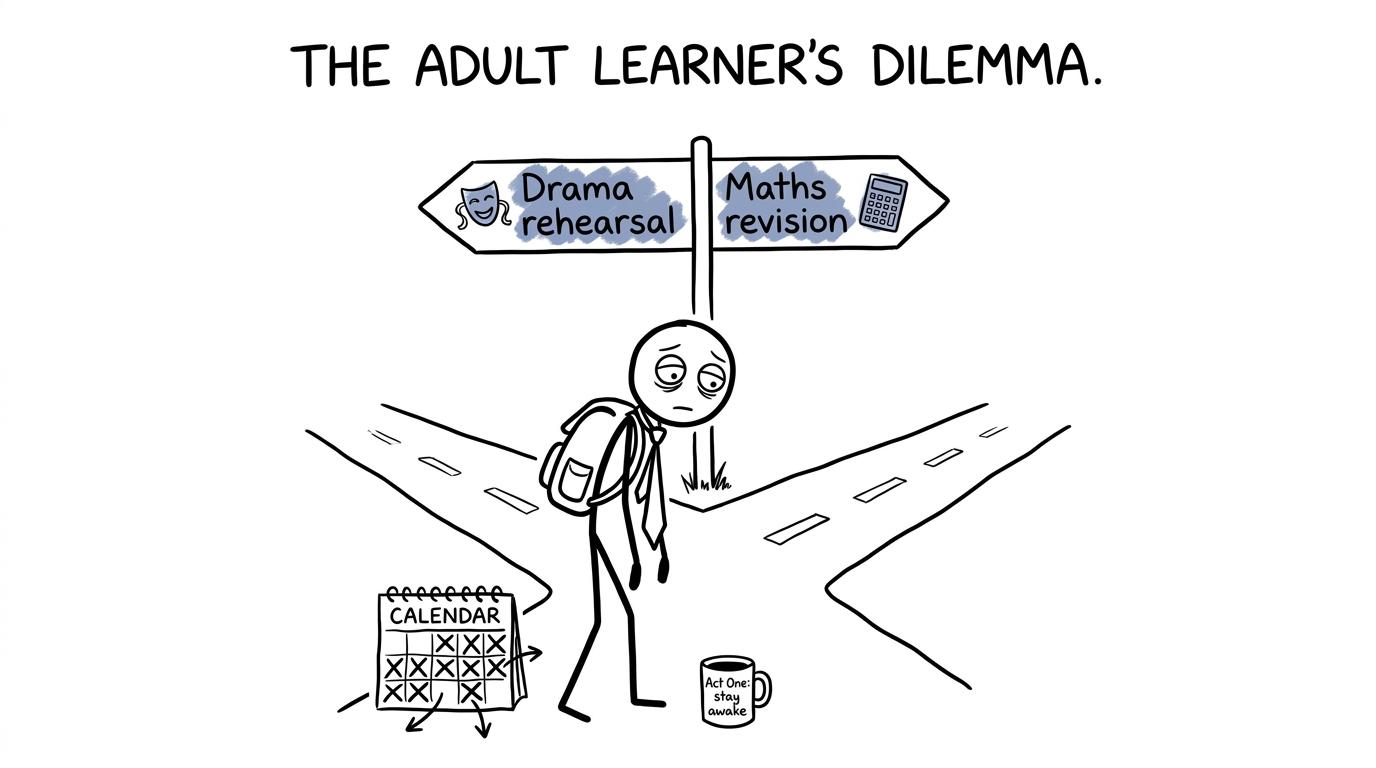 Adult learner choosing between drama rehearsal and maths revision
Why GCSE Drama is difficult to self-study completely
In England, Ofqual's current assessment requirements allocate 60%60\%60% of GCSE Drama to non-exam assessment and 40%40\%40% to examination. Students must participate in devised and text-based performance work, while specifications also require engagement with live theatre.
The details differ between AQA, Pearson Edexcel, OCR and Eduqas, but the broad shape remains consistent: creating drama, applying theatrical skills, understanding how theatre is made, and analysing or evaluating work.
That makes GCSE Drama very different from a subject that can be prepared for entirely through books and past papers. Independent revision can develop your written knowledge, but it cannot automatically provide:
- authenticated practical assessment;
- suitable performers for collaborative work;
- rehearsal direction and technical facilities;
- recorded or visiting assessment arrangements;
- centre submission of marks and evidence;
- access to the correct live-performance experience.
Private-candidate rules also vary. For example, AQA's published GCSE Drama specification states that its qualification is not available to private candidates. Pearson's current administration material contains private-candidate and centre-entry arrangements, but candidates still need an approved centre willing and able to conduct the practical components. Never assume that a centre offering private GCSE maths or English entries can also accommodate Drama.
Contact the prospective centre before buying textbooks or selecting a performance text. Confirm the exact specification, entry route and assessment responsibilities in writing.
What an evening class can give you
A real rehearsal structure
Drama improves through action and response. A scene that appears convincing in your head may feel static on stage. An evening class creates recurring opportunities to test movement, vocal choices, staging and interaction with other performers.
The timetable also creates accountability. For an adult balancing employment and other qualifications, a fixed session can prevent Drama from becoming something that is always postponed until next week.
Feedback while choices can still change
Useful feedback arrives before a performance is fixed. A specialist teacher can identify whether an artistic intention is visible to an audience, whether terminology is being used accurately and whether written evaluation contains analysis rather than description.
This is one of the strongest arguments for evening classes. Self-study tells you what you intended. An informed observer can tell you what actually reached the audience.
Administrative support
Practical GCSEs involve more than turning up for a written examination. Evidence must be authenticated, assessment conditions followed and materials submitted correctly. A genuine GCSE evening course should coordinate those requirements with its examination centre.
Do not treat administration as a minor convenience. If the practical components cannot be assessed correctly, excellent independent preparation for the written paper will not produce a complete GCSE result.
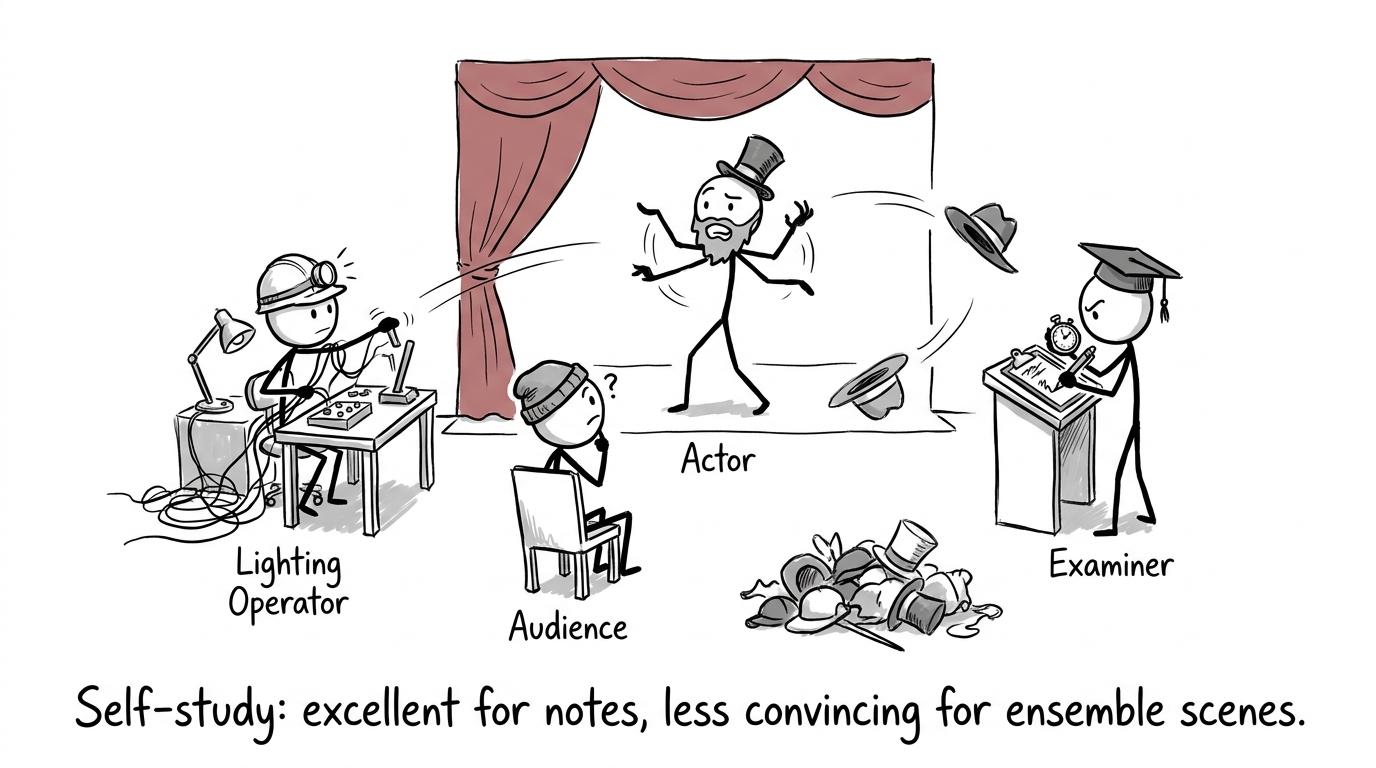 One learner attempting to perform every theatre role during self-study
When evening classes may not be worth it
An evening class is not automatically valuable because it appears on a college timetable. It may be poor value if it offers general acting tuition without entry for an accredited GCSE, provides little specification-focused feedback or leaves candidates to arrange practical assessment themselves.
It may also be unsuitable when attendance creates an unsustainable weekly load. Travel, rehearsal preparation and written tasks can occupy more time than the advertised classroom hours. An exhausted learner does not receive full value from either Drama or maths revision.
Cost should be considered as a complete figure:
total cost=tuition+entry fees+travel+materials+additional assessment costs\text{total cost}=\text{tuition}+\text{entry fees}+\text{travel}+\text{materials}+\text{additional assessment costs}total cost=tuition+entry fees+travel+materials+additional assessment costsFees and funding differ considerably between providers and learners, so a national average would be misleading. Ask for an itemised figure. Check whether the advertised price includes examination entry, theatre visits, scripts, resits and any technical or performance charges.
The real comparison is not simply paid class against free self-study. It is a complete route to assessment against an independent route for which you must secure every missing practical element.
Can a hybrid approach work better?
For many adults, yes. The most efficient model is often to use the evening class for what cannot easily be recreated alone: ensemble work, practical exploration, feedback and controlled assessment. Written knowledge, terminology and set-text revision can then be consolidated independently.
This protects class time from becoming expensive supervised reading. It also gives you more control over your wider revision timetable.
Self-study becomes more realistic if you already have:
- a confirmed examination centre;
- an approved route through every practical component;
- dependable rehearsal partners;
- access to suitable performance space;
- someone qualified to provide specification-specific feedback;
- enough time to study the written component independently.
Without these, the apparent saving can be false economy. You may spend less initially but discover too late that you cannot complete or authenticate an assessed component.
Protecting GCSE maths while attending Drama classes
For a learner preparing for maths exams, the question is not whether Drama deserves time. It is whether both subjects have a clear place in the week.
Begin with the GCSE Maths revision hub and identify your exam board, tier and weakest topics. If you are unsure what foundation and higher tier contain, use the GCSE maths topics by exam board and tier guide to map the work ahead.
On a Drama-class day, keep maths deliberately small: one short retrieval session or a GCSE mini test is more sustainable than attempting a full paper after travelling home. Reserve longer timed work for an evening without rehearsals or for the weekend.
A balanced weekly pattern might include:
- two focused maths topic sessions;
- one short mini test;
- one Drama evening class;
- one independent Drama reading or writing session;
- one timed maths paper section at the weekend;
- one protected rest evening.
The exact schedule depends on your responsibilities. The principle is more important: do not let one demanding evening erase the other subject for the entire week. The GCSE maths revision timetable guide can help you build a repeatable routine rather than relying on spare time appearing.
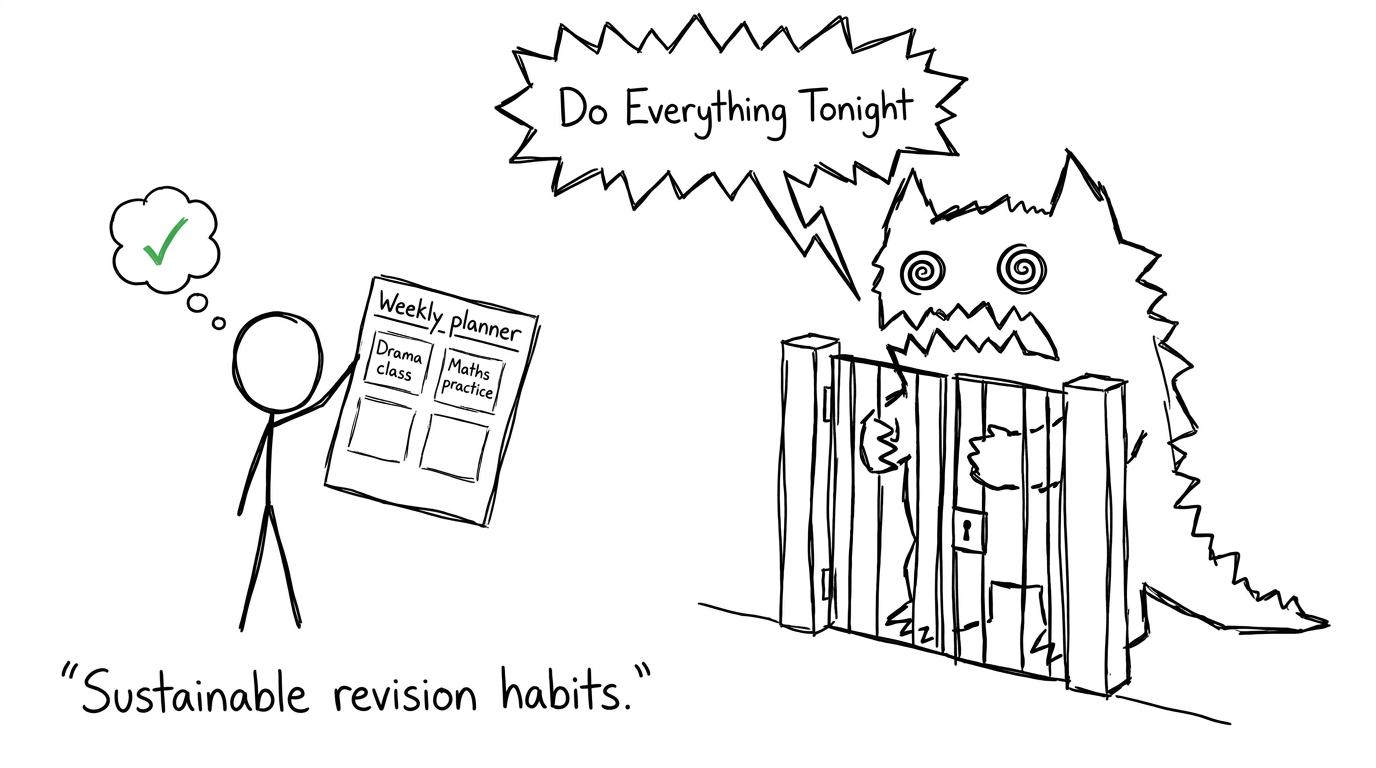 A calm weekly plan keeping the do-everything-tonight monster outside
How to judge value after the course begins
Do not wait until the examination season to decide whether the class is helping. Review it after the first few sessions.
You should be able to explain:
- which assessment component you are preparing for;
- what evidence or performance will be submitted;
- how feedback relates to the assessment objectives;
- when rehearsals, written work and assessments occur;
- which tasks must be completed outside class.
Progress should become visible. Your performance choices should grow more deliberate, your evaluations more precise and your understanding of the set text more practical. If sessions remain enjoyable but disconnected from assessment, ask the tutor how each activity contributes to the specification.
Apply the same evidence-based approach to maths. Complete a paper from the Edexcel GCSE Maths past papers collection, or choose the correct board through the main revision hub, then mark it and identify recurring errors. The guide to using GCSE maths past papers properly explains how to turn mistakes into targeted practice.
Common mistakes when choosing a GCSE Drama course
Confusing acting lessons with a GCSE course
A class can be enjoyable and professionally taught without leading to a regulated qualification. Look for the exam board, specification code, assessment plan and entry arrangements.
Assuming self-study means no centre is needed
You may study written material independently, but practical assessment and examination entry still require appropriate centre arrangements. Confirm these before beginning.
Comparing tuition prices only
Travel, scripts, theatre attendance, examination entry and assessment charges can change the real cost. Compare itemised totals and check what happens if you withdraw.
Ignoring the group dependency
Collaborative performance creates a risk that does not exist in the same way for solo revision. Ask how the provider handles absence, withdrawal and rehearsal scheduling.
Sacrificing all maths revision on class weeks
Long gaps make mathematical methods less secure. Short, regular practice is enough to preserve momentum. MathsGenie's guide to self-studying GCSE maths provides a practical structure, while the advice on when to start GCSE past papers helps you plan the later stages.
The final verdict
Adult evening classes for GCSE Drama are usually worth it when they provide something self-study genuinely cannot: a valid assessment route, practical collaboration, expert feedback and reliable centre administration. They are less worthwhile when they are general theatre classes carrying a GCSE-shaped label, or when their cost and timetable undermine more urgent qualifications.
Ask precise questions before enrolling. Confirm the board. Confirm the assessment. Calculate the complete cost. Then decide whether the structure solves your actual problem.
And keep maths moving. Use MathsGenie's free revision lessons and practice questions to repair individual topics, mini tests to maintain recall, and past papers, predicted papers, mark schemes and video solutions to build exam confidence. A Drama class can occupy one evening. It does not have to take over the whole week.










