Edexcel English Language 2.0: November 2026 Guide
Edexcel English Language 2.0 explained for November 2026: 1EN2 papers, dates, timings, differences from 1EN0, plus a resit plan for students and teachers.
Resitting English Language can feel strangely familiar. You recognise the skills and terminology, yet the paper code on your timetable may not be the one you remember. Edexcel English Language 2.0, officially coded 1EN2, is Pearson's alternative GCSE English Language qualification. It is not simply a renamed version of 1EN0.
For November 2026, 1EN2 has two equally weighted papers. Both last 1 hour 55 minutes, both are worth 80 marks, and both contribute 50% of the GCSE. Paper 1 is scheduled for Tuesday 3 November and Paper 2 for Thursday 5 November, both in the morning.
That is the short answer. The important next step is understanding what each paper expects.
Edexcel English Language 2.0 at a glance
Pearson's specification and final November 2026 timetable give the following structure:
| Component | Date and session | Focus | Duration | Marks | Weighting |
|---|---|---|---|---|---|
| 1EN2/01 Paper 1 | Tuesday 3 November 2026, morning | Non-Fiction Texts | 1 hour 55 minutes | 80 | 50% |
| 1EN2/02 Paper 2 | Thursday 5 November 2026, morning | Contemporary Texts | 1 hour 55 minutes | 80 | 50% |
Your preparation checklist is therefore straightforward:
- Confirm that your entry code is 1EN2, not 1EN0.
- Learn which reading and writing skills appear on each paper.
- Practise responding to unseen texts within the time limit.
- Use the correct 1EN2 sample materials, past papers and mark schemes.
- Review reading and writing separately after every timed attempt.
- Check practical arrangements with your school, college or exam centre.
November GCSE English Language entries are subject to an age restriction. Pearson states that a candidate entering the November series must be at least 16 on the preceding 31 August. Teachers and private candidates should confirm eligibility and entry arrangements with their centre.
What is 1EN2?
1EN2 is Pearson Edexcel's GCSE English Language 2.0 qualification, graded on the usual 9-1 scale. It provides a different pathway through GCSE English Language rather than replacing Pearson's established 1EN0 specification.
Pearson describes the route as less literary and more functional than 1EN0. This does not mean that literary analysis disappears. Paper 2 still includes fiction and literary non-fiction. It means the overall balance, paper organisation and selection of texts have been designed differently.
The qualification consists of two externally examined papers. There is no foundation or higher tier, so every candidate sits the same papers. The Spoken Language Endorsement requirement is separate from the written grade and, according to Pearson's guidance, is assessed in the same way as it is for 1EN0.
A resit student should not assume that previous preparation automatically matches 1EN2. The broad abilities are transferable, but the route through the examination is different. Check the code before choosing resources.
Paper 1: Non-Fiction Texts
Paper 1, code 1EN2/01, lasts 1 hour 55 minutes and is worth 80 marks. It contains two sections.
Section A: reading
The reading section is worth 40 marks. Students respond to unseen non-fiction, including functional 19th-century material and non-fiction from the 20th or 21st century. The questions assess the ability to retrieve information, make inferences, analyse language and structure, evaluate a text and compare ideas or perspectives where required.
The word functional matters. A text may have been written to report, explain, advise, argue or persuade in a real context. Strong answers do more than identify a technique. They connect the writer's choice to purpose, audience and effect.
Section B: writing
The writing section is worth 40 marks and assesses transactional writing. This is writing with a recognisable purpose and audience, such as presenting an argument or communicating a viewpoint.
Content and organisation matter, but accuracy matters too. Paragraphing, vocabulary, sentence control, spelling and punctuation all contribute to the quality of the response. A sophisticated argument loses force if the reader has to untangle every sentence.
Paper 2: Contemporary Texts
Paper 2, code 1EN2/02, also lasts 1 hour 55 minutes and is worth 80 marks.
Section A: reading
Students work with thematically linked, unseen fiction and literary non-fiction extracts drawn from the 20th and 21st centuries. As on Paper 1, the reading section is worth 40 marks.
The challenge is not prior knowledge of a novel, memoir or topic. It is the ability to read unfamiliar material carefully and construct an evidence-based response. Students need to distinguish between explaining what happens and analysing how the writing shapes a reader's understanding.
Section B: writing
The remaining 40 marks assess imaginative writing. Students need to establish a convincing voice, organise ideas and choose details deliberately. Imaginative writing is not a competition to produce the most complicated plot. A controlled response built around a clear situation is often more manageable than an ambitious story that cannot be completed.
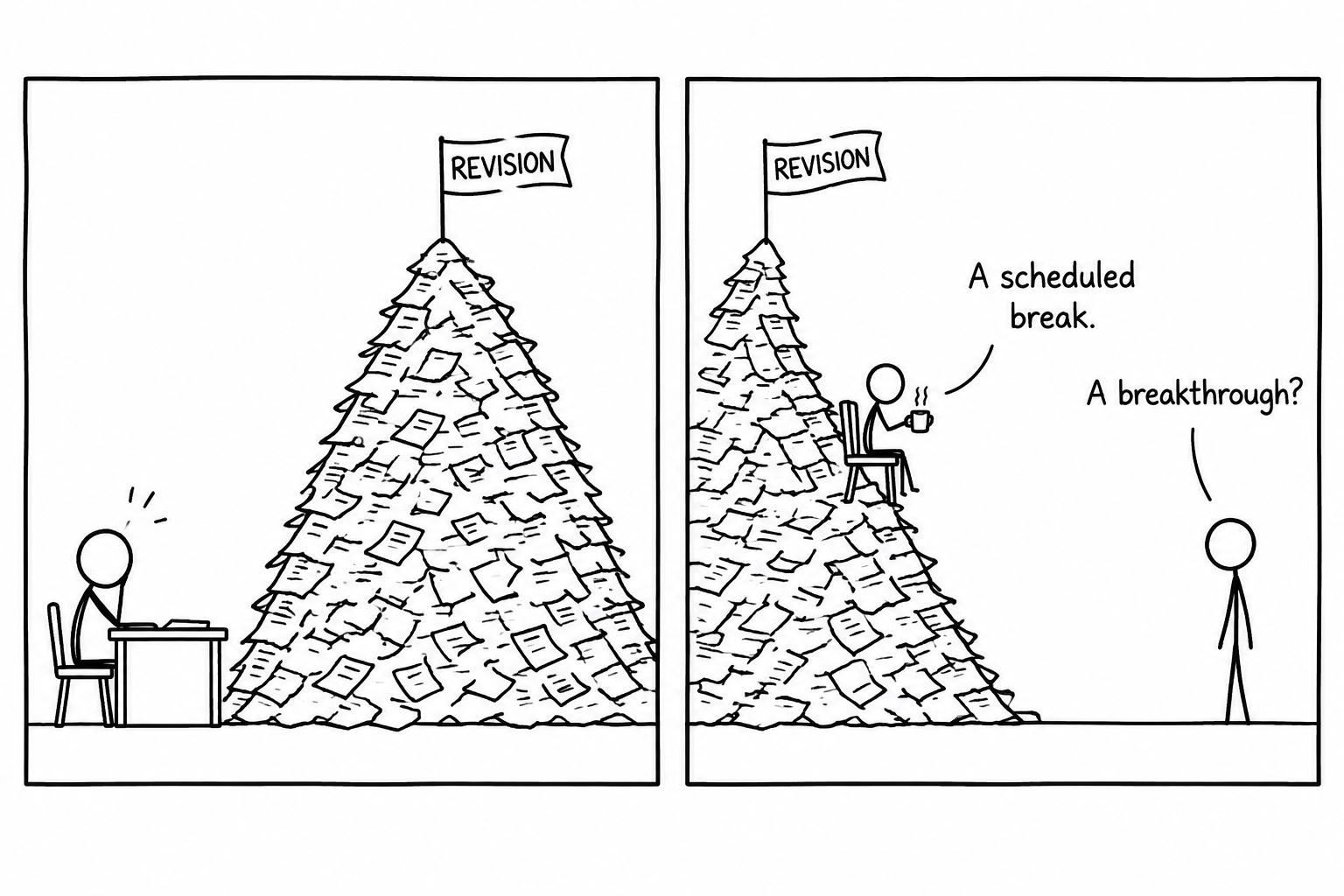 XKCD-style comic showing a GCSE student taking a scheduled break halfway up a revision mountain
How 1EN2 differs from 1EN0
The easiest mistake is to treat the two codes as interchangeable. They lead to the same type of GCSE outcome, but their assessments are organised differently.
| Feature | English Language 2.0, 1EN2 | English Language, 1EN0 |
|---|---|---|
| Paper weighting | Two papers worth 50% each | Paper 1 worth 40%, Paper 2 worth 60% |
| Paper timings | Both papers are 1 hour 55 minutes | Paper 1 is 1 hour 45 minutes; Paper 2 is 2 hours 5 minutes |
| Marks | 80 marks on each paper | 64 marks on Paper 1; 96 marks on Paper 2 |
| Paper 1 emphasis | Non-fiction reading and transactional writing | Fiction reading and imaginative writing |
| Paper 2 emphasis | Contemporary fiction and literary non-fiction, plus imaginative writing | Non-fiction reading and transactional writing |
| General design | A more functional pathway with equal papers | A differently weighted route with a stronger Paper 2 weighting |
The overall written examination time happens to be the same across the two qualifications, but it is distributed differently. That changes revision decisions. On 1EN2, neither paper can be treated as the smaller component because each carries half of the final result.
The specifications also organise text types differently. A student who has revised a 1EN0 question sequence should not rely on it for 1EN2. Familiar skills such as comparison, evaluation and language analysis remain useful, but the paper instructions, mark totals and combinations of texts must come from the correct specification.
A practical resit plan for students and teachers
Start with a timed diagnostic using an official 1EN2 paper or specimen assessment. Mark reading and writing separately. A single total mark can hide the real problem: a student may read insightfully but leave too little time for writing, or write accurately without selecting precise textual evidence.
Teachers can then group improvement work around specific needs:
- retrieving and interpreting relevant information;
- analysing the effects of language and structure;
- comparing ideas and perspectives;
- evaluating a writer's methods;
- organising transactional arguments;
- controlling imaginative writing;
- improving sentence accuracy and proofreading.
Timed practice should develop gradually. Begin with individual questions, then complete sections, and finally sit full 1 hour 55 minute papers. Afterwards, use the mark scheme to identify why marks were missed. The purpose is not merely to record a score. It is to decide what changes next time.
The same principle supports revision across a resit programme. MathsGenie's guide to starting GCSE past papers explains why papers work best when they are introduced with enough time to review mistakes. The advice on redoing GCSE past papers effectively is equally relevant: repeating a paper is useful only when the second attempt tests a deliberate improvement.
Students resitting English alongside maths can organise their wider workload through the free GCSE past papers collection. For maths, the GCSE Maths revision hub combines revision lessons, practice questions, mini tests, videos and mark schemes. A structured one-month GCSE revision plan can also provide a useful model for balancing short practice sessions with complete papers.
Common mistakes to avoid
Revising the wrong code: A resource labelled Edexcel English Language may be for 1EN0. Look explicitly for 1EN2 or English Language 2.0.
Memorising a universal paragraph formula: A rigid structure can make every response sound identical. Answer the precise question and select evidence that genuinely supports the point.
Listing techniques without interpretation: Naming a metaphor or short sentence earns little by itself. Explain what it communicates, how it shapes the reader's response and why it suits the writer's purpose.
Ignoring the second writing mark area: Ideas and organisation are only part of successful writing. Sentence control, spelling, punctuation and vocabulary require deliberate attention.
Spending too long on an early question: Both papers have substantial reading and writing sections. Practise making decisions under timed conditions and leave time to check the writing response.
Comparing texts separately: Where comparison is required, connect the texts directly. Focus on meaningful similarities or differences rather than writing two unrelated analyses.
Prepare for November with the correct paper in front of you
A resit is not a return to the beginning. It is a chance to revise with better information. For November 2026, that begins by knowing that 1EN2 Paper 1 is on Tuesday 3 November, Paper 2 is on Thursday 5 November, and both morning papers last 1 hour 55 minutes.
From there, improvement becomes specific: one question, one paragraph and one reviewed paper at a time. Use official 1EN2 materials for English, then visit MathsGenie's free GCSE revision resources to support maths resits with revision lessons, video solutions, practice questions, predicted papers, past papers and mark schemes.