Do Documentaries Help GCSE Statistics Revision?
Documentaries help GCSE Statistics by adding context, but not by replacing practice. Learn how active viewing can turn curiosity into exam marks.
A documentary can make statistics feel alive. A graph becomes a changing climate, a percentage becomes an election result, and a sample becomes a group of real people rather than a line in a textbook. But when the credits roll, an uncomfortable question remains: do documentaries help GCSE Statistics enough to improve your grade?
The short answer is yes, but only indirectly. Documentaries can improve your statistical awareness, vocabulary and ability to question evidence. They cannot replace learning the specification, answering exam-style questions or checking your work against a mark scheme. Enjoyable viewing becomes useful revision only when you turn it into active thinking.
This distinction matters whether you are revising the statistics content within GCSE Maths or taking a separate GCSE Statistics qualification. Exams reward what you can interpret, calculate, explain and evaluate under pressure, not simply what you have watched.
The quick verdict
Use documentaries and wider reading as a supplement, not the centre of your revision plan.
A useful checklist is:
- choose programmes containing genuine data, graphs, surveys or comparisons;
- pause when a statistical claim appears;
- identify the population, sample and variables;
- question how the data were collected and presented;
- distinguish correlation from causation;
- write a short summary from memory afterwards;
- follow the documentary with specification-based practice questions.
If time is limited, prioritise the GCSE Statistics revision hub, where you can move directly from lessons and worksheets to exam questions and past papers.
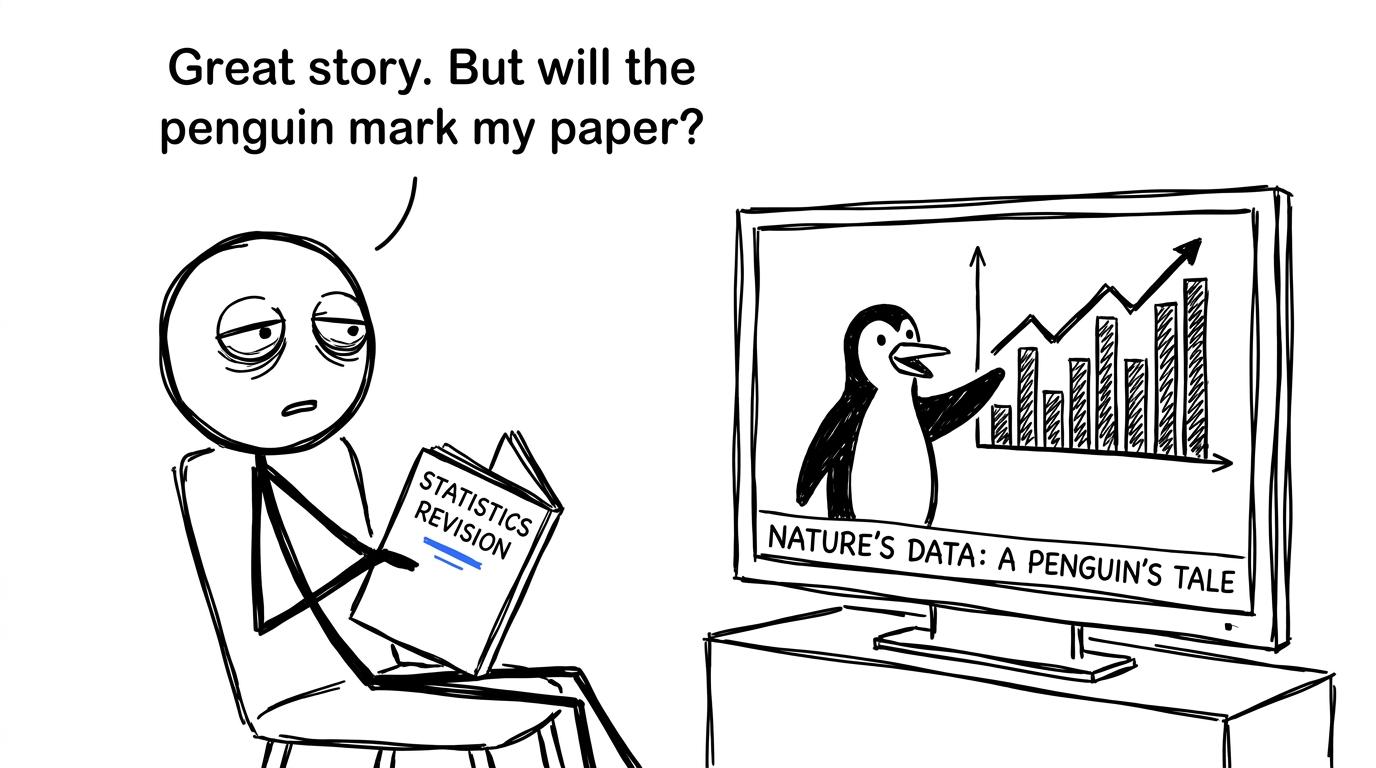 A student wonders whether a documentary penguin can mark a Statistics paper
Where documentaries genuinely help GCSE Statistics
Documentaries are strongest at showing why statistics exist. In an exam question, a data set may occupy half a page. In real life, similar data can influence public policy, medical decisions, business planning and environmental research.
That context can support several parts of GCSE study.
They make statistical language meaningful
Terms such as population, sample, bias, trend, outlier and correlation are easier to understand when you meet them in a real investigation. A programme about voting intentions might discuss polling samples. A health documentary might compare risk between groups. An environmental programme might use time-series data to show change.
This exposure does not teach every required method, but it helps you recognise the purpose behind the method. That can be valuable when an exam places familiar mathematics inside an unfamiliar context.
They develop healthy scepticism
Good statistical thinking begins with a pause: How do we know?
When a documentary presents a dramatic claim, you can ask:
- Who collected the data?
- What was the target population?
- How was the sample selected?
- Was the sample large and representative enough for the claim being made?
- Were important groups excluded?
- Does the graph use a clear and appropriate scale?
- Is the programme reporting an association or claiming that one variable caused another?
These questions connect closely to sampling, bias, misleading representations and the difference between correlation and causation. They are also useful for extended interpretation questions, where a calculation alone may not earn every available mark.
They expose you to unfamiliar data
Official specifications require students to interpret information in context. The setting may be unfamiliar even when the mathematics is not. Watching different kinds of evidence being presented can make that unfamiliarity less intimidating.
However, recognition is only the first step. You still need to practise extracting exact values, comparing distributions and writing conclusions that refer to the context. The Edexcel GCSE Statistics revision page brings together topic resources and exam practice for students taking that qualification.
What documentaries cannot teach reliably
A documentary is made to communicate a story. An examination is designed to assess a specification. Those purposes overlap occasionally, but they are not the same.
A programme may show an attractive graph without explaining how to construct it. It may quote an average without discussing whether the mean, median or mode is most appropriate. It may mention a relationship without requiring you to interpret a scatter graph or justify a conclusion.
Documentaries are therefore unlikely to give you systematic coverage of:
- averages and measures of spread;
- frequency tables and grouped data;
- cumulative frequency diagrams and box plots;
- histograms and frequency density where required;
- scatter graphs and lines of best fit;
- sampling methods and sources of bias;
- probability and relative frequency;
- the precise language expected by mark schemes.
The exact content depends on whether you are studying GCSE Maths or the separate GCSE Statistics qualification, as well as your exam board and tier. AQA, Edexcel, OCR and Eduqas specifications should always be your reference point. Do not assume that something belongs on your course merely because it appeared in an interesting programme.
For a structured route through GCSE Maths topics, use MathsGenie's guide to the best order for learning GCSE Maths. It places statistics within the wider journey rather than treating it as an isolated collection of graphs.
Passive watching is the real problem
Educational research generally supports active retrieval: trying to recall and use knowledge rather than repeatedly encountering it. Research into video learning also suggests that video is more useful when learners answer questions, explain ideas or complete related tasks instead of watching passively.
That does not prove that a particular documentary will raise a GCSE grade. Documentaries vary widely, and much of the research concerns instructional video rather than television made for a general audience. The sensible conclusion is narrower: watching can introduce ideas, but learning requires action afterwards.
This explains why a documentary may feel productive while producing little exam improvement. The story remains familiar, so you feel that you understand it. Yet the exam asks you to select a method, perform a calculation, interpret the result and communicate a precise conclusion without prompts.
Comfort and recall are not the same thing.
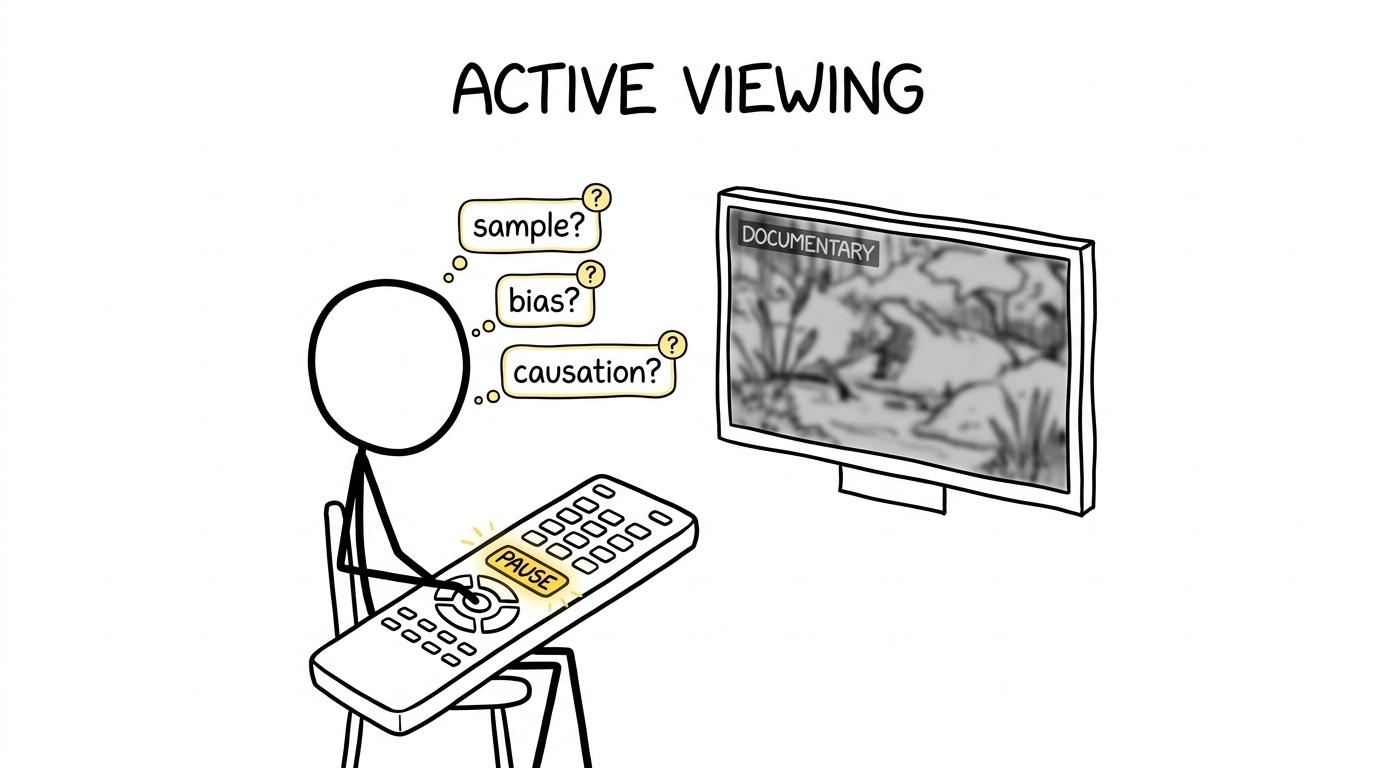 A student pauses a documentary to question its sample, bias and causal claims
How to turn watching into active revision
The best approach is not to take pages of notes. That can turn an enjoyable programme into slow copying without testing what you understand. Instead, use a simple before, during and after routine.
Before watching
Choose one statistical lens. You might focus on sampling, data presentation, averages or correlation. Write two or three questions you want the programme to answer.
For example, if your focus is sampling, listen for information about who was studied, how participants were chosen and whether the findings were generalised beyond that group.
During the documentary
Pause only when a relevant claim appears. Record the claim in a short sentence, then identify the evidence supporting it. If a graph is displayed, inspect its axes, units, labels and scale.
Do not accept a percentage in isolation. Ask what the percentage is a proportion of and whether the original group is clearly defined. Likewise, a large numerical change may sound impressive while representing a modest proportional change, or the reverse.
After watching
Close your notes and write down what you remember. Then try to answer:
- What was the strongest statistical claim?
- What evidence supported it?
- What limitation affected the evidence?
- Did the programme imply causation from correlation?
- Which GCSE topic did the claim connect to?
Finally, complete a small set of exam-style questions on that topic. This last stage is what converts general awareness into exam preparation. If the questions expose a weakness, use the method in MathsGenie's guide to finding your weakest GCSE topics and log the reason for each lost mark.
Does reading around GCSE Statistics help more?
Reading articles, reports and data stories has similar strengths and limitations. It can be slightly easier to analyse because you control the pace and can inspect a chart for longer. It also exposes you to written claims, which may resemble the language of interpretation questions more closely than spoken narration does.
Yet reading around the subject is still not a substitute for revision. Its value depends on what you do with it.
A useful reading routine is to identify:
- the claim;
- the source of the data;
- the population and sample;
- the type of data collected;
- the representation used;
- one justified conclusion;
- one possible limitation.
Be careful with secondary reporting. An article may simplify a study, omit uncertainty or use causal language more strongly than the underlying evidence allows. You do not need to become a professional researcher, but you should learn to separate what the data show from what the writer suggests.
A balanced revision plan
Documentaries should usually occupy a small, optional part of your revision time. A stronger weekly pattern is:
- learn or review one statistical method;
- answer focused practice questions without notes;
- check the mark scheme and correct errors;
- revisit the topic after a gap;
- complete mixed questions or part of a paper;
- use a documentary or article occasionally to practise evaluating real evidence.
When individual topics become secure, move towards timed papers. MathsGenie's GCSE Statistics resit plan explains a useful progression from diagnosis and topic work to complete past papers. The principles are valuable even if you are sitting the qualification for the first time.
Predicted papers can add focused practice near the exam, but they should not encourage guessing which topics will appear. The article on using predicted GCSE topics without guessing explains how to combine predictions with broader specification coverage.
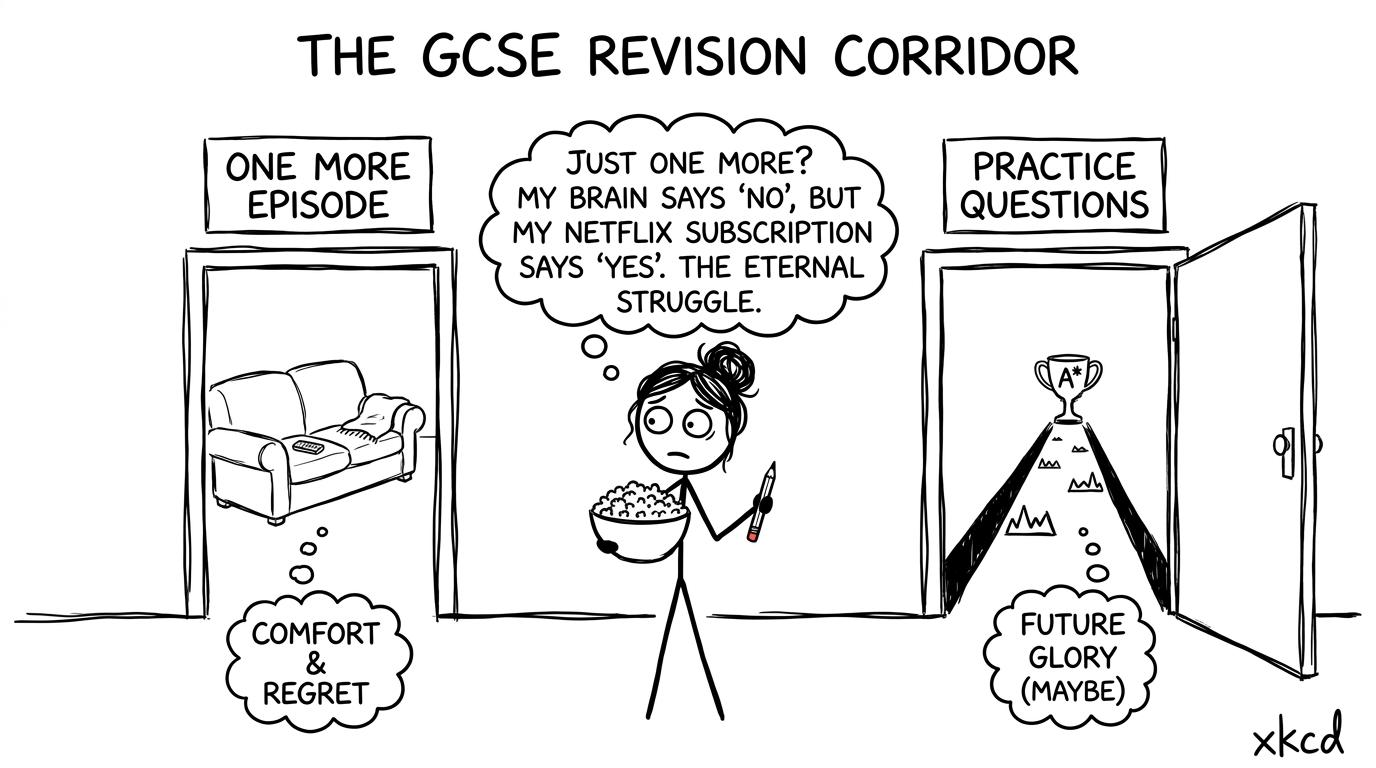 A student chooses between one more episode and practice questions
Common mistakes when using documentaries for revision
Counting viewing time as complete revision
Watching is input. Exams require output. If you cannot answer a related question afterwards, the programme has not yet become effective revision.
Remembering the story but not the statistics
A memorable human story can overshadow the sample, graph or comparison supporting it. Ask what evidence made the story statistically convincing.
Trusting every graph automatically
Professional presentation does not guarantee good statistical communication. Check scales, labels, intervals and whether the visual size of a difference matches the numerical difference.
Treating correlation as proof of causation
Two variables moving together does not, by itself, establish that one caused the other. Other variables, reverse causation or coincidence may provide alternative explanations.
Replacing past papers with wider learning
Interesting background knowledge cannot reveal whether you can perform under exam conditions. Past papers show how your board phrases questions and how marks are awarded. Use mark schemes honestly, then return to lessons or worksheets for anything you could not do.
Watching only near the exam
The final weeks should prioritise weaknesses, timed practice and correction. If documentaries help you stay curious, use them earlier or as a brief break after focused work, not as an escape from the questions you find difficult.
Enjoyment is valuable, but evidence earns marks
So, documentaries help GCSE Statistics when they make you curious about data, alert you to weak evidence and give real meaning to ideas such as sampling, bias and correlation. Reading around the subject can do the same. Both are genuinely worthwhile forms of enrichment.
But enjoyment and exam preparation are not interchangeable. Your grade depends on specification knowledge, accurate methods, careful interpretation and repeated practice.
Start with the free MathsGenie GCSE Statistics resources. Use revision lessons to repair gaps, complete practice questions without support, and check your reasoning with mark schemes and video solutions. Then build towards mini tests, past papers and predicted papers. Put each task into your revision planner so that an interesting documentary remains what it should be: a spark for better statistical thinking, followed by the practice that turns understanding into marks.