

Cramming vs Learning GCSE Economics
Cramming vs learning GCSE Economics explained: spot false confidence, build lasting recall and apply economic ideas and maths under exam pressure.
The night before an exam, familiarity can feel like knowledge. You recognise every heading. Your highlighted notes look reassuring. Definitions seem obvious when they are sitting in front of you. Then the paper introduces an unfamiliar business, market or government decision, and the certainty disappears.
That is the practical difference between cramming vs learning GCSE Economics. Cramming helps information feel familiar for a short time. Genuine learning means you can retrieve an idea without notes, apply it to a new context, analyse a chain of consequences and use quantitative evidence accurately. Those abilities are far more likely to survive exam-day pressure.
This matters to maths students because GCSE Economics is partly quantitative. Official GCSE subject requirements say that at least 10%10\%10% of the marks must reward quantitative skills. These include percentages, percentage change, averages, revenue, costs, profit, income, graphs and the interpretation of economic data.
A quick cramming or learning checklist
You are probably cramming if you mainly:
- reread, copy or highlight notes;
- memorise model answers word for word;
- revise one topic for hours and never return to it;
- recognise definitions but cannot produce them independently;
- avoid questions until you feel completely ready;
- check an answer before making a serious attempt.
You are more likely to be learning if you:
- retrieve ideas with your notes closed;
- explain concepts in your own precise language;
- apply the same idea to unfamiliar scenarios;
- connect causes, consequences and stakeholders;
- revisit material across several sessions;
- answer questions, check feedback and correct mistakes;
- interpret calculations rather than stopping at a number.
The dividing line is not how long you spend at your desk. It is what your brain has to do while you are there.
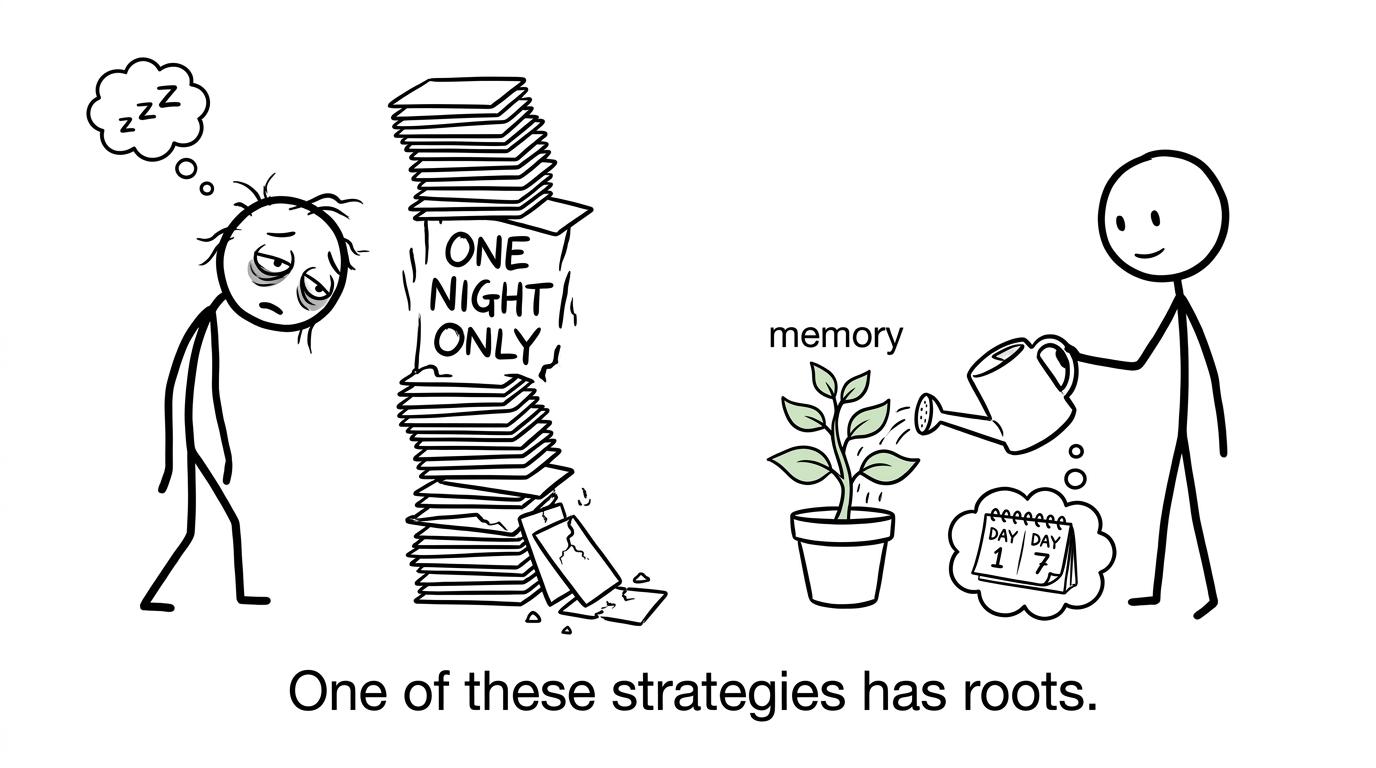 A student compares a wobbling wall of flashcards with a well-watered memory plant
Why cramming feels more effective than it is
Cramming often produces a quick improvement in recognition. If you read the definition of opportunity cost five times, the sixth reading feels easy. But the notes are supplying the cue and the answer. The ease may come from the page, not from a durable memory.
An exam removes that support. You must decide which knowledge is relevant, retrieve it and adapt it to the context. Research on learning consistently distinguishes passive review from active retrieval. Trying to recall information strengthens access to it and reveals gaps that rereading can conceal. Spacing those attempts over time generally supports longer-lasting retention better than concentrating the same revision into one sitting.
This does not mean rereading is useless. A short review can rebuild understanding before practice. The problem begins when reading becomes the whole revision session.
A useful test is simple: close the book. If you cannot reconstruct the idea, identify its limits or use it in a question, it is not secure yet.
What genuinely learning GCSE Economics looks like
Economics exams do not reward memory alone. Ofqual's assessment objectives require students to demonstrate knowledge and understanding, apply it to different contexts, and analyse and evaluate evidence and issues. The nationally specified weightings are 35%35\%35% for knowledge and understanding, 35%35\%35% for application, and 30%30\%30% for analysis and evaluation.
Those proportions explain why a stack of memorised definitions is not enough. Knowledge is necessary, but much of the examination asks you to do something with it.
You can retrieve the idea unaided
Start with a blank page or an unanswered prompt. Can you define scarcity, demand, productivity or inflation without seeing the wording first? Can you draw and label a relevant diagram from memory? Can you state the conditions under which your explanation may change?
Retrieval should feel slightly difficult. That effort is useful because it exposes what is available to you without support. After attempting an answer, check your notes or mark scheme promptly and repair omissions. Practising errors without feedback can make them more familiar rather than more accurate.
Maths students can use the same process. A short lesson introduces or repairs a method; closed-book questions test it. MathsGenie's guide to turning GCSE notes into active recall explains how to move from reading towards retrieval and correction.
You can apply it when the context changes
A crammed answer often depends on familiar wording. Genuine understanding is more flexible. You might learn how a rise in costs can affect supply, but the examination could place that idea in agriculture, transport or manufacturing. The underlying reasoning remains relevant; the details and final judgement may change.
When practising, ask:
- Which concept is being tested here?
- Which detail from the extract changes my answer?
- Who gains or loses?
- What happens next in the chain?
- What condition could weaken my conclusion?
This prevents memorised paragraphs from being dropped into unsuitable questions. It also turns context into evidence rather than decoration.
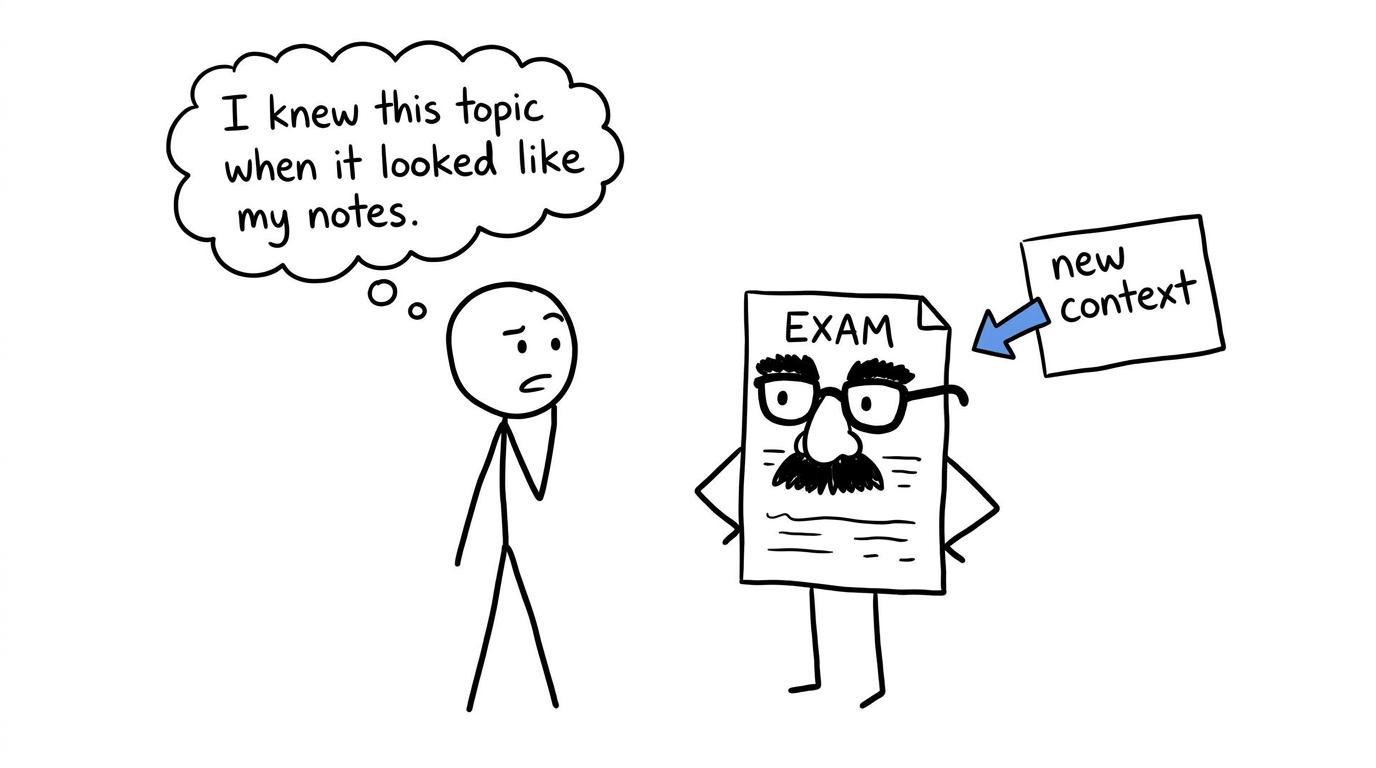 An exam question in disguise surprises a student who only recognises familiar notes
You can connect calculation to interpretation
In Economics, calculation is usually part of a larger argument. You may need to calculate percentage change using
percentage change=new value−original valueoriginal value×100.\text{percentage change}=\frac{\text{new value}-\text{original value}}{\text{original value}}\times 100.percentage change=original valuenew value−original value×100.But a correct figure is not always the end. You may also need to explain what the change suggests, use it to support a decision or recognise a limitation in the data.
That is why quantitative practice should combine method and meaning. MathsGenie's percentage change lesson helps secure the calculation, while the averages revision resources strengthen another skill named in GCSE Economics requirements. The broader GCSE Maths revision hub lets you select your exam board and find relevant lessons, worksheets and practice questions.
Graphs need the same two-layer approach. You should be able to construct or read them accurately, then explain the economic significance of the pattern. A graph is evidence. It is not automatically an argument.
A revision cycle that replaces cramming
A reliable session has four stages: retrieve, apply, check and revisit.
Retrieve before reviewing
Choose one small area, such as market failure or economic growth. With notes closed, write the essential definitions, relationships and possible evaluative points. Keep this brief. The purpose is diagnosis, not producing beautiful notes.
Apply knowledge to questions
Move quickly into questions. Include short knowledge prompts, contextual application and extended analysis. For quantitative topics, mix calculation with data interpretation. This variety matters because the real paper will not announce which mental process you need.
Maths skills can be sharpened through focused resources such as AQA percentages revision and the Edexcel percentage change scheme of learning. Use the board-specific maths page matching your own qualification where possible.
Check the quality, not just the total
Mark schemes are most useful when treated as feedback rather than a verdict. Separate each weakness into a clear category:
- missing knowledge;
- weak use of context;
- incomplete chain of analysis;
- unsupported judgement;
- inaccurate calculation;
- misread command word;
- poor timing.
A total mark tells you what happened. The category tells you what to do next.
Revisit after a gap
Return to the topic on another day and attempt fresh prompts without looking at your correction. This is the moment that distinguishes learning from temporary repair. If the idea can be retrieved and applied after time has passed, it is becoming more dependable.
A plan makes those return visits less accidental. The GCSE Maths revision timetable guide shows how to combine spaced topic work, marking and timed practice without relying on occasional revision marathons.
How to test whether learning will hold up on exam day
Do not ask, "Have I revised this?" Ask, "What can I do without help?"
Use these four tests:
The blank-page test
Write everything essential about one narrow topic from memory. Then compare it with your specification and class materials. Missing content becomes your next target.
The new-context test
Answer a question set in an industry or situation you have not practised before. If your reasoning survives the unfamiliar setting, your knowledge is becoming transferable.
The delayed test
Reattempt a topic several days later. Immediate success after reading can be misleading; delayed retrieval gives stronger evidence of retention.
The pressure test
Complete a mixed, timed section without notes. Timing changes the task because you must select ideas while managing attention. MathsGenie's Edexcel GCSE Maths past papers demonstrate the same learn-practise-mark-fix cycle for mathematical skills. Past papers should diagnose readiness, not merely fill an evening.
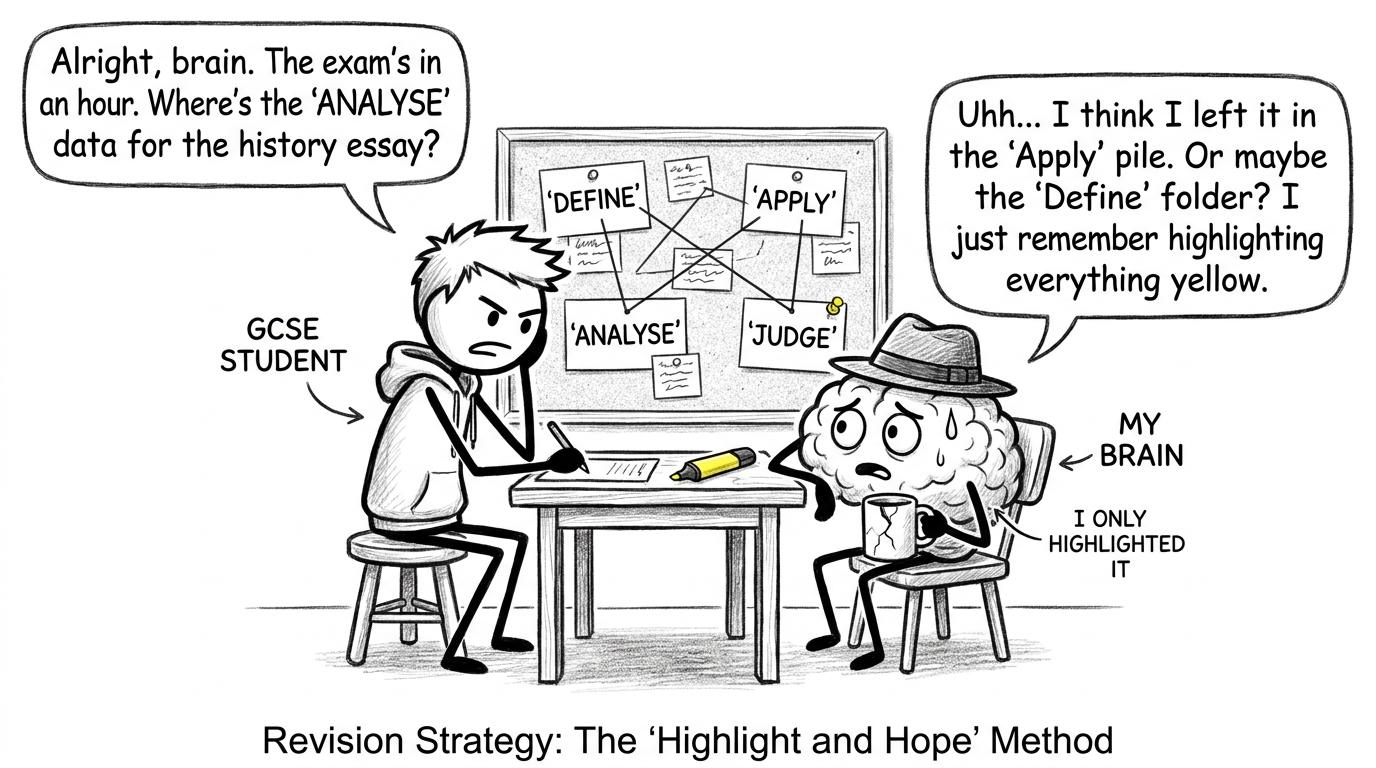 A detective student questions a brain that admits it only highlighted the notes
Common mistakes when moving beyond cramming
Turning active recall into another copying exercise
Writing notes from memory is useful only if the notes begin closed. Copying first and hiding the page afterwards mostly tests recognition.
Memorising evaluation paragraphs
A prepared paragraph may sound sophisticated but fail to answer the actual context. Learn evaluative questions instead: how large is the effect, how long will it take, which stakeholder matters, and what assumption could change the judgement?
Revising only favourite topics
Comfort is not the same as progress. Use question results to choose the next topic. Weaknesses should receive more attention, while stronger areas still need occasional retrieval.
Treating a correct calculation as a complete economic answer
Check units, show clear working and interpret the result. Ask what the number means for the consumer, firm, worker, government or wider economy.
Completing papers without repairing mistakes
A paper creates evidence. Learning happens when you classify the lost marks, rebuild the weak skill and reattempt a similar question. For maths preparation, MathsGenie's guide to using past papers properly sets out this feedback loop clearly.
Build knowledge that remains available
Cramming is attractive because it compresses effort and produces fast familiarity. Genuine learning is quieter. You retrieve an idea, discover that it is incomplete, correct it and return later. It can feel slower precisely because your brain is doing more of the work.
That work is what makes knowledge usable. On exam day, you need economic concepts that survive unfamiliar contexts, calculations that remain accurate under time pressure and judgements built from the evidence in front of you.
Use your Economics specification, teacher materials and board papers for subject content. Then make MathsGenie your free base for the quantitative side: choose revision lessons, complete practice questions, check mark schemes and video solutions, and build towards mini tests, past papers and predicted papers. Start with one weak mathematical skill today. Retrieve it, practise it, mark it and schedule the return visit. That is not cramming. It is learning.











