Comparing GCSE English Literature Progress With Friends
Comparing GCSE English Literature progress with friends can distort revision. Learn what to track instead and build a calmer, more effective GCSE routine.
A friend says they know every quotation. Someone else has already written six practice essays. The class group chat is trading mock grades, and suddenly your own revision feels inadequate.
The question behind the search comparing GCSE English Literature progress friends is whether that comparison is useful. Usually, it is not. Comparing methods can give you ideas, but comparing speed, grades or hours often gives you poor information and unnecessary anxiety. Your classmates may study different texts, have different starting points or need to improve different skills.
A better question is: can you now do something that you could not do reliably last week? That principle works in English Literature, and it is especially valuable when balancing the subject with GCSE maths revision.
A quick checklist for healthier comparison
Before treating a classmate's progress as evidence about your own, ask:
- Are you following the same exam board and studying the same texts?
- Are you comparing genuine exam performance or just hours and pages?
- Do you know how much help they used?
- Are your strengths and weaknesses actually similar?
- Has the comparison revealed a useful next action?
- Could you measure your progress against your own earlier work instead?
If a comparison produces no clear action, it is probably noise.
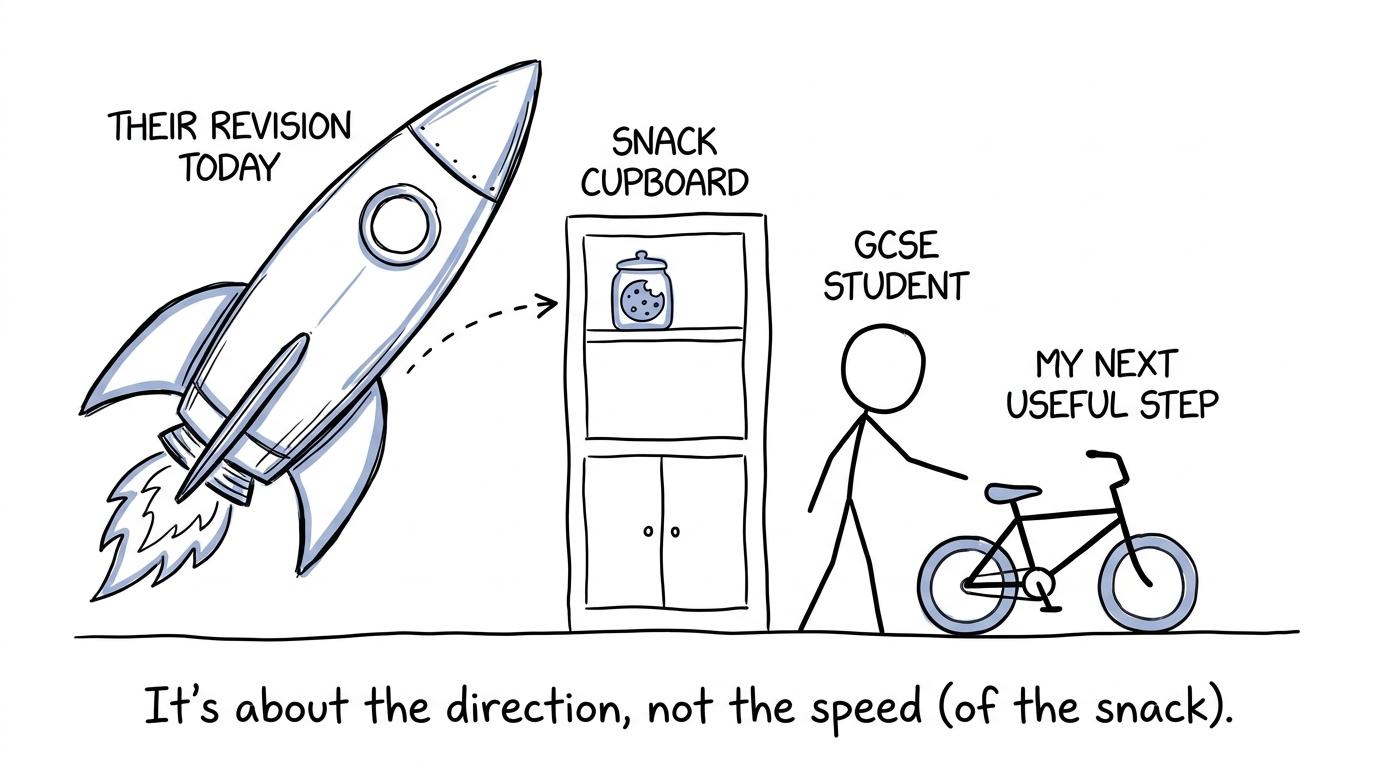 A student chooses a steady revision bicycle instead of a misleading rocket
Why comparing progress usually does more harm than good
Comparison feels sensible because GCSEs are shared experiences. Your class may sit the same paper on the same day, so it is tempting to imagine that everyone should reach each revision milestone together.
But learning is not a queue. Students do not move through it in one fixed order.
One student may remember quotations quickly but struggle to analyse language. Another may understand a play deeply but write too slowly under timed conditions. A third may produce confident verbal interpretations yet find it difficult to organise an essay. Saying that one is "ahead" compresses several different skills into one vague judgement.
Research into academic self-concept indicates that students judge their ability partly in relation to classmates. Being surrounded by apparently high-performing peers can therefore change how capable someone feels, even when their underlying knowledge has not changed. Social comparison is not automatically harmful, but upward comparison without context can reduce confidence rather than improve learning.
That distinction matters. A feeling of being behind is not the same as evidence that you are behind.
You usually see the output, not the process
You might see a friend's high mock mark without seeing the feedback they received, the tutoring they had or the topics they still avoid. You might hear that they revised for three hours without knowing whether those hours involved active recall, focused writing or rearranging colourful notes.
Visible effort is not always effective effort. In both English and maths, the important evidence is what you can retrieve, apply and explain without support.
Different specifications make weak comparisons even weaker
GCSE English Literature is untiered, unlike GCSE maths, but exam boards including AQA, Edexcel, OCR and Eduqas organise their papers, set texts and question styles differently. Assessment focuses broadly on responding to texts, supporting interpretations, analysing language, form and structure, and understanding context where required. However, the exact weighting and paper structure depend on the specification.
So a social-media post about somebody else's revision target may not even describe your course. Your teacher and current exam-board specification should determine what you prepare.
What GCSE English Literature progress actually looks like
Progress is not the number of quotations highlighted or essays completed. Those are activities. Useful evidence is a change in performance.
You are making progress when you can:
- recall short, flexible textual references without immediately checking notes;
- develop an interpretation rather than retell the plot;
- connect evidence directly to the question;
- analyse how language, form or structure creates meaning;
- use context to illuminate an argument rather than attach an isolated fact;
- compare poems through a purposeful idea;
- plan and write more effectively within the available time;
- identify weaknesses accurately after reading feedback.
This is why a student with a smaller folder can be better prepared than somebody with hundreds of pages. The exam rewards the quality of the response produced under its conditions, not the volume of revision materials made beforehand.
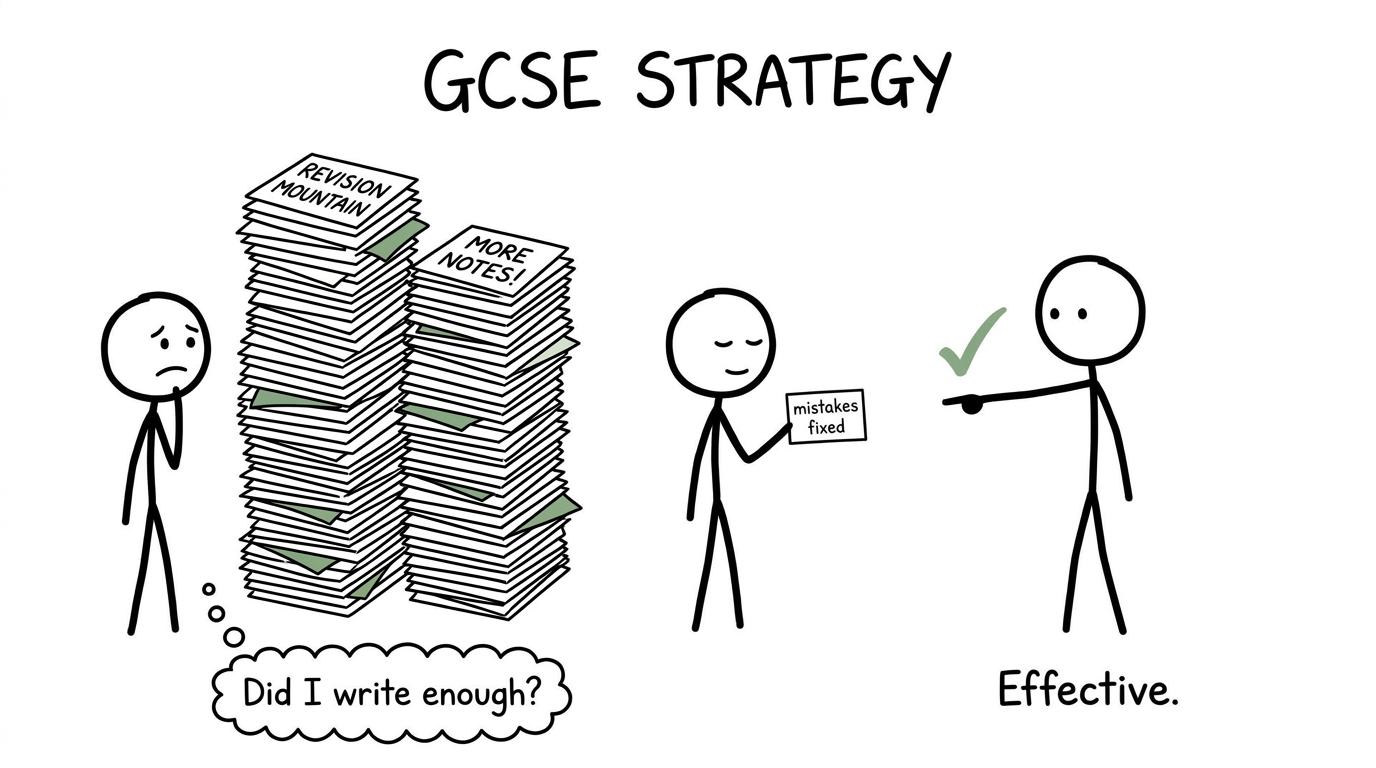 Students compare huge note piles while a smaller card records mistakes fixed
Replace the class scoreboard with a personal one
The healthiest comparison is usually temporal: your current performance against your earlier performance.
Keep a short progress record with four headings:
- Skill: the precise ability being checked.
- Evidence: what you attempted without notes.
- Feedback: what was successful and what limited the response.
- Next action: one task that addresses the weakness.
For English Literature, your evidence might be a timed plan, quotation recall, one analytical paragraph or a complete response. For maths, it could be a mini test, a group of topic questions or a timed paper section.
The same improvement loop works across both subjects:
- attempt something independently;
- mark or review it honestly;
- identify the narrowest important weakness;
- practise that weakness;
- return later and test it again.
MathsGenie's guide to finding your weakest GCSE topics explains how to turn lost marks into specific revision decisions. The subject is maths, but the central habit transfers: diagnose from evidence rather than mood.
Track inputs you control and outputs that matter
Some inputs are worth recording because you control them: completing a planned session, putting your phone away or attempting questions before viewing a solution.
Outputs should show learning: fewer repeated errors, better recall, clearer analysis or a higher mark on a comparable task.
Do not let an input become a false result. Revising for 606060 minutes is not proof that the material is secure. It is only an opportunity to learn. What you can produce afterwards is the stronger measure.
For busy days, MathsGenie's 20-minute GCSE revision routine offers a simple structure for choosing a small task, practising actively and recording the next step.
When comparing with friends can be useful
Friends are not the problem. Unstructured comparison is.
Peer discussion can help when it answers a practical question. You might exchange interpretations, test each other's quotation recall or discuss why a piece of evidence supports one reading better than another. In maths, you might compare methods after both attempting a problem independently.
Use three boundaries:
Compare strategies, not identities
Ask, "How did you revise that text?" rather than, "Why are you better than me?" A strategy can be tested and adapted. A judgement about intelligence usually leads nowhere.
Compare after attempting the task
Looking at somebody else's response too early can create an illusion of understanding. Attempt the task first. Then use their approach, a model response, a mark scheme or a video solution to identify what you missed.
End with an action
A useful conversation should change what you do next. If it only leaves you anxious, step away from it. You are allowed to mute a grade discussion or decline to share mock marks.
Protecting your maths revision from comparison anxiety
English Literature worry can spill into maths. After hearing that a friend has completed several essays, you may abandon the maths session in your revision planner and spend the evening rereading a novel. The result is not balance. It is reactive revision.
Keep separate evidence for each subject. For maths, start with the GCSE Maths revision hub and choose resources for your board and tier. Maths has Foundation and Higher tiers, so your paper practice should reflect what you will actually sit.
A calm maths cycle is:
- use a revision lesson to rebuild one method;
- answer practice questions without copying;
- check the mark scheme or video solution;
- record why marks were lost;
- retest with a mini test or another question set;
- move to timed papers once individual skills are becoming secure.
The MathsGenie resources hub brings together predicted papers, short tests and other practice materials. When you begin full papers, follow the guide to using GCSE past papers properly rather than treating every total mark as a verdict.
Mark schemes are particularly valuable because they turn a vague feeling into evidence. The guide to using GCSE mark schemes as a revision coach shows how lost marks can direct your next session.
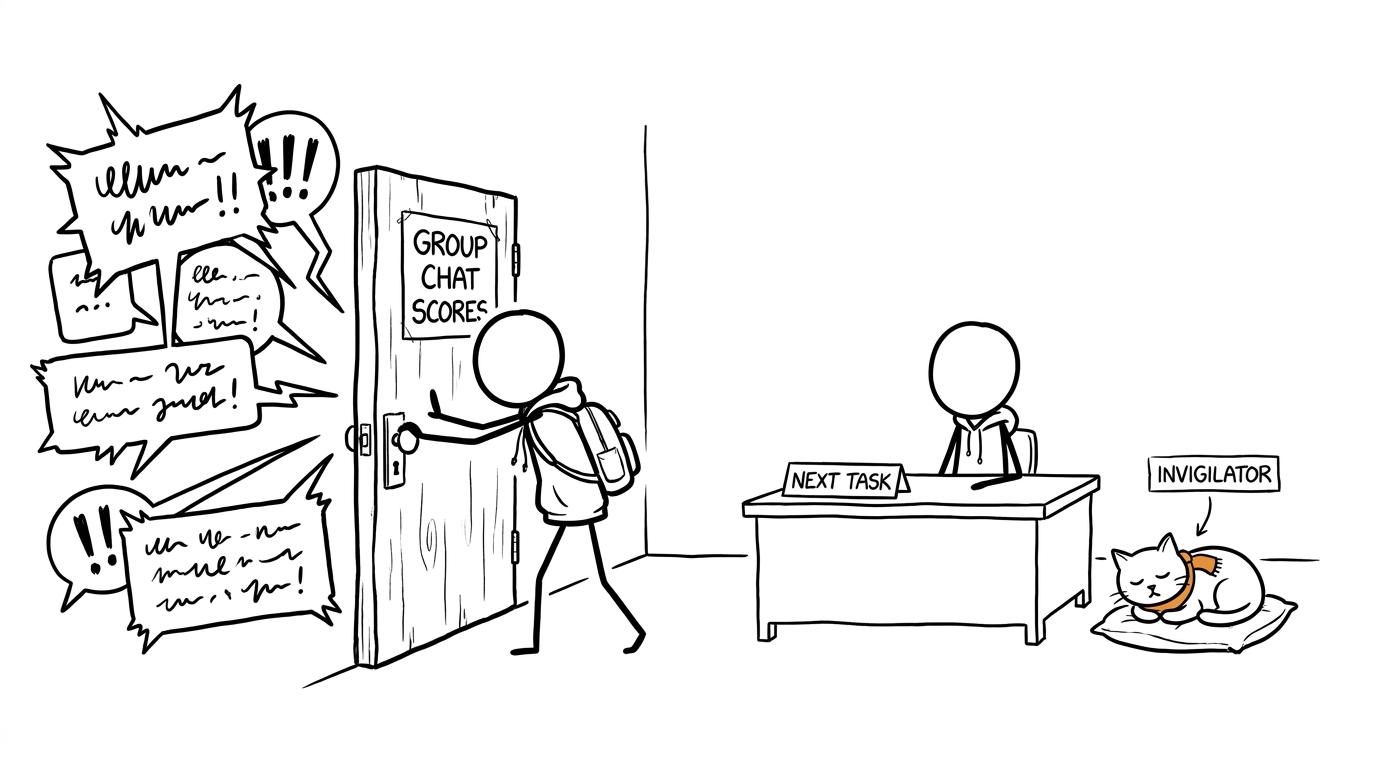 A student closes the noisy group-chat door and focuses on the next task
Common mistakes when judging your progress
Using hours as the main measure
Time matters, but attention and difficulty matter too. One focused session with independent recall can reveal more than a long evening of passive reading.
Comparing best performances with ordinary practice
A friend will usually mention a strong mark, not every difficult attempt that came before it. Compare like with like: similar conditions, similar content and similar access to notes.
Treating one mock grade as permanent
A mock is evidence from one moment. Use it to identify weaknesses, question types and timing problems. It is not a fixed description of your ability.
Copying someone else's revision plan
Their weakest text may be your strongest. Their maths tier, exam board, timetable and available time may differ. Borrow useful ideas, but build your plan from your own evidence. MathsGenie's guide to the best order for learning GCSE maths topics can help you create a logical sequence without copying a classmate's schedule.
Doing more papers without reviewing them
Completing another paper can feel productive, but improvement happens during correction. Mark it, classify errors, revisit the lesson and retest. The same principle applies to literature essays: feedback must alter the next response.
Assuming forgetting means failure
Forgetting is a signal to retrieve the material again, not proof that you cannot learn it. The advice in how to stop forgetting GCSE maths content uses recall, spacing and exam questions to make knowledge more durable.
Focus on the next piece of evidence
Your friends can be companions, sources of ideas and generous revision partners. They should not become your measuring instrument.
Instead of asking whether you are ahead or behind, ask what the next reliable evidence will be. Perhaps it is recalling quotations without notes, improving one timed paragraph, completing a maths mini test or correcting the questions that cost you marks.
Then repeat the process. Small cycles are less dramatic than class rankings, but they are far more useful.
Use MathsGenie as your free maths revision base: learn through revision lessons, build accuracy with practice questions, diagnose gaps through mini tests, and develop exam confidence with past papers, predicted papers, mark schemes and video solutions. Open the GCSE Maths revision hub, choose one weak area and create your next piece of evidence today.