Comparing GCSE Art and Design Progress With Friends
Comparing GCSE Art and Design progress with friends can mislead you. Learn what examiners assess and how to focus on calmer, more useful next steps.
Comparing GCSE Art and Design progress with friends can feel almost unavoidable. Their sketchbook is thicker. Their final piece looks more polished. They appear to have settled on an idea while yours is still changing.
But is comparison actually bad? Usually, yes, particularly when you use another student's visible output as a judgement on your own grade. GCSE Art and Design rewards the quality of your creative journey against assessment objectives, not whether you worked faster than the person beside you. Healthy comparison can offer inspiration or useful feedback. Ranking yourself against classmates usually offers neither.
The better question is not, Am I ahead of my friend? It is, What does my own work need next?
A quick checklist when comparison takes over
When somebody else's portfolio makes you doubt your progress, pause and check:
- Are you comparing like with like? Different themes, media and intentions develop at different speeds.
- Does your work show development? Examiners need evidence of investigation, experimentation, recording and a meaningful response.
- Have you acted on teacher feedback? Your teacher can assess your work against the relevant criteria.
- Can you name your next task? A specific action is more useful than a general feeling of being behind.
- Are you protecting time for other subjects? Art coursework should not quietly consume every maths revision session.
That final point matters. A beautiful sketchbook cannot sit your maths papers for you. If several subjects are competing for attention, a realistic GCSE maths revision timetable can help you decide where each evening goes.
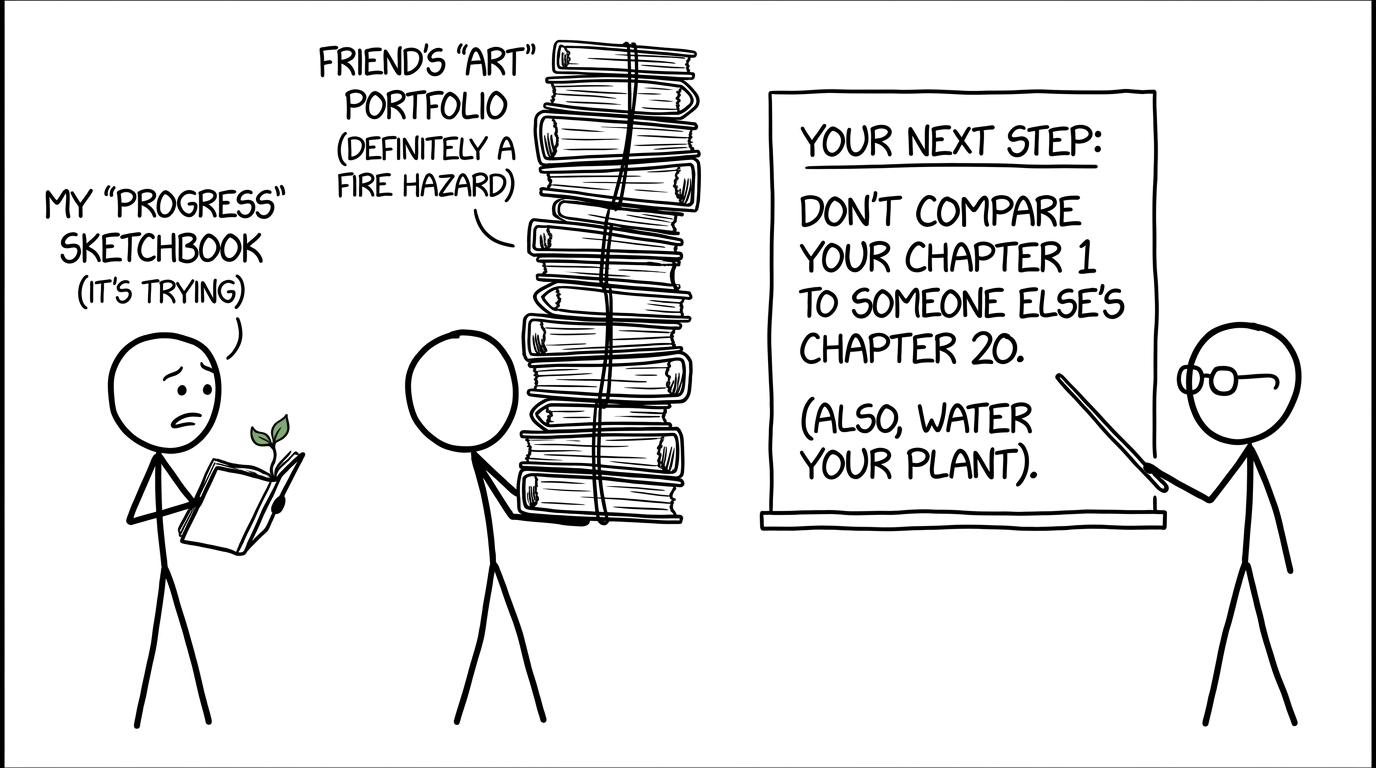 A student's sketchbook grows quietly while comparison builds an unhelpful portfolio tower
Why comparing GCSE Art and Design progress with friends misleads you
You can see output, but not the whole process
A finished page is visible. The thinking behind it is not.
You may see a friend's confident painting without seeing the abandoned compositions, material tests or teacher conversations that shaped it. Equally, somebody looking at your unfinished work cannot see the idea you are preparing to develop.
This creates an unfair comparison: their most visible strength against your private uncertainty.
Art and Design also includes several disciplines. Fine art, photography, graphic communication, textile design and three-dimensional design do not produce identical-looking evidence. Even students following the same title may use different materials, scales and working methods. The number of pages completed is therefore a weak measure of quality.
Creative progress is rarely tidy
Maths revision can sometimes provide quick evidence of improvement: complete a mini test, mark it and identify the marks gained or lost. Creative work is less linear.
An experiment that fails visually may still help you refine an idea. A final outcome might change after weeks of preparation. A quiet period of research may later make the practical work more purposeful. This does not mean deadlines are unimportant. It means speed alone cannot tell you whether a project is developing well.
Your friend may be further through a final piece while you have stronger evidence of refinement. Or they may genuinely be ahead on a deadline. In either case, anxious comparison still does not tell you what to do next. Teacher feedback does.
Your classmate is not the mark scheme
GCSE Art and Design is assessed through four broad assessment objectives. Students must show that they can:
- develop ideas through investigations and understanding of sources;
- refine work through experimentation with media, materials, techniques and processes;
- record ideas, observations and insights as work progresses;
- present a personal and meaningful response that realises their intentions.
These objectives apply across GCSE Art and Design specifications, although each exam board presents its guidance and administration in its own documents. For AQA and Pearson Edexcel, the portfolio or personal portfolio contributes 60%60\%60%, while the externally set assignment contributes 40%40\%40%. Both include a supervised period of 101010 hours for the final response to the externally set assignment under the specifications researched for this article.
Always follow the instructions from your school and check your own specification, particularly if you study with OCR or Eduqas. Your teacher will know which evidence, deadlines and authentication rules apply.
The important principle is simple: work is assessed against criteria, not against the person at the next table. Unlike GCSE maths, Art and Design is not divided into foundation and higher tier. There is no value in treating your classroom as an informal league table.
What to focus on instead
Compare your current work with your earlier work
Self-comparison gives you information you can use. Look back at the beginning of the project and ask:
- Are my ideas now more personal and specific?
- Have I investigated sources rather than merely copied their appearance?
- Can somebody see why I changed materials, composition or technique?
- Does my recording connect clearly to my intentions?
- Is the final direction supported by the development that came before it?
This turns progress into evidence. It also reveals gaps without turning them into a judgement about your ability.
The same habit is powerful in maths. Rather than comparing mock grades with a friend, compare your latest errors with your previous ones. MathsGenie's guide to finding your weakest GCSE topics explains how to turn results into a focused list of actions.
Ask for criterion-based feedback
“Is mine as good as theirs?” is a question your teacher cannot answer usefully. Try questions such as:
- Which assessment objective is least visible in my project?
- Where do I need to explain a decision more clearly?
- Have I experimented enough before choosing my final method?
- What is the most important improvement I can complete next?
These questions invite precise feedback. Write the answer down and agree on a sensible priority. If your teacher identifies several issues, ask which one should come first.
You can borrow this approach for maths revision. After a paper, do not stop at the total mark. Identify whether each loss came from missing knowledge, an inaccurate method, a misread question or poor timing. The GCSE Maths revision hub then lets you move from revision lessons to practice questions, mini tests and full papers.
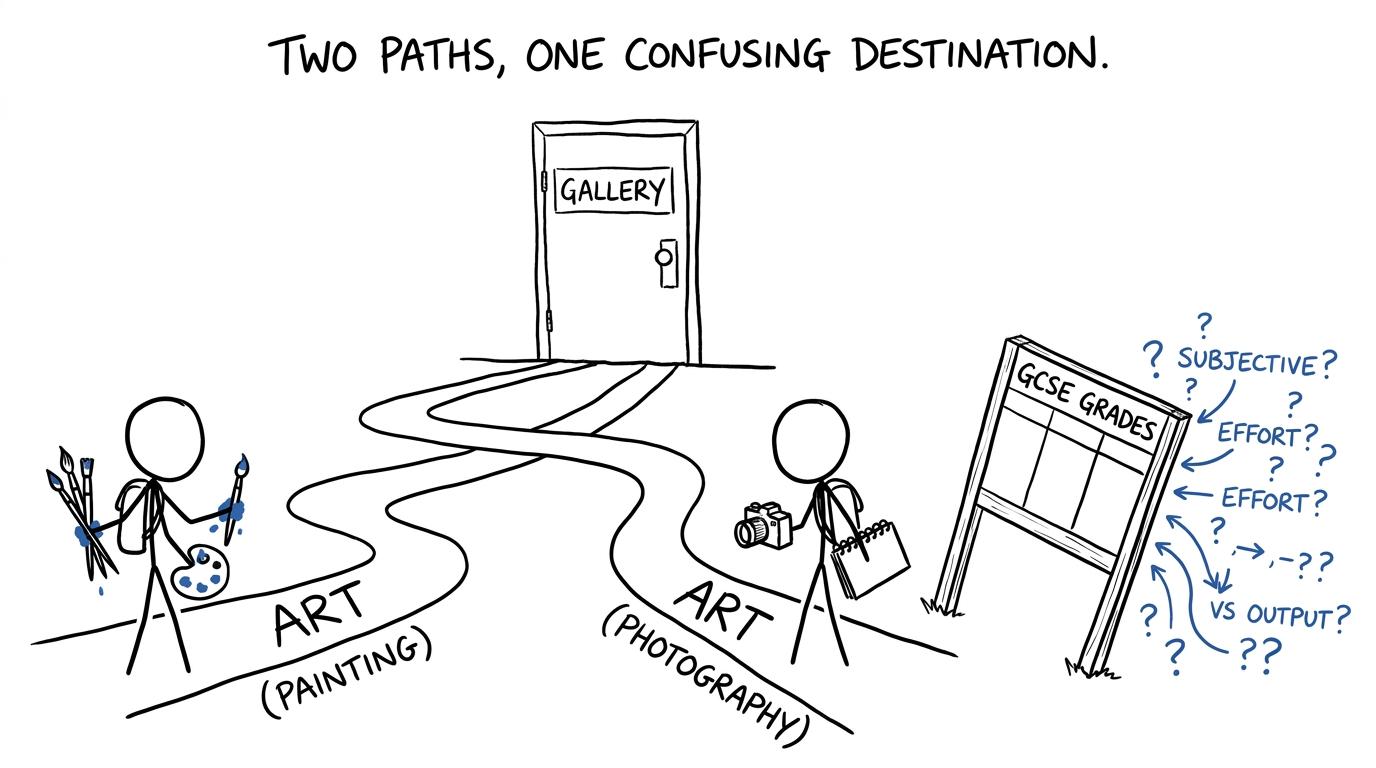 Two students take different creative paths towards the same gallery rather than using a comparison scoreboard
Reduce the next task until it feels clear
“Finish my portfolio” is too large to guide an evening. A better task might be:
- annotate why one experiment was unsuccessful;
- photograph a model in better lighting;
- test one material on a smaller scale;
- select the most relevant source image;
- ask the teacher to review the connection between development and outcome.
A clear task limits comparison because your attention has somewhere else to go.
If school feels crowded, the same principle can rescue maths revision. The MathsGenie 202020-minute revision routine is designed for days when coursework and other subjects leave little space. One focused maths session is better than postponing revision until life becomes quiet.
Use classmates as collaborators, not measuring sticks
Friends can still improve your work. Ask what they notice first, whether your intention is clear or which experiment communicates the idea most effectively. Offer the same kind of feedback in return.
Keep the boundary clear: feedback should help you make your own decisions. It should not lead to copying another student's composition, annotations or practical response. Submitted work must be your own, and sources that are not your own should be acknowledged according to your course requirements.
A useful classroom question is, What can I learn from the way they approached the problem? An unhelpful one is, Does their result prove that I am failing?
Protect your maths revision while completing Art and Design
Art coursework can expand to fill every available hour because there is always another page to refine. Maths has a different danger: it is easy to postpone because the work has clearer edges.
Set boundaries for both subjects. Give Art and Design a defined task and stopping time, then give maths a defined topic or paper section. The one-month GCSE maths revision plan provides a structure for balancing targeted practice with regular past papers.
For exam preparation, measure maths progress using evidence that belongs to you:
- questions you can now begin without help;
- methods you can reproduce accurately;
- errors that no longer recur;
- marks gained on comparable papers;
- improved timing under exam conditions.
Choose resources for your board and tier. Edexcel, AQA, OCR and Eduqas cover the national GCSE maths subject content, but organise and assess it differently. MathsGenie's exam board and tier topic guide can help you find the right route.
When you are ready for full-paper practice, use the correct foundation or higher paper. For example, the Edexcel GCSE Maths past papers include mark schemes and worked solutions where available. A paper marked carefully gives you better evidence than asking what your friend scored.
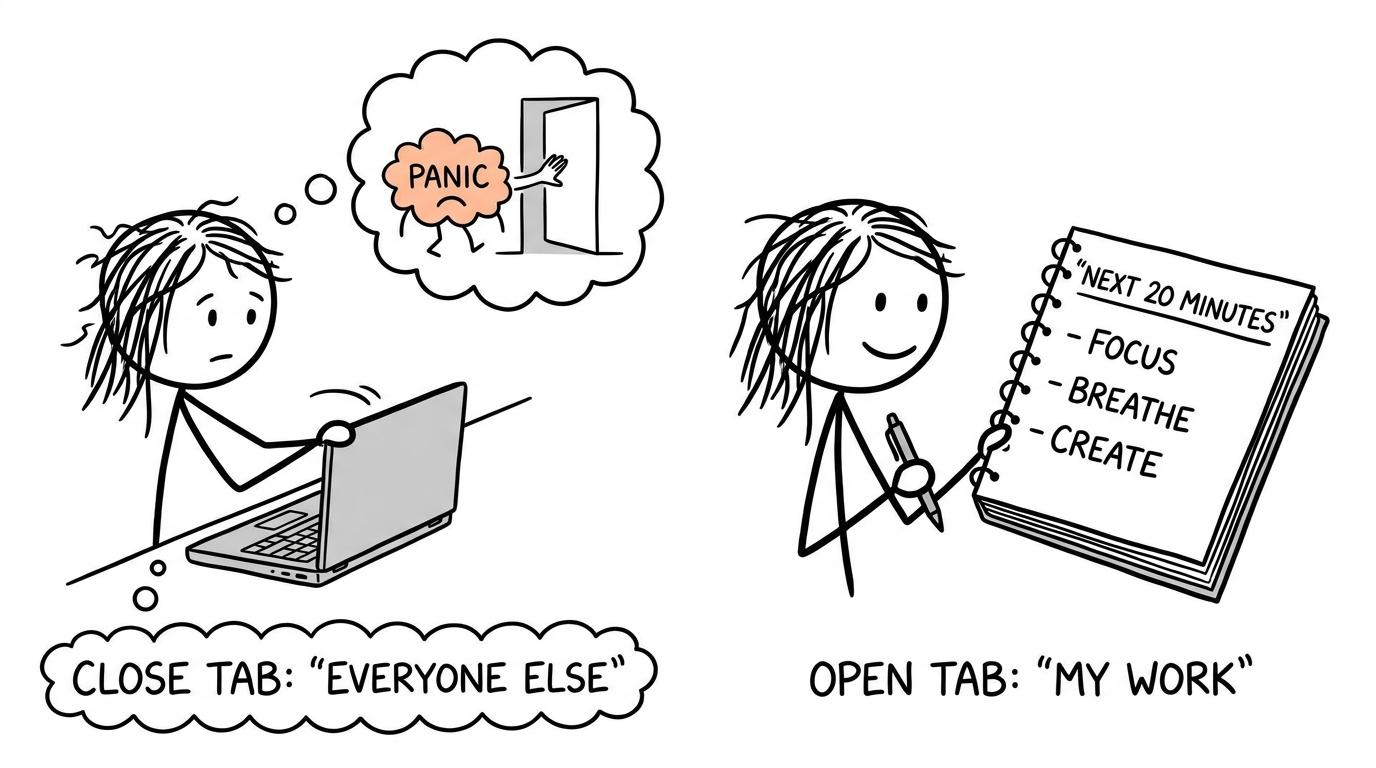 A student closes the unhelpful Everyone Else tab and opens a calm next-task checklist
Common mistakes when dealing with comparison
Treating more pages as better work
Volume may show effort, but it does not automatically demonstrate thoughtful investigation, purposeful refinement or a meaningful response. Ask whether each piece of evidence contributes to the project.
Copying the pace of the fastest student
Working faster may produce rushed decisions and weaker reflection. Keep your school's deadlines firmly in view, but build a plan around your own remaining tasks.
Hiding problems from your teacher
Students sometimes avoid feedback because they fear confirmation that they are behind. Early feedback is usually more useful because there is still time to act on it. Bring a specific question rather than waiting for a general verdict.
Letting one subject consume the timetable
Spending every evening on Art and Design can create panic when maths papers approach. Protect short, repeatable maths sessions and build towards timed practice. MathsGenie's guide to when to start GCSE past papers explains how paper practice can develop gradually rather than arriving as a final-week emergency.
Replacing comparison with vague reassurance
Telling yourself that everything is fine may feel kinder, but it can ignore a real deadline or missing evidence. The goal is not to avoid honest evaluation. It is to evaluate the right thing: your work against the assessment criteria, your plan and your teacher's feedback.
Your progress needs evidence, not a leaderboard
Comparing GCSE Art and Design progress with friends usually does more harm than good when it turns difference into a judgement. Your classmate may offer inspiration, feedback or companionship, but they cannot tell you what your work will be awarded.
Return to the criteria. Identify the least convincing part of your creative journey. Ask your teacher one precise question, choose one manageable next action and stop when the planned task is complete.
Then give your maths revision the same calm attention. Start at MathsGenie's free GCSE Maths resources, choose your exam board and tier, and use revision lessons and practice questions to repair gaps. Follow with mini tests, past papers and predicted papers, then learn from the mark schemes and video solutions.
Progress becomes less frightening when it becomes specific. Not Where is everyone else? but What is my next useful step?