How to Catch Up GCSE Spanish After Absence
Catch up GCSE Spanish after absence with a realistic four-week plan for vocabulary, grammar, speaking and exam practice alongside maths revision.
Missing several weeks of school can make Spanish feel as though it has carried on moving while you stood still. New vocabulary has appeared, grammar has changed tense and the class may already be preparing speaking answers. If you need to catch up GCSE Spanish after absence, the answer is not to copy every missed page. First identify what your class covered, then rebuild the essential vocabulary and grammar through short daily sessions across listening, speaking, reading and writing.
That approach matters when Spanish is only one part of your workload. You may also be preparing for GCSE maths, science and other exams. A useful catch-up plan must therefore be selective, realistic and sustainable, especially if you are still recovering from illness.
Your catch-up checklist
Start with these actions:
- Tell your Spanish teacher how much lesson time you missed.
- Confirm your exam board, tier and current specification.
- Request the missed topic list, vocabulary and assessed tasks.
- Find out whether any speaking preparation has been completed.
- Diagnose your gaps before trying to revise everything.
- Use short sessions covering all four language skills.
- Protect time for maths and your other GCSE subjects.
- Review progress with your teacher after one or two weeks.
The aim is not to recreate every lesson. It is to recover the knowledge and skills that future lessons depend upon.
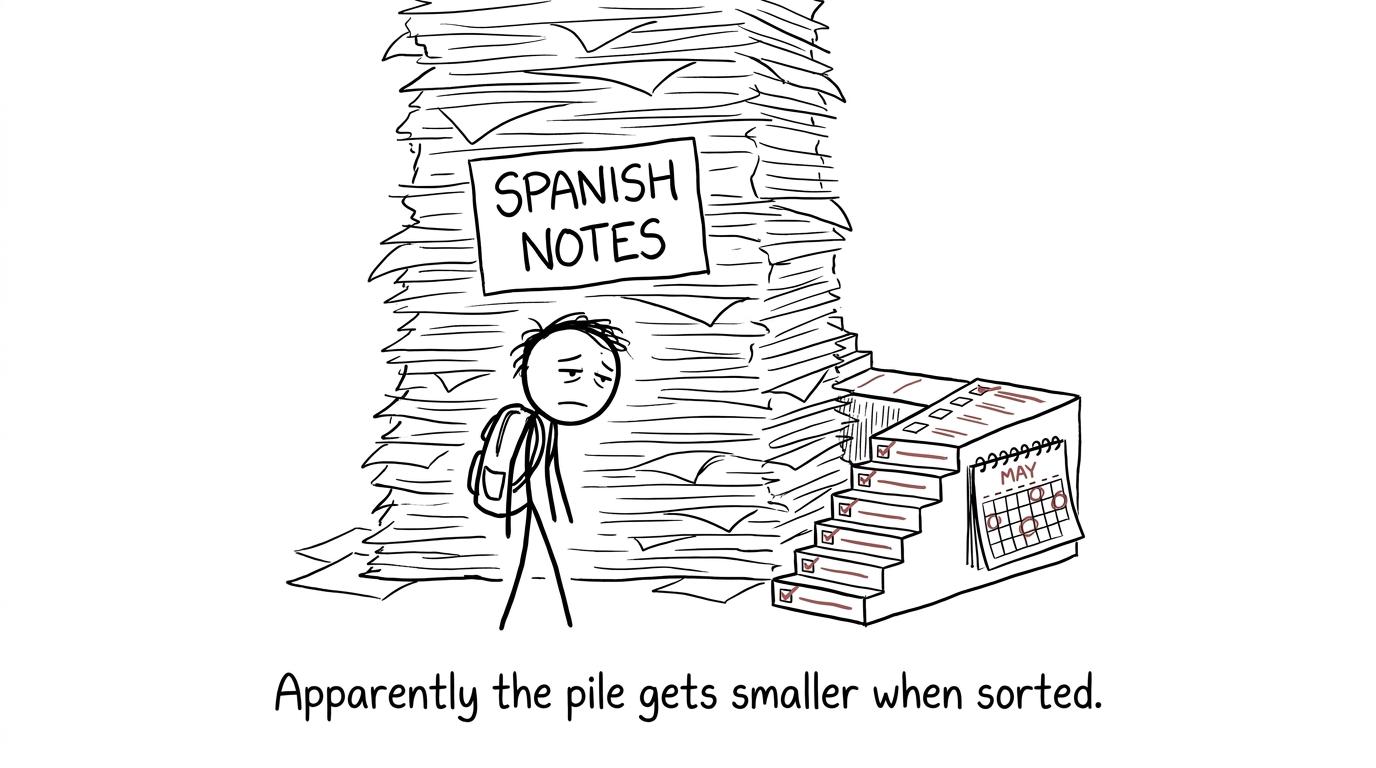 A returning student discovers that sorting the Spanish notes makes the pile manageable
Find out exactly what you missed
An absence feels vague until it becomes a list. Ask your teacher for the scheme of work or a simple summary covering:
- topics taught during your absence;
- vocabulary lists or textbook units;
- grammar introduced or revisited;
- listening and reading exercises completed;
- writing tasks and teacher feedback;
- speaking questions, role-plays or photo tasks practised;
- homework, tests and deadlines;
- resources that are essential rather than merely useful.
Also ask which content the class is using now. Sometimes the most urgent gap is not the largest one. If the class has moved from school vocabulary to discussing future plans, for example, understanding the future tense may matter more immediately than completing every old worksheet.
Do not rely entirely on a friend's exercise book. Their notes can help you see what happened, but your teacher can distinguish core specification content from optional classroom activities.
Check your board and specification
Current GCSE Spanish courses are organised around listening, speaking, reading and writing, but task formats and prescribed content vary between AQA, Pearson Edexcel and Eduqas. The reformed specifications taught from September 2024 have their first assessments in summer 2026. Students resitting an older specification may face different requirements, so confirm the exact course with your school.
For example, the current AQA course gives each of the four papers 25%25\%25% of the qualification and includes dictation in listening, reading aloud in speaking and translation tasks. Other boards have their own wording and assessment details. Use your board's specification and sample assessment materials rather than a generic online checklist.
Diagnose before you start revising
A pile of notes tells you how much paper exists. It does not tell you what you can do.
Use one short task in each skill:
- Listening: hear a short course-level recording and note its main message and details.
- Speaking: answer familiar questions aloud without reading a script.
- Reading: read a short passage and identify opinions, time frames and key facts.
- Writing: produce a short response using vocabulary from the missed topic.
Add a brief grammar and vocabulary check based only on the units taught during your absence. Ask your teacher to help you interpret the results if possible.
Sort gaps into three groups:
- Essential now: knowledge required for current lessons or an approaching assessment.
- Important later: specification content that must be recovered but is not blocking you today.
- Already secure: material you can retrieve and apply without substantial help.
This is the same diagnostic principle that makes GCSE maths revision efficient: find the weakness before spending time repairing it. For maths, a GCSE self-assessment and revision timetable approach can help you prevent Spanish catch-up work from displacing another important subject.
A realistic four-week GCSE Spanish catch-up plan
This plan assumes that you missed several weeks rather than most of the course. Adjust the pace with your teacher, particularly if you are still unwell or have approved access arrangements.
Week one: collect, sort and reconnect
Your first week is about restoring context.
- Collect the essential materials and deadlines.
- Confirm your board, tier and missed units.
- Complete the four-skill diagnosis.
- Learn the highest-priority vocabulary in small groups.
- Review one grammar point needed for current lessons.
- Attend current lessons even if your old notes are incomplete.
Aim for manageable sessions rather than a weekend marathon. Ten focused minutes retrieving vocabulary can be more revealing than forty minutes copying it. Cover the English side of a vocabulary list, recall the Spanish, then reverse the direction.
Week two: rebuild language you can use
Move from recognition to production. Each session should make you retrieve or create Spanish.
A balanced week might include:
- two vocabulary retrieval sessions;
- two short grammar sessions;
- two listening or dictation sessions;
- two spoken recordings on your phone or school device;
- one reading task;
- one short writing task followed by correction.
These activities can overlap. A short passage can provide vocabulary for a spoken response, while corrections from writing can shape the grammar you revise next.
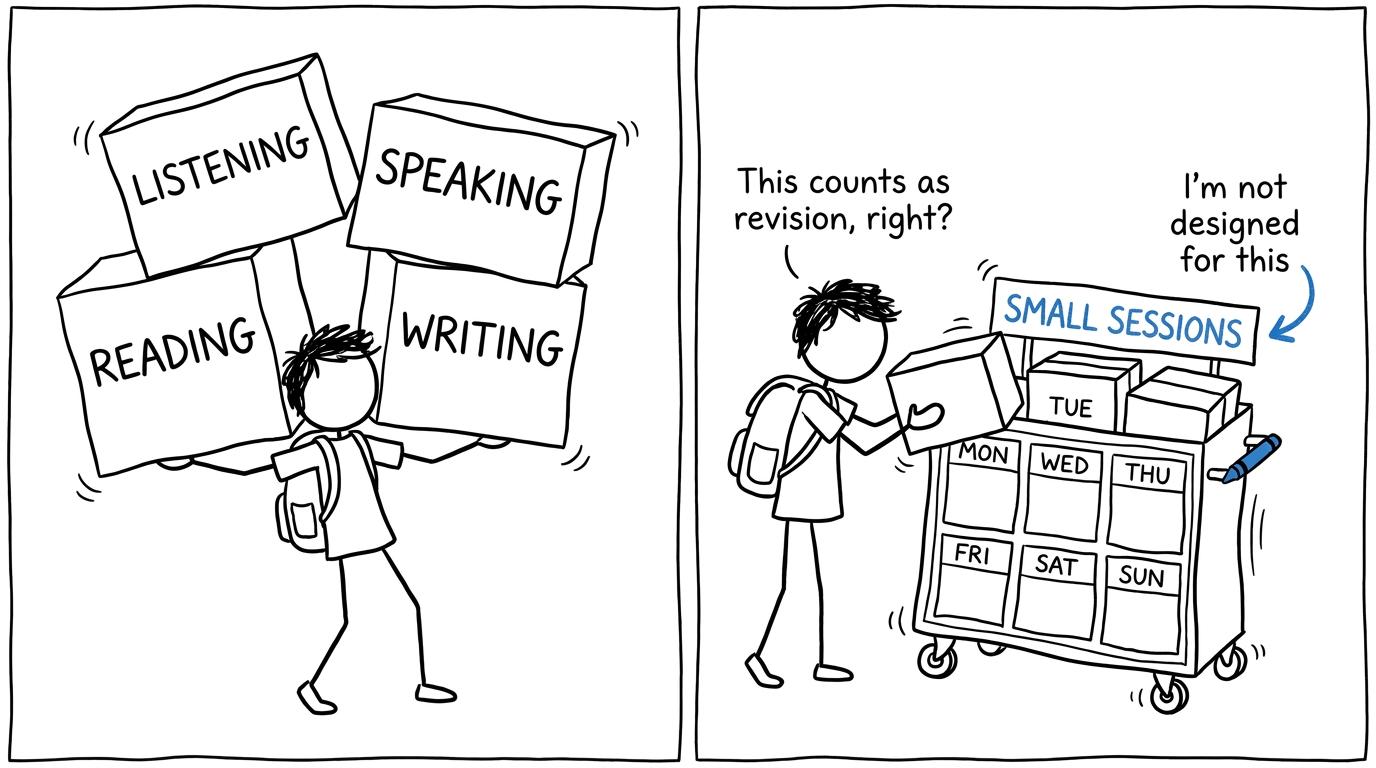 A student places listening, speaking, reading and writing into manageable weekly sessions
Week three: connect topics with exam skills
By week three, start applying recovered content to the task types used by your board. This may involve reading aloud, role-play, photo discussion, dictation, comprehension, translation or extended writing.
Use short sections first. A complete paper can be discouraging and inefficient when the purpose is to repair a specific absence. Complete one relevant task, check the official mark scheme or teacher guidance, and record:
- vocabulary you could not retrieve;
- grammar that became inaccurate under pressure;
- parts of the question you misunderstood;
- pronunciation or fluency issues;
- one action for your next session.
MathsGenie's guide to using past papers properly explains the wider attempt, mark, fix and retest cycle. Although Spanish tasks differ from maths questions, the feedback principle transfers well.
Week four: retest and return to normal revision
Repeat the short diagnostic tasks from week one using different material from the same topics. Ask whether you can now:
- understand the central message and supporting details;
- retrieve core vocabulary without prompts;
- use the required time frames accurately;
- respond aloud without depending on a memorised paragraph;
- complete the relevant task format under light time pressure.
Take the results to your teacher. Anything still weak should enter your normal revision timetable rather than extending an emergency catch-up phase indefinitely.
How to revise vocabulary and grammar efficiently
Vocabulary must become retrievable, not merely familiar. Use flashcards, covered lists, quick quizzes and spoken recall. Include articles, spellings and accents where they are part of the word. Learn useful language in short phrases so that you can transfer it into speaking and writing.
For grammar, prioritise what unlocks current work. This commonly includes verb forms, negatives, adjective agreement, opinions, connectives and references to past, present or future events, but your missed units and board specification should decide the order.
Use this cycle:
- recall the rule without notes;
- check a concise explanation;
- apply it in several short sentences;
- say some of those sentences aloud;
- correct them using teacher feedback or trusted course materials;
- return to the same point on another day.
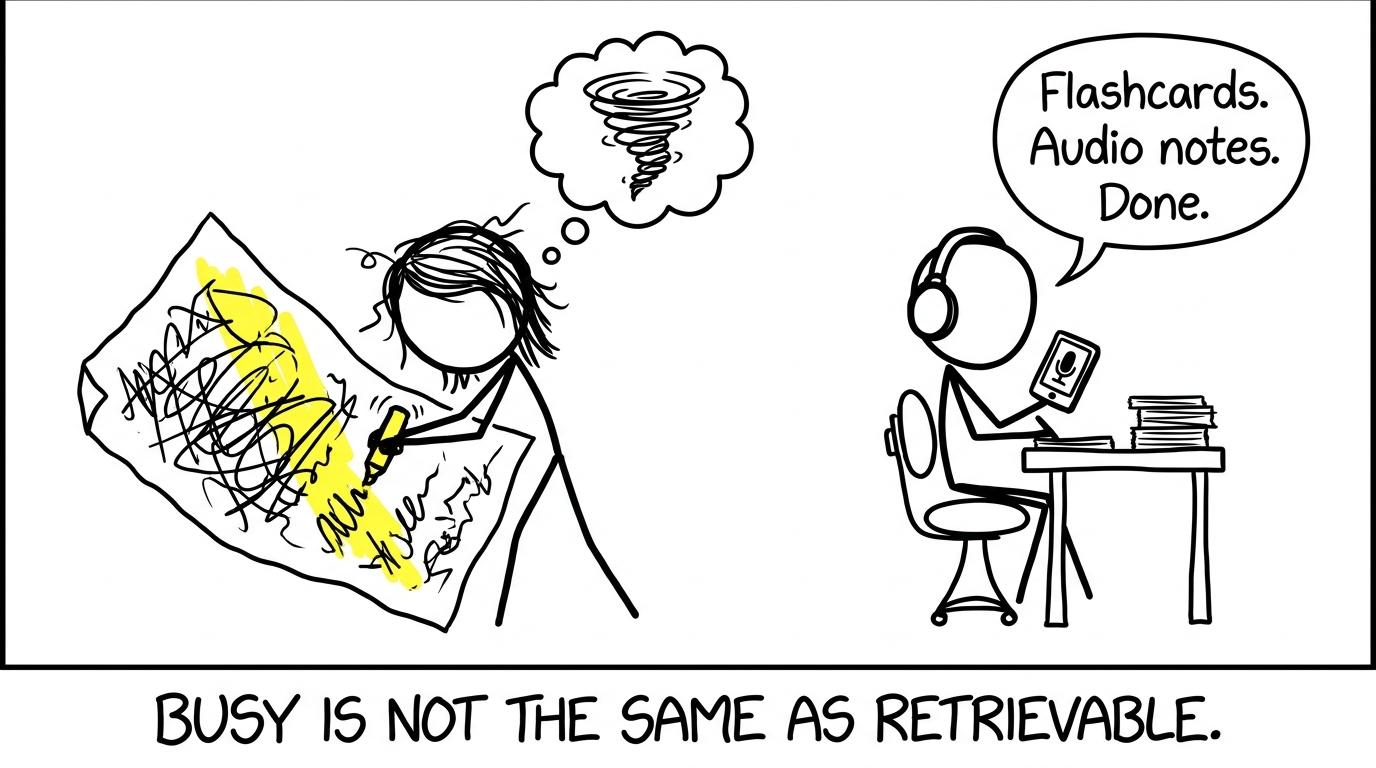 One student highlights frantically while another uses retrieval, audio and flashcards
Balance Spanish catch-up with GCSE maths
One subject can easily consume every available evening because its unfinished work is visible. That does not make it the only priority.
Place Spanish into a whole-week plan. Keep a minimum commitment to maths, even during the catch-up period. A short revision lesson followed by practice questions is more valuable than allowing maths to disappear for four weeks.
MathsGenie's one-month GCSE maths revision plan offers a practical structure for topic work, retrieval and paper practice. You can also use the free MathsGenie resources hub for mini tests and predicted papers, or choose real papers from the GCSE past papers collection.
If exams are close, divide your available time according to urgency, weakness and upcoming assessment dates. Do not assume that every subject needs identical hours. Your plan should reflect the evidence from your work.
Common mistakes when catching up
Copying everything before attempting anything
Neat notes can create the appearance of progress. Test yourself early so that your time follows genuine gaps.
Revising only vocabulary
Vocabulary is essential, but GCSE Spanish also requires you to understand and communicate through listening, speaking, reading and writing. Words must be used in context.
Memorising one perfect speaking script
A prepared answer may help organise ideas, but speaking assessments require you to respond to prompts and questions. Practise adapting familiar language rather than reciting one fixed paragraph.
Ignoring pronunciation and listening
Silent revision cannot fully prepare you for spoken language. Read aloud, record yourself and listen regularly, even if sessions are brief.
Starting with full papers
A full paper may expose gaps without helping you repair them. Begin with topic-relevant tasks, then build towards longer timed practice.
Trying to recover while still exhausted
If illness is continuing, tell your school. Ask which work can be reduced, delayed or supported. A smaller plan completed consistently is better than an ambitious timetable that worsens your recovery.
Move from absence to a steady routine
Catching up is not about proving that you can endure an enormous workload. It is about making the next lesson understandable, the next assessment less unfamiliar and your remaining revision more focused.
Begin today with three actions: contact your Spanish teacher, list the missed content and complete one short diagnostic task. Then build four weeks of small, active sessions around the evidence you uncover.
Keep your maths preparation stable at the same time. Use MathsGenie's GCSE revision hub for free revision lessons and practice questions, then check progress with mini tests, past papers, predicted papers, mark schemes and video solutions. When each subject has a clear next step, absence stops feeling like one impossible gap and becomes a sequence of manageable repairs.