

Best Time of Day to Revise: A Practical Guide
Best time of day to revise depends on your energy. Use this practical GCSE and A Level plan to schedule focused sessions while protecting sleep and rest.
The best time of day to revise is when you are alert, reasonably rested and able to work without interruption. Early evening after a break is a useful weekday starting point; late morning can work at weekends. Neither is a universal rule.
If you keep rereading the same paragraph without remembering it, timing may be part of the problem. Test two realistic revision windows, compare the quality of your work, then schedule demanding tasks in the better one. Your school timetable, home life and sleep needs matter more than somebody else's routine.
Your quick timing checklist
Choose a window when:
- You have eaten and had something to drink.
- You can concentrate without frequent interruptions.
- You have at least 202020 focused minutes.
- Revision will not reduce your sleep.
- You can repeat the routine during the week.
Consistency matters more than finding a perfect minute. A useful window you regularly protect gives you something dependable to build on.
Why different students need different times
Imagine Aisha, a hypothetical Year 111111 student. She starts immediately after school because it looks efficient, but hunger and tiredness make concentrating difficult. A planned break might improve her work. Another student might find that starting promptly prevents procrastination.
Chronotype describes a person's tendency to feel more alert earlier or later. Research suggests that matching demanding work to this preference can help cognitive performance, although the effect varies. Teenagers also commonly experience later sleep and waking patterns.
That does not make midnight an ideal revision time. Teenagers aged 131313-181818 are generally advised to get 888-101010 hours of sleep. Regularly sacrificing rest can undermine attention and memory.
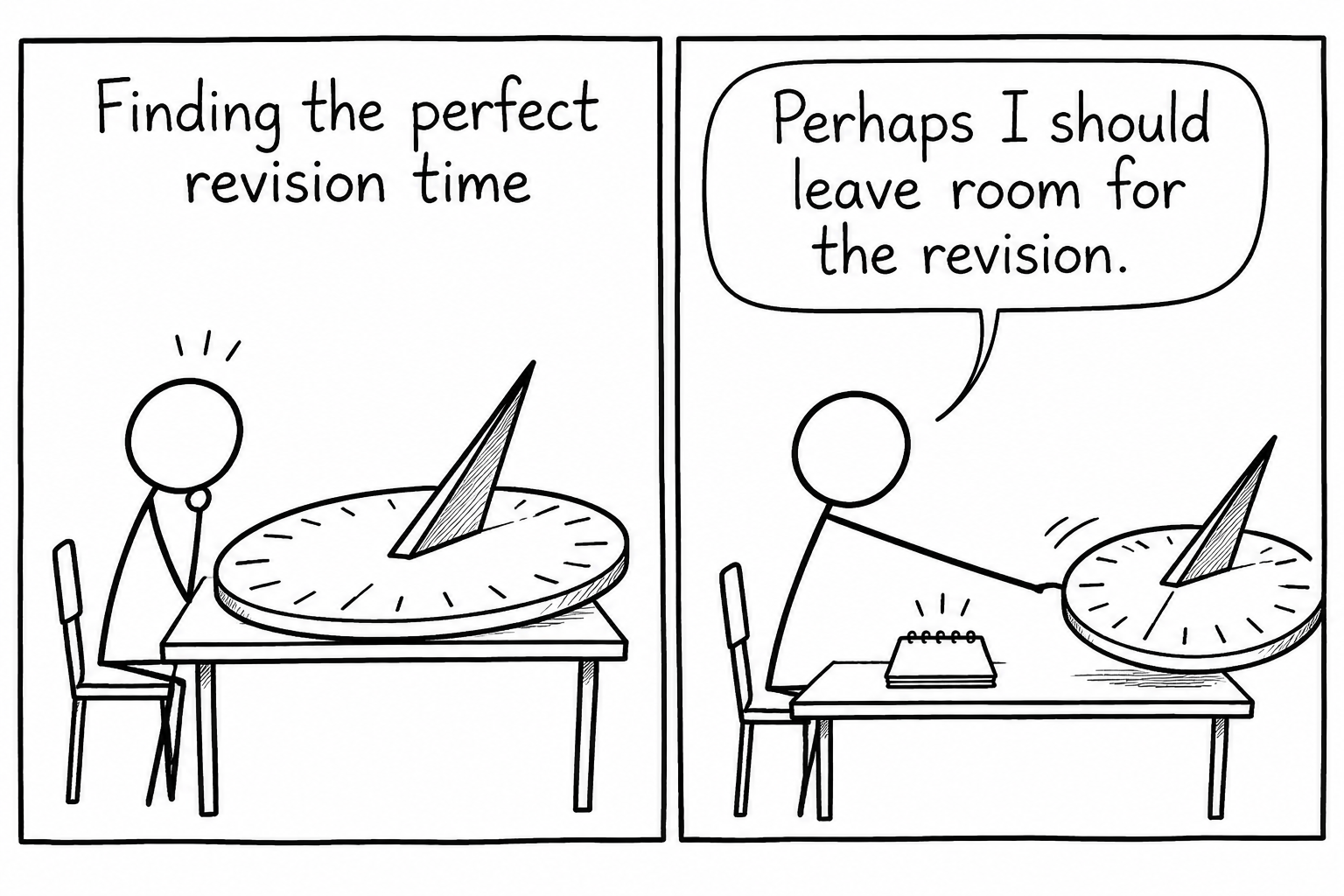 A student moves an enormous sundial aside to make room for actual revision
Revision windows worth testing
Before school
Morning revision can suit students who wake naturally and have an unhurried start. Try formula recall, retrieval practice or correcting previous mistakes.
Avoid creating this window by cutting sleep or rushing breakfast. An early alarm helps only if you are rested enough to use the time.
After school or early evening
A break of roughly 303030-606060 minutes can provide a boundary between lessons and independent work. Eat, drink and decide your start time before settling into another activity.
If your evening is crowded, try the 20-minute maths revision routine. A short, focused session is easier to repeat than an ambitious plan that keeps slipping.
Late morning at weekends
Late morning leaves time for sleep and breakfast while keeping revision ahead of other plans. It can suit past papers and demanding A Level questions.
Allow time to mark your answers too. The guide to revising GCSE maths efficiently explains how reviewing methods, answering questions and checking mistakes fit together.
Late evening
Some students have quieter homes and better concentration later. Set a stopping time that protects sleep.
Repeatedly misreading instructions, making unusual errors or forgetting what you have just covered are reasons to stop and return when rested.
Find your best time of day to revise
Run a simple comparison across one week. Choose two realistic windows and complete three sessions in each.
Keep session lengths and task difficulty similar. Comparing easy flashcards in the morning with unfamiliar algebra at night tells you little about timing.
Begin with brief recall, answer questions without notes, then mark your work. Record how easily you started, how focused you felt and how accurately you answered. Check some of the material again the following day to see what you remember.
Choose the window that supports reliable starts and useful work. Feeling comfortable matters, but completed questions and retained knowledge provide stronger evidence.
Use the GCSE revision timetable guide to fit that window into your week, or organise sessions with the MathsGenie Revision Planner.
Match the task to your energy
Protect your strongest concentration for unfamiliar topics, multi-step questions, timed papers and analysing mistakes. Use quieter, shorter sessions for formula recall, straightforward corrections and planning tomorrow's work.
Keep maths revision active. Watch a MathsGenie revision lesson when you need an explanation, then attempt practice questions independently. Use mark schemes and video solutions to understand errors before trying again. Mini tests can help you check whether a topic needs further attention.
Past papers and predicted papers provide broader practice, but marking and correcting them should be part of the session. Simply finishing a paper leaves useful learning unfinished.
The guide to how many hours GCSE students should revise helps you set manageable expectations. The GCSE maths revision timetable can help distribute topics across the week.
A Level students can apply the same approach, allowing longer blocks where proofs, mechanics problems or full papers require sustained attention.
Common mistakes when choosing a revision time
Copying somebody else's routine. An early start on social media tells you nothing about whether it suits your sleep, travel or responsibilities.
Letting breaks drift. A planned pause can help, but decide when revision will begin so the whole evening does not disappear.
Counting desk hours. Judge progress through recall, completed questions and corrected errors. Time spent sitting down is an incomplete measure.
Saving everything for the weekend. Smaller weekday sessions keep topics active and make your plan less vulnerable to changing arrangements.
Extending every evening. When revision repeatedly replaces sleep, reduce or rearrange lower-priority tasks rather than continually moving bedtime.
Build a routine around your attention
You do not need to discover one perfect hour. Find a workable window, give it a fair trial and adjust when your circumstances change.
Choose one topic from MathsGenie's free GCSE and A Level maths revision resources, schedule a focused session and leave time to check your answers. Let the quality of that work guide your next decision.















