

Best GCSE Subjects to Pair with Geography
GCSE subjects to pair with Geography: compare Science, History, languages and creative options to build a balanced, manageable GCSE timetable.
Choosing GCSE options can feel strangely permanent. A subject that occupies one box on a form will eventually occupy lessons, homework, revision sessions and exam days. The real question is not simply which subjects look impressive. It is which combination you can sustain.
The best GCSE subjects to pair with Geography are usually Biology, Maths, Statistics, Computer Science, a modern foreign language, Business, History and one creative or practical subject. Each offers either useful skill overlap or welcome variety. However, the right combination depends on your interests, your school's option blocks and the amount of writing, coursework or factual content you can manage.
Geography is already broad. It blends science, data, maps, fieldwork and extended writing. Your other choices should build on that breadth without turning every week into the same kind of workload.
A quick GCSE options checklist
Before comparing individual subjects, ask:
- Do I enjoy the subject enough to revise it when it becomes difficult?
- Does it support a possible A Level, apprenticeship or career direction?
- Am I creating too many content-heavy or extended-writing subjects?
- Does the assessment suit me: examinations, practical work, performance or a mixture?
- Is the subject available in my school's option blocks?
- What do current students and teachers say about the actual course?
- Have I checked the specification used by my exam board?
Geography is one of the humanities included in the English Baccalaureate subject combination. The wider combination also includes English, maths, science and a language. Yet school requirements and accountability arrangements can change, and GCSE structures differ across the UK. Treat your school's current options booklet as the practical authority.
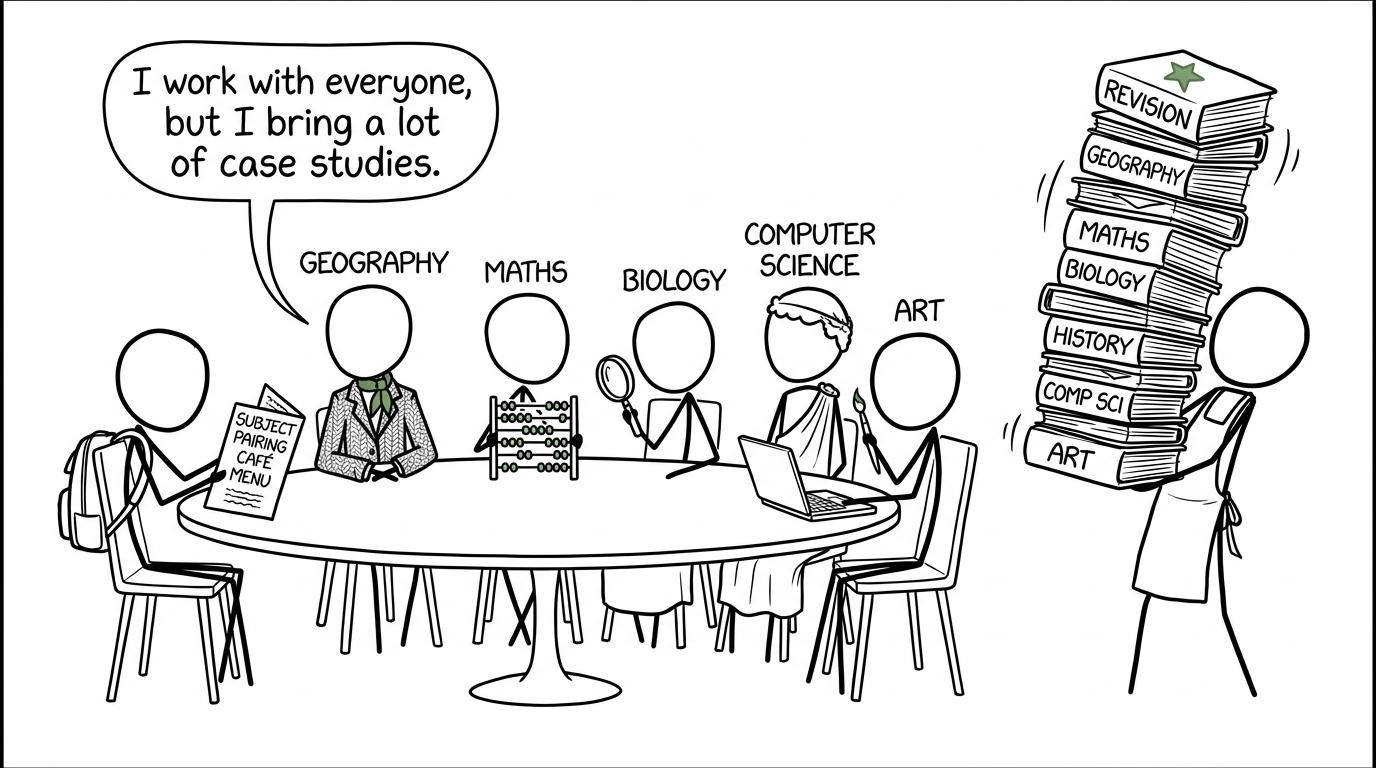 A student considers subject combinations at a Geography-themed café
Why Maths pairs so naturally with Geography
Maths is normally part of the core curriculum rather than an optional subject, but it is still Geography's most useful companion. Modern Geography is full of quantitative evidence: population figures, climate data, river measurements, map scales, economic indicators and fieldwork samples.
Official GCSE Geography specifications from boards such as AQA and Pearson Edexcel require numerical, graphical and statistical skills. Depending on the specification, these can include ratio, proportion, percentage change, averages, range, quartiles, cumulative frequency, scatter graphs and lines of best fit.
For example, percentage change is represented by:
Percentage change=new value−original valueoriginal value×100\text{Percentage change}=\frac{\text{new value}-\text{original value}}{\text{original value}}\times 100Percentage change=original valuenew value−original value×100That skill can appear in maths and then return in Geography through population change, tourism, energy use or environmental data. It is not two unrelated pieces of revision. It is one method used in two settings.
The MathsGenie GCSE Maths revision hub lets you select your exam board and work through lessons, questions and papers. For directly transferable skills, use the Geography statistical skills revision guide, percentage change revision and scatter graphs resources.
The strongest optional subjects alongside Geography
Biology or separate sciences
Biology is one of the clearest academic matches. Ecology, ecosystems, adaptation, biodiversity and human impacts connect naturally with physical and environmental Geography. Chemistry can support topics involving resources, pollution and atmospheric processes, while Physics strengthens confidence with energy, measurements and data.
Your school may offer Combined Science or separate GCSEs in Biology, Chemistry and Physics. Separate sciences can be a sensible choice if you enjoy science and may want to take it further. They are not automatically the better choice if the additional lesson and revision load would weaken your performance elsewhere.
Science and Geography both reward precise use of evidence. They also share practical habits: selecting variables, considering sample size, evaluating methods and interpreting graphs. Students who enjoy fieldwork often find scientific practical work familiar in spirit.
Statistics
If your school offers GCSE Statistics, it has unusually direct overlap with Geography. Sampling, averages, distributions, correlation and data presentation all support fieldwork and geographical enquiry.
AQA Geography, for example, assesses cartographic, graphical, numerical and statistical skills across its written examinations. Statistical confidence can therefore reduce the mental load of Geography questions: instead of trying to remember both the geographical idea and an unfamiliar calculation, you can concentrate on interpretation.
Statistics is still a separate GCSE with its own content and assessment. Choose it because you like analysing evidence, not because you assume it will be an effortless extension of maths. You can explore the free GCSE Statistics revision resources before deciding whether the style appeals to you.
Computer Science
Computer Science complements Geography through logical thinking, data handling and problem-solving. It is particularly relevant if you are interested in mapping technology, geographical information systems, environmental modelling or digital careers.
The overlap is mainly in ways of thinking rather than repeated content. Geography asks what a pattern means in the real world; Computer Science asks how information can be represented and processed. That makes the pairing broad without feeling disconnected.
Be realistic about programming. Do not choose Computer Science solely because you use technology confidently. Read the course description and ask how much programming, theory and independent debugging are expected.
A modern foreign language
French, Spanish, German or another available language can create a strong academic combination. Geography studies places, cultures, migration, global development and international connections; languages help you approach those places through communication and cultural understanding.
A language also completes the language element of the traditional EBacc combination when taken alongside the required core subjects and Geography. More importantly, it keeps language-based post-161616 options open.
The workload is different from Geography but not necessarily light. Vocabulary needs regular retrieval, while speaking and listening require frequent practice. This pairing works best for students who prefer short, repeated revision sessions to occasional cramming.
Business or Economics
Where offered, Business or Economics can support the human side of Geography. Development, globalisation, employment, trade, resources and sustainability all involve economic decisions.
Business often includes calculations involving percentages, averages, revenue and costs. That makes mathematical fluency useful again. The benefit is contextual: the subjects encourage you to interpret figures rather than calculate without asking what the answer means.
Check the specification carefully. Business and Economics are distinct subjects, and schools do not all offer both. Neither should be chosen on the assumption that it is simply common sense.
History
History and Geography form a respected humanities combination. Both develop argument, source evaluation and the ability to explain why places and societies change.
The drawback is workload concentration. Both can involve substantial factual recall and extended written answers. If essays are one of your strengths and you genuinely enjoy both subjects, the combination can be excellent. If long answers exhaust you, adding History to Geography and other writing-heavy options may create unnecessary pressure.
Art, Design and Technology, Music, Drama or PE
A contrasting subject can be the smartest pairing of all. Creative and practical subjects provide a different rhythm from case studies, calculations and extended responses. Art can strengthen visual communication; Design and Technology connects with materials, sustainability and problem-solving; PE links with data, health and performance.
But contrast does not mean easy. Art and design subjects may require sustained portfolio work. Drama and Music can include rehearsals, performance and written components. GCSE PE is not simply additional sport. Ask how each course is assessed before choosing it as your supposedly lighter option.
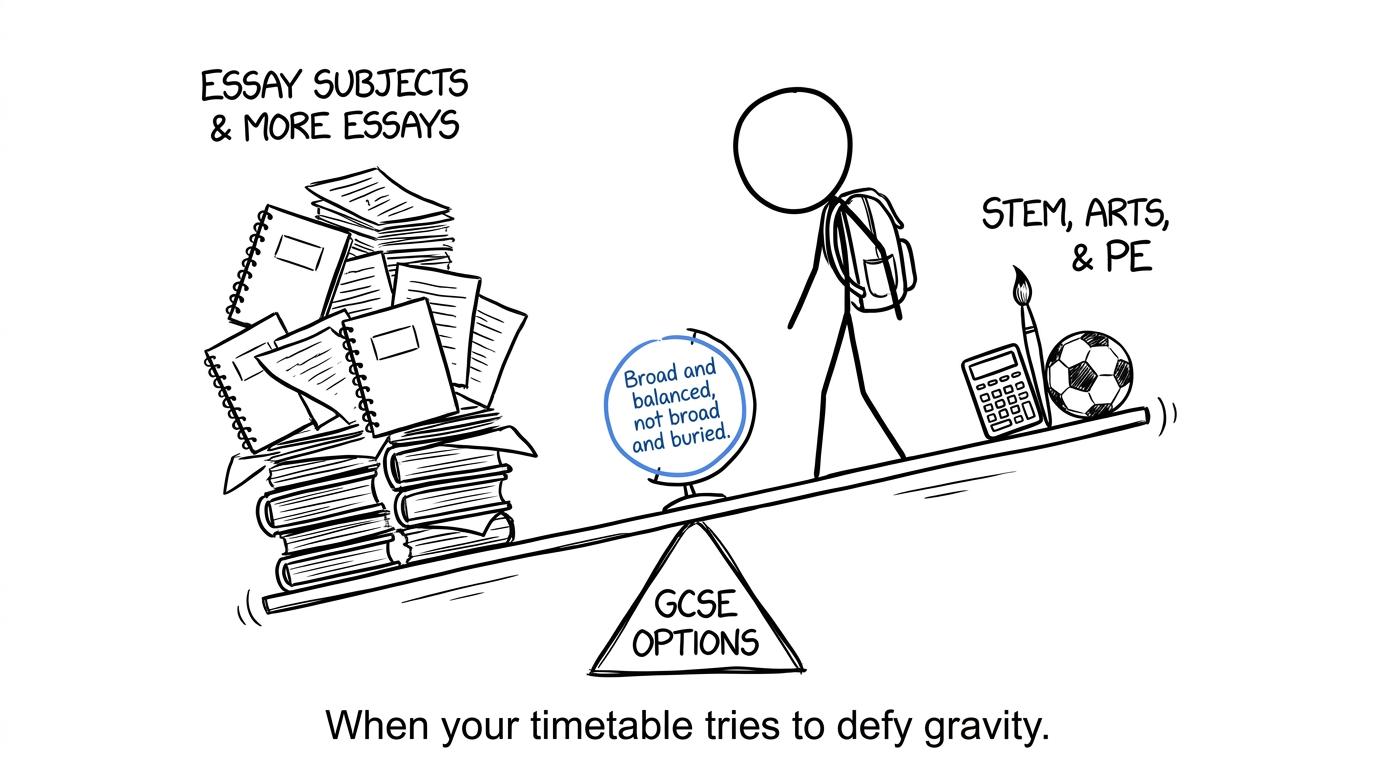 A student balances essay-heavy subjects against practical choices
Which combinations make the most sense?
| Student interest | Possible combination | Why it can work | Main pressure to watch |
|---|---|---|---|
| Environment and science | Geography, separate sciences and Statistics | Strong links through ecosystems, fieldwork and data | Large scientific content load |
| Technology and data | Geography, Computer Science and Statistics | Develops analytical and digital thinking | Programming and numerical demands |
| Global affairs | Geography, History and a language | Broad understanding of places, cultures and change | Heavy recall and extended writing |
| Business and development | Geography, Business and Computer Science | Links people, economies, decisions and technology | Several unfamiliar technical terms |
| Balanced curriculum | Geography, a language and a creative or practical subject | Mixes academic depth with different assessment styles | Portfolio, rehearsal or speaking deadlines |
These are examples, not recipes. A combination only works if your school offers it and you are willing to engage with each subject for the whole course.
When a subject combination creates unnecessary stress
Stress usually comes from the total pattern rather than one supposedly difficult subject.
Three or four content-heavy options can create constant factual recall. Several essay subjects may place long answers in every mock week. Multiple creative subjects can produce overlapping portfolio deadlines. Separate sciences, Computer Science and Statistics may suit an analytical student, but they can feel relentless to someone who needs more variety.
A useful workload audit is to label each option by its dominant demands:
- factual recall;
- extended writing;
- calculation and problem-solving;
- practical or performance work;
- portfolio or project completion;
- frequent vocabulary practice.
If every option has the same two demands, pause. Balance is not about avoiding challenge. It is about avoiding one type of challenge arriving from every direction.
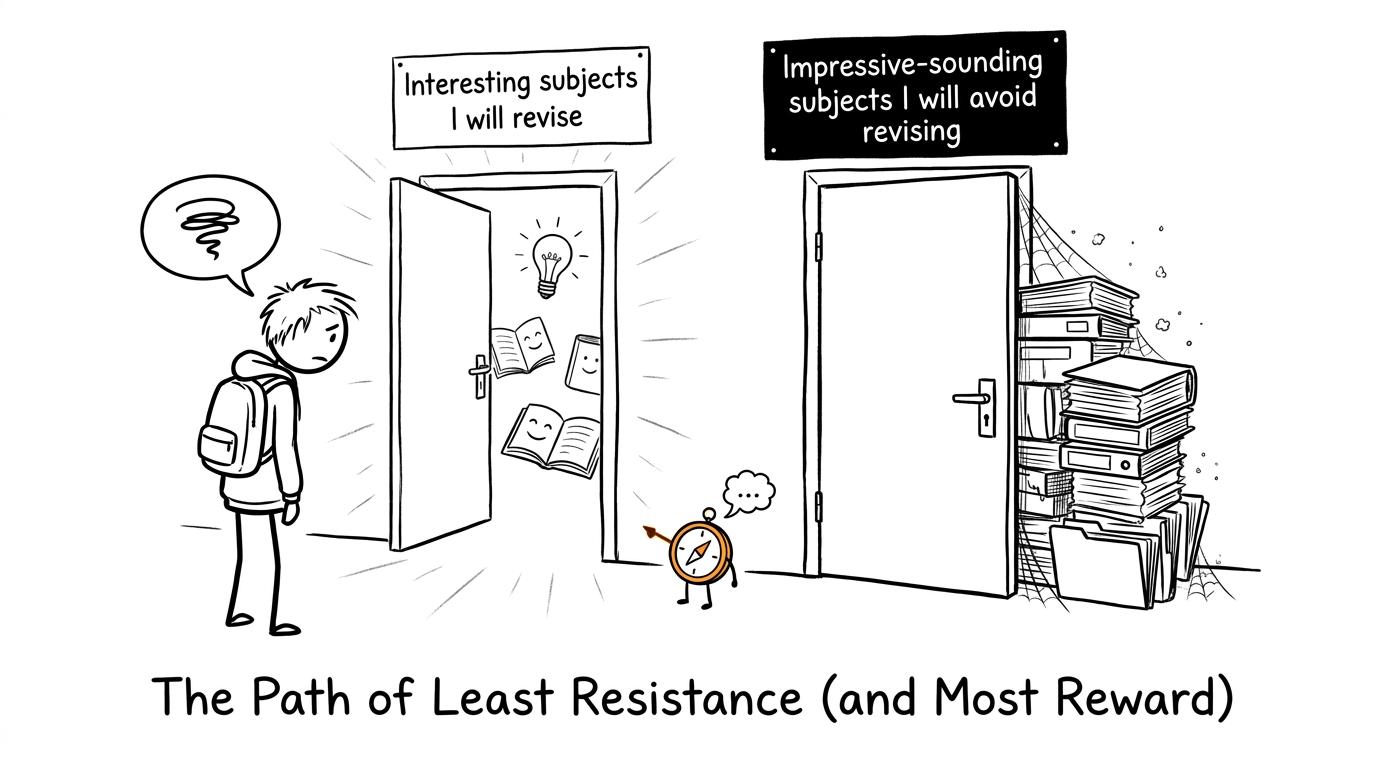 A student chooses between interesting subjects and impressive-sounding folders
Common mistakes when choosing GCSE options
Choosing for a friend
Timetables change and classes may be split. Choose subjects you would still want if your friend were placed elsewhere.
Treating one subject as universally impressive
There is no combination that guarantees future success. Strong grades, appropriate post-161616 choices and genuine engagement matter more than collecting subjects that merely sound demanding.
Assuming practical subjects require little revision
Portfolio, rehearsal and performance deadlines can consume significant time. Investigate the complete assessment structure, not just the lesson activities you enjoy now.
Ignoring future entry requirements
If you have a possible A Level or college course in mind, check its published entry requirements. Some courses expect a particular GCSE subject or grade, while others focus mainly on English and maths.
Forgetting the core subjects
Your options sit beside English, maths and science, not in isolation. An ambitious options list can become unmanageable once core homework and mock examinations are included.
Build a revision plan that supports both subjects
The most valuable overlap between maths and Geography is not that you can revise once and forget both. It is that one skill can be practised in different contexts.
Use Geography data to notice where you hesitate: percentages, scale, averages, graphs or sampling. Then repair the underlying method through MathsGenie. The GCSE Maths topics by exam board and tier guide helps you identify the relevant foundation or higher content, while the best order to learn GCSE Maths topics provides a sensible progression.
Once individual skills are secure, move into mixed examination practice. Use revision lessons first, practise with topic questions, check mark schemes and video solutions, then build timing through mini tests and past papers. Nearer the exams, GCSE Maths predicted papers can provide an additional rehearsal, but they should complement rather than replace official past papers.
Choose a combination you can grow into
The best GCSE subjects to pair with Geography are not simply those with the greatest overlap. Biology, Statistics, Computer Science, languages, Business and History can all strengthen geographical thinking. A creative or practical option may offer the balance that makes the whole timetable manageable.
Choose with three ideas in mind: interest, future usefulness and workload variety. Then ask your teachers about the precise specification and assessment structure before submitting the form.
Once your choices are made, turn them into a steady routine. Use MathsGenie's free revision lessons to learn, practice questions to build fluency, mark schemes and video solutions to correct mistakes, and mini tests, past papers and predicted papers to prepare for exam conditions. A good subject combination opens the door. Consistent revision is what carries you through it.











