

Best GCSE Engineering Revision Guide: How to Choose
Best GCSE Engineering revision guide checklist: assess specification coverage, maths support, exam questions, answers and practical value before buying.
A revision guide can look reassuring long before it becomes useful. The cover is polished, the pages are colourful and the word “complete” appears somewhere in large type. Yet none of that proves it will help when a question combines engineering knowledge, calculations and evaluation.
The best GCSE Engineering revision guide is current, matched to your exact qualification, complete enough to cover the specification and built around active practice rather than passive reading. It should explain engineering principles clearly, connect maths to realistic contexts, include exam-style questions and provide answers detailed enough to diagnose mistakes.
Price matters, but usefulness matters more. Here is how to judge it.
A quick revision guide checklist
Before buying or relying on a guide, check whether it:
- names the correct exam board, qualification and specification code
- reflects the current assessment structure
- covers every specification section, not merely the easiest topics
- teaches calculations with units, formulae and rearrangement
- includes engineering diagrams, processes and realistic applications
- distinguishes recall, application, analysis and evaluation
- provides exam-style questions alongside useful answers
- supports revision for both the written paper and non-exam assessment where appropriate
- is easy to navigate when you need to repair one precise weakness
- can be tested against an official specification and recent past paper
A guide does not need to be enormous. It needs to make all ten checks easy to answer.
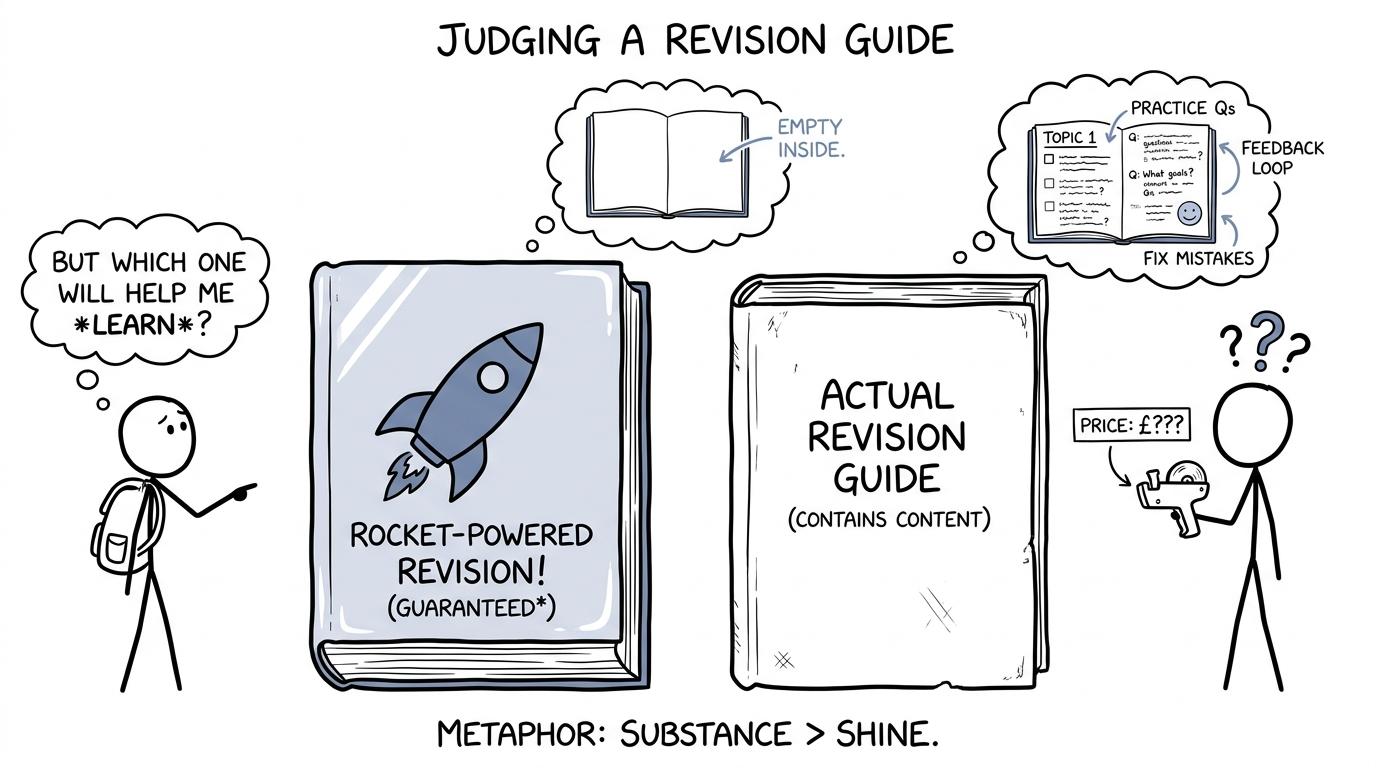 A student discovers that the shiniest revision guide is not necessarily the most useful
Start with the qualification, not the cover
A revision guide is only useful if it prepares you for the course you are actually taking. Look for the qualification title and specification code on your school materials, then compare them with the details printed in the guide.
For example, AQA's current GCSE Engineering qualification is specification 885288528852. Its assessment includes a two-hour written paper worth 120120120 marks and 60%60\%60% of the qualification, alongside non-exam assessment worth 808080 marks and 40%40\%40%. The written paper can contain multiple-choice questions, short answers, calculations, practical contexts and extended responses.
Those details reveal an important principle: a compact book of engineering definitions cannot prepare you for the whole assessment. A suitable guide must help you recall knowledge, apply it in unfamiliar situations, and analyse or evaluate evidence.
Do not assume a resource labelled “GCSE technology” or “engineering revision” matches your course. Older specifications and related qualifications can use different content or assessment arrangements. GCSE Engineering is also not divided into foundation and higher tiers in the way GCSE Maths is. If a seller describes an Engineering guide using maths-style tier labels, investigate carefully.
Your teacher should confirm your qualification if you are uncertain. For GCSE Maths, where Edexcel, AQA, OCR and Eduqas specifications genuinely differ, the MathsGenie GCSE Maths revision hub lets you choose the appropriate board and tier.
Specification coverage is the first real quality test
A good contents page resembles the structure of the official specification. For AQA GCSE Engineering, that means appropriate coverage of areas including engineering materials, manufacturing processes, systems, testing and investigation, practical engineering skills, and the wider impact of engineering.
Coverage should also have depth. A page naming metals, polymers, ceramics and composites is not enough if the specification expects you to compare properties, select materials for a context or evaluate environmental consequences.
Use this comparison test:
| What to inspect | Evidence of a strong guide |
|---|---|
| Specification mapping | Topics or chapters can be matched to current specification statements |
| Technical vocabulary | Terms are defined and then used in engineering contexts |
| Processes and systems | Explanations include purposes, limitations and applications |
| Maths content | Formulae, units, graphs and interpretation are integrated into engineering |
| Assessment skills | Questions require recall, application, analysis and evaluation |
| Answers | Explanations show why an answer earns marks, not only the final response |
Be suspicious of vague claims such as “covers everything”. Take three specification statements from different sections and find them in the guide. Then choose one less obvious mathematical skill, such as interpreting the slope of a graph or changing the subject of a formula. If several items are missing, the guide has failed a simple audit.
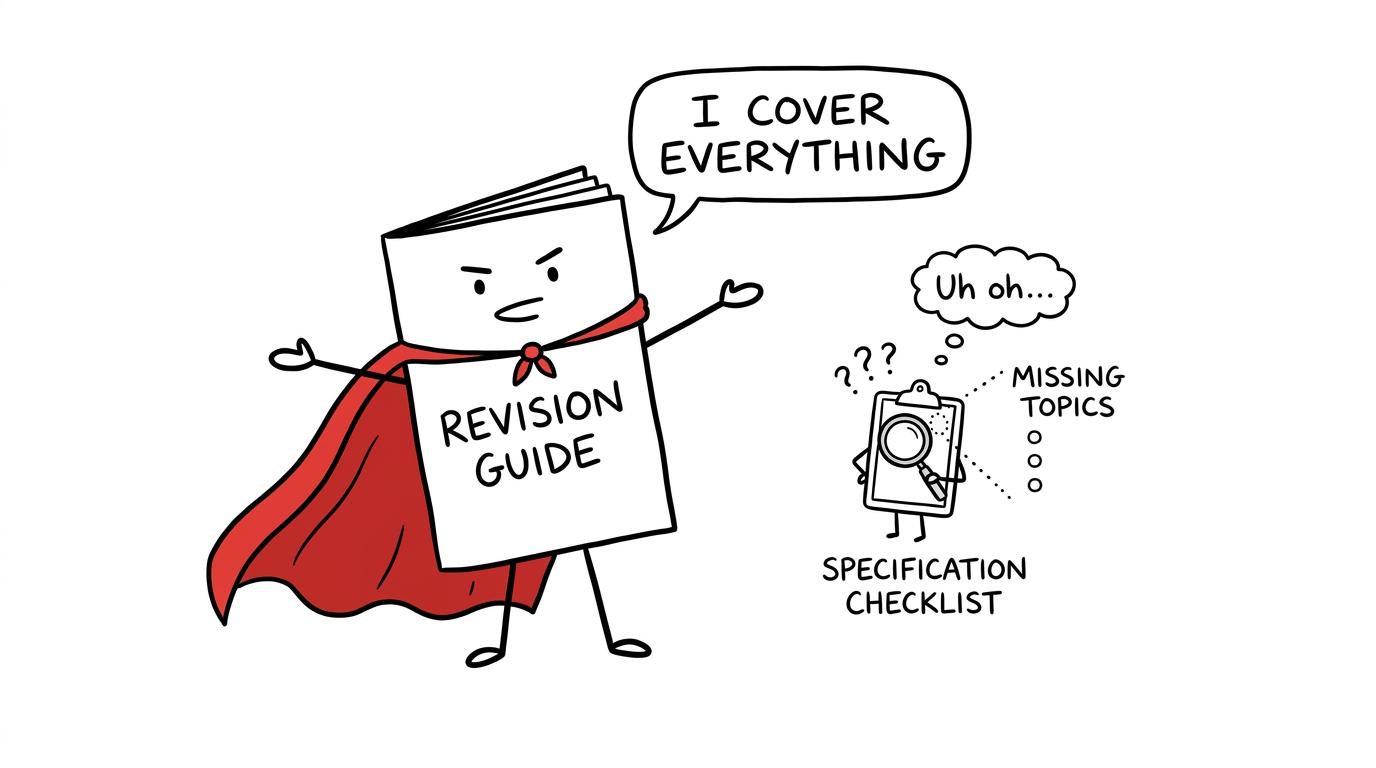 A tiny specification checklist finds gaps in a revision guide claiming to cover everything
The best GCSE Engineering revision guide must teach the maths
Engineering maths is not an optional appendix. The AQA specification expects students to apply Key Stage 333 and Key Stage 444 mathematical knowledge in engineering contexts. Its stated skills include arithmetic, standard form, ratio, percentages, significant figures, means, algebra, graphs, Pythagoras' theorem and trigonometry.
It also identifies engineering equations involving ideas such as area, volume, density, stress, strain, pressure, resistance, gear ratio and mechanical advantage. Examples of the relationships a guide should handle accurately include:
ρ=mV\rho = \frac{m}{V}ρ=Vm σ=FA\sigma = \frac{F}{A}σ=AF I=VRI = \frac{V}{R}I=RVListing formulae is not enough. A strong guide should explain:
- what every symbol represents
- which units are appropriate
- how to convert between relevant units
- how to select a formula from a context
- when rearrangement is required
- how to present a sensible degree of accuracy
- how to interpret the result as an engineer
That final point separates calculation from understanding. A number may be arithmetically correct but physically implausible because the units were inconsistent or the wrong area was used.
If rearranging equations is a weakness, use MathsGenie's Changing the Subject of a Formula revision lesson and follow it with exam-style formula rearrangement questions. Although these pages support GCSE Maths specifications, the underlying algebra transfers directly to engineering formulae.
Good explanations lead to action
Some guides are pleasant to read but difficult to use. Every sentence makes sense while the book is open; little remains available when the book closes.
A better guide creates a cycle:
- learn a small section
- close the guide and retrieve the main ideas
- answer a question without support
- mark the response
- identify the exact gap
- revisit only what needs repairing
- attempt another question
Look for short checks, mixed questions and opportunities to interpret unfamiliar scenarios. Answers should reveal missing reasoning. For a longer response, a bare model paragraph may be less useful than an annotated answer that identifies the engineering principle, application to the context, evidence and justified conclusion.
This is also why practice volume alone can mislead. Fifty near-identical recall questions may feel productive but offer weak preparation for application and evaluation. The assessment objectives for GCSE Engineering place substantial importance on applying knowledge and skills, so a worthwhile guide must move beyond memorisation.
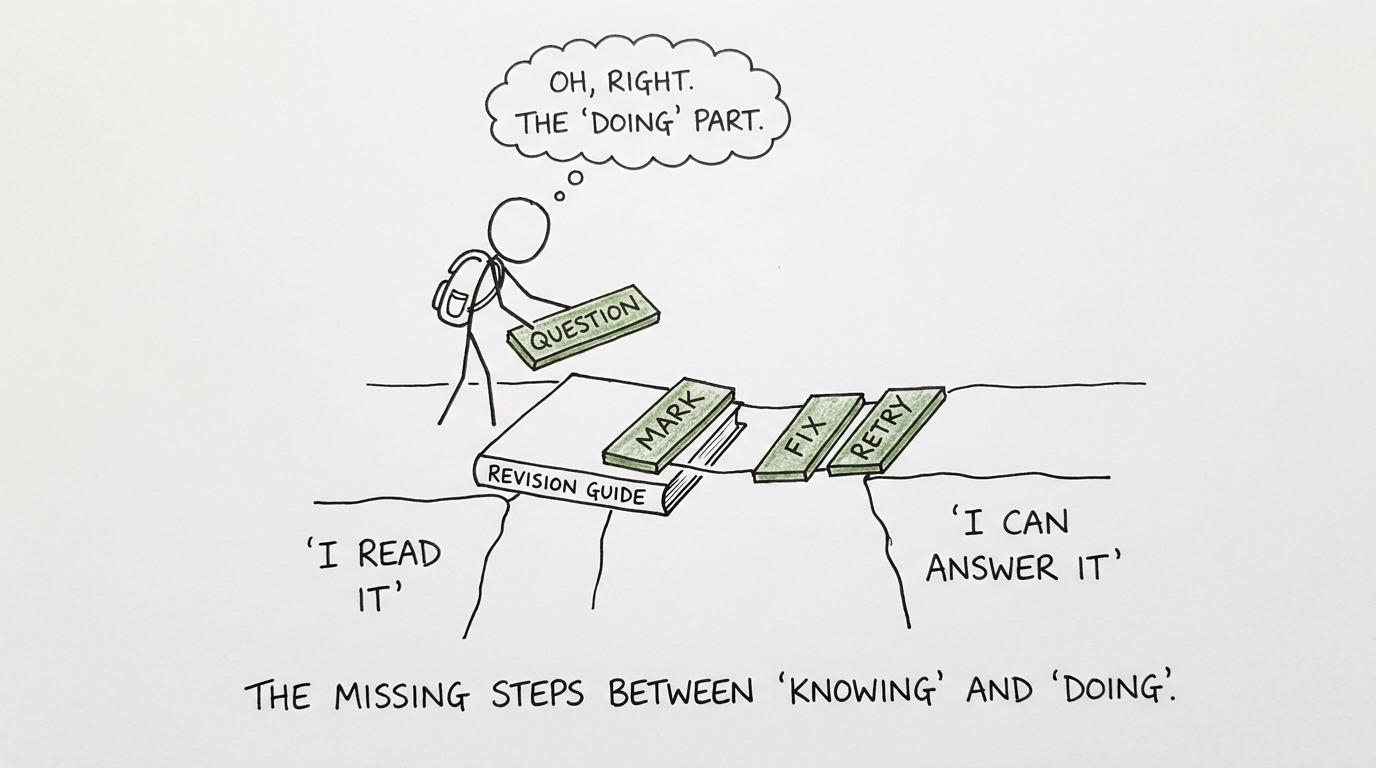 A revision bridge becomes solid only after question, marking, correction and retry are added
Check the questions against real assessment material
A revision guide's own questions may look convincing because the guide also defines what “correct” means. Real assessment material provides an independent check.
Choose a few questions from an official specimen or past paper and ask:
- Does the guide contain the knowledge needed?
- Does it prepare you to apply that knowledge in context?
- Does it teach the relevant calculation or graph skill?
- Does its answer guidance resemble the precision demanded by a mark scheme?
- Does it prepare you for extended responses as well as short recall?
One guide does not need to contain every past paper. It should, however, prepare you to use past papers successfully. Maths students can see this process clearly through AQA GCSE Maths past papers and mark schemes: attempt, mark, classify the error and return to focused revision.
The same evidence-led habit works across subjects. The guide teaches; the paper tests whether the teaching transferred.
Match the guide to how you actually revise
The theoretically perfect guide is useless if its structure makes you avoid opening it. Consider practical details beyond page count:
Navigation
Can you find one topic quickly? A detailed index, clear headings and specification references save time when a mock reveals a narrow weakness.
Page design
Diagrams should clarify systems, processes and components rather than decorate the page. Dense colour is not automatically clearer. Look for labels that remain readable and explanations positioned near the relevant visual.
Question spacing
Questions should appear often enough to interrupt passive reading. Ideally, answers are accessible but not so visible that you accidentally read them first.
Digital support
A useful companion platform may add videos, mini tests or fresh questions. Check whether access expires, requires payment or depends on a code that may already have been used in a second-hand copy.
Accessibility
Readable type, uncluttered pages and manageable sections matter. The best format is the one that allows sustained, accurate revision rather than creating unnecessary friction.
If organisation is the main problem, MathsGenie's guide to the best order for learning GCSE Maths topics shows how prerequisite skills can be sequenced instead of attacked randomly.
Common mistakes when choosing an Engineering guide
Buying by price alone
The cheapest guide is poor value if it follows an outdated course or lacks answers. The most expensive guide is not automatically more complete. Judge the evidence inside.
Trusting the word “complete”
“Complete” is a marketing claim until you compare the contents with the specification. Audit several topics, mathematical skills and assessment demands yourself.
Choosing a general design and technology book
There may be overlap, but related subjects are not interchangeable. Materials or manufacturing content can still differ in scope, terminology and context.
Ignoring maths until the end
Formulae, graphs and units require repeated practice. Treating them as a final chapter encourages fragile knowledge. MathsGenie's method for finding your weakest GCSE topics can help turn lost marks into a focused practice list.
Reading without testing
Familiar pages create confidence without proving recall. Every revision session should contain an attempt made without looking at the explanation.
Expecting one book to do everything
A guide provides structure, but it cannot replace teacher feedback, practical experience, official assessment materials or timed practice. It should sit inside a broader revision system.
Build a stronger revision system around the guide
Once you have chosen a guide, assign it one clear job: teaching and organising content. Use separate tools to test performance.
A sensible weekly rhythm is:
- use the guide to revise one engineering topic
- retrieve the key ideas without looking
- answer engineering questions on that topic
- practise any supporting maths skill separately
- mark carefully and record lost marks
- revisit the weakness later with a fresh question
Do not wait until every chapter feels finished before attempting papers. Short sections of exam material can reveal gaps early enough to fix them. The MathsGenie article on when to start GCSE past papers explains how to move from shorter diagnostic work towards timed papers.
Choose evidence over appearance
A good GCSE Engineering revision guide is not the one with the loudest promise. It is the one that survives inspection. It matches your qualification, maps cleanly to the specification, teaches engineering maths accurately, prepares you for different assessment objectives and makes your mistakes visible.
Use the guide for explanations, but use questions to measure whether those explanations have become usable knowledge. For the mathematical side of Engineering, make MathsGenie your free practice base: begin with GCSE Maths revision lessons and questions, strengthen weak methods, then move into past papers, predicted papers, mini tests, mark schemes and video solutions.
The cover may persuade you to pick up a guide. What happens after you close it is what makes the guide good.










