Apprenticeship GCSE English Literature Requirement
Apprenticeship GCSE English Literature requirement explained: discover when a specific grade matters, what adverts mean and your options if you fall short.
A single word can change how an apprenticeship advert feels. You expected it to ask for English and maths, but then you notice Literature. Does that mean your English Language grade does not count?
The short answer is that an apprenticeship GCSE English Literature requirement is not a universal rule. In England, official apprenticeship guidance generally recognises GCSE qualifications with English in the title, including English Language and English Literature. However, an employer, training provider or university can set narrower entry criteria for a particular vacancy. If an advert specifically names English Literature, you should treat that wording seriously and ask whether alternatives are accepted.
The occupation alone rarely gives you the full answer. The individual vacancy does.
The quick checklist
Before ruling yourself in or out, check:
- Does the advert say English Literature, English Language, English, or either Language or Literature?
- Is the grade described as essential, preferred or desirable?
- Are equivalent qualifications accepted?
- Is the criterion set by the employer, training provider or university?
- Can the required English qualification be completed during the apprenticeship?
- Does your predicted grade count, or must you provide a final certificate?
- Is maths also required at a particular grade?
For a broader explanation of entry criteria, read MathsGenie's guide to apprenticeships after GCSE and the grades you need.
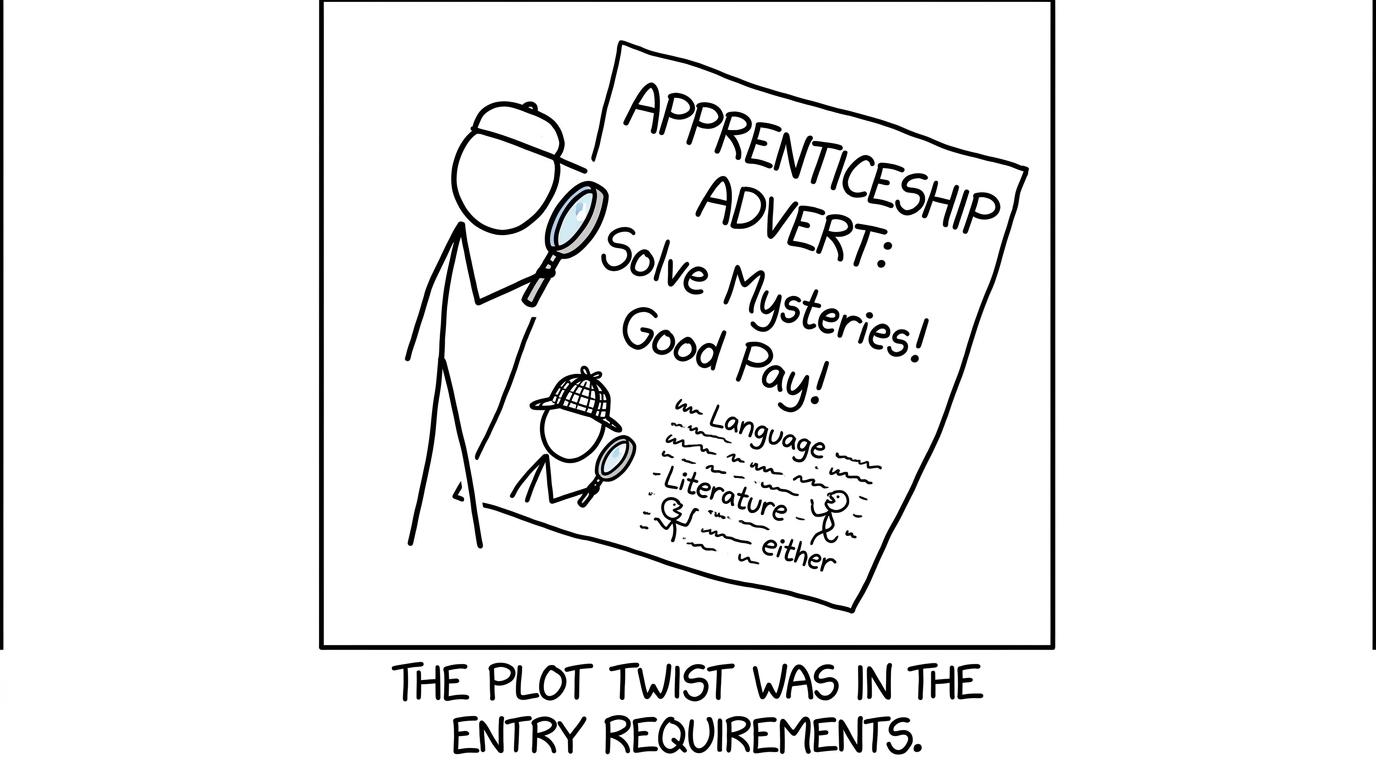 A student detective discovers the important wording hidden in an apprenticeship advert
Is GCSE English Literature required for apprenticeships?
Usually, not as a distinct national requirement.
Official guidance for apprenticeships in England separates the programme's English requirements from an employer's recruitment criteria. The approved English qualifications can include GCSE English Language, GCSE English Literature and other recognised equivalents, subject to the relevant level and minimum grade.
For an approved Level 222 English qualification, a GCSE with English in its title at grade 444 or above can be acceptable under the official qualification list. Functional Skills English at Level 222 is another recognised route. That does not mean every employer must accept every qualification on the list when selecting applicants. Employers can impose their own entry requirements if those requirements are lawful and stated clearly.
There are therefore two questions to answer:
- Programme question: Does your qualification satisfy the apprenticeship's official English rules?
- Recruitment question: Does it satisfy this employer's or provider's entry criteria?
A Literature grade may answer the first question but not the second if a vacancy expressly asks for English Language. The reverse can also happen if the advert specifically requests Literature.
Which apprenticeship routes require a specific Literature grade?
There is no stable list of occupation families in which every apprenticeship requires GCSE English Literature. Publishing, content creation, communications, journalism, education and cultural-sector roles may value strong reading and writing, but their requirements still vary between vacancies.
In practice, a genuine Literature-specific minimum normally appears in one of the following places.
An individual employer's vacancy
An employer may write something precise such as “GCSE English Literature at grade 444 or above”. If Literature is listed as essential, an English Language grade should not automatically be assumed to replace it.
This is a vacancy-level rule, not necessarily a rule for every apprenticeship with the same title. Another employer recruiting for the same occupation may ask for English Language, either English qualification, or simply Level 222 English.
A training provider's admissions criteria
The employer offers the job, while an approved provider delivers the training. Occasionally, the provider has separate admissions requirements for the course or a mandatory qualification within it.
You may therefore satisfy the employer but still need the provider to confirm your eligibility. This is particularly important when the advert uses broad wording such as “GCSE English”. Ask the provider which subject titles appear on its accepted-qualifications list.
A university's requirements for a degree apprenticeship
Degree apprenticeships combine employment with university-level learning. The employer and university may each assess your qualifications, so there can be more than one admissions test to pass.
Universities commonly publish accepted English qualifications. English Literature may appear on that list, but appearing as an accepted qualification is different from being the only acceptable subject. Many programmes accept Language, Literature or a recognised equivalent. Some may require English Language specifically.
A mandatory qualification or regulated role
A small number of programmes can include mandatory qualifications or regulatory conditions with their own English requirements. Where this applies, the apprenticeship standard, assessment plan, provider or employer should explain it.
Again, this does not create a general Literature rule across an entire sector. It creates a requirement for that particular programme or qualification.
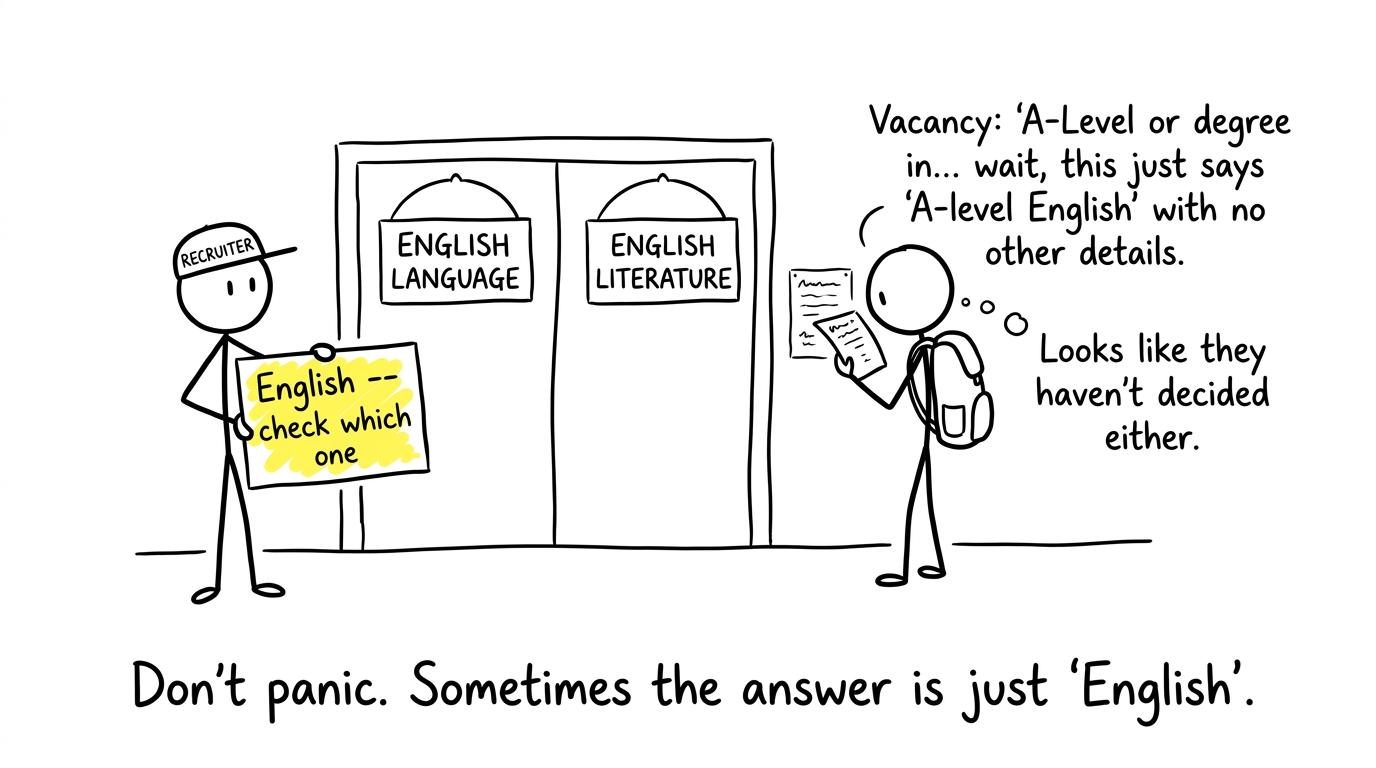 A student checks whether an apprenticeship means Language, Literature or either subject
How to read the wording in an apprenticeship advert
Small differences in phrasing matter.
“English Literature at grade 444 or above”
This is specific. Contact the recruiter before relying on English Language or Functional Skills as a substitute. Ask whether the stated subject is mandatory and request the answer in writing if possible.
“English Language or Literature at grade 444 or above”
Either named GCSE should normally satisfy the wording. Check whether the employer also accepts equivalent qualifications and whether it needs an achieved grade rather than a prediction.
“GCSE English at grade 444 or above”
This is ambiguous. It might mean Language, Literature, either subject or an older combined English qualification. Do not guess. Ask.
“Level 222 English or equivalent”
This is broader and may include GCSE English Language, GCSE English Literature or Functional Skills English at Level 222. The recruiter or provider must still confirm what it accepts for that vacancy.
“English preferred” or “English desirable”
A desirable criterion is not usually the same as an absolute entry barrier. You may still be considered, particularly if the rest of your application shows strong written communication. Essential requirements carry more weight.
Why English Literature can count as English
Literature develops close reading, interpretation, comparison and extended writing. Those abilities are useful in workplaces where apprentices must understand documents, explain decisions or communicate clearly.
Official English qualification lists for apprenticeships in England recognise more than one route to demonstrating English attainment. GCSE English Literature at grade 444 or above can be an approved Level 222 English qualification. Lower grades can also have relevance at Level 111, depending on the programme rules and the apprentice's circumstances.
For apprentices aged 161616 to 181818 when they begin, English and maths qualifications form part of the apprenticeship where suitable equivalents are not already held. The exact completion requirement depends on the apprenticeship level and applicable funding rules. Apprentices aged 191919 or over may also receive funded English or maths training where the conditions are met and the employer agrees to include it in the training plan.
This support should not be confused with guaranteed entry. An employer can still decide that a particular achieved grade is needed before employment starts.
What to do if you are short of the required grade
Missing one grade is a problem to investigate, not a reason to abandon the entire route.
Confirm what the advert really requires
Send a short, direct question to the named contact:
I have GCSE English Language at grade 444 and English Literature at grade 333. The advert asks for English Literature at grade 444. Would English Language or Level 222 Functional Skills English be accepted as an equivalent?
Include your exact qualification, subject and grade. Recruiters can answer a precise question more easily than “Are my grades OK?”
Ask whether the requirement is essential
If Literature is only desirable, apply and show evidence of the underlying skill. A well-structured application, accurate spelling and a clear explanation of your interest may strengthen your case. Never claim that a desirable criterion is irrelevant, but do not treat it as an automatic rejection either.
Discuss equivalent qualifications
Ask whether the programme accepts:
- GCSE English Language;
- GCSE English Literature;
- a combined English qualification;
- Functional Skills English at Level 222;
- another qualification listed as an approved equivalent.
An official equivalent may satisfy apprenticeship programme rules while still failing a narrower employer criterion. Confirmation from the employer and provider is therefore essential.
Consider a resit or alternative qualification
If the employer genuinely requires Literature, ask your school, college or examination centre about resitting that subject. If the requirement is broader Level 222 English, GCSE English Language or Functional Skills may be a more relevant option, depending on what the recruiter accepts.
Check the timing. A result arriving after the apprenticeship's start date may not solve an immediate admissions problem.
Apply for comparable vacancies
The same apprenticeship occupation can be advertised by employers with different entry criteria. One rejection does not define the whole route. Search for vacancies using phrases such as “English Language or Literature”, “Level 222 English” and “equivalent accepted”.
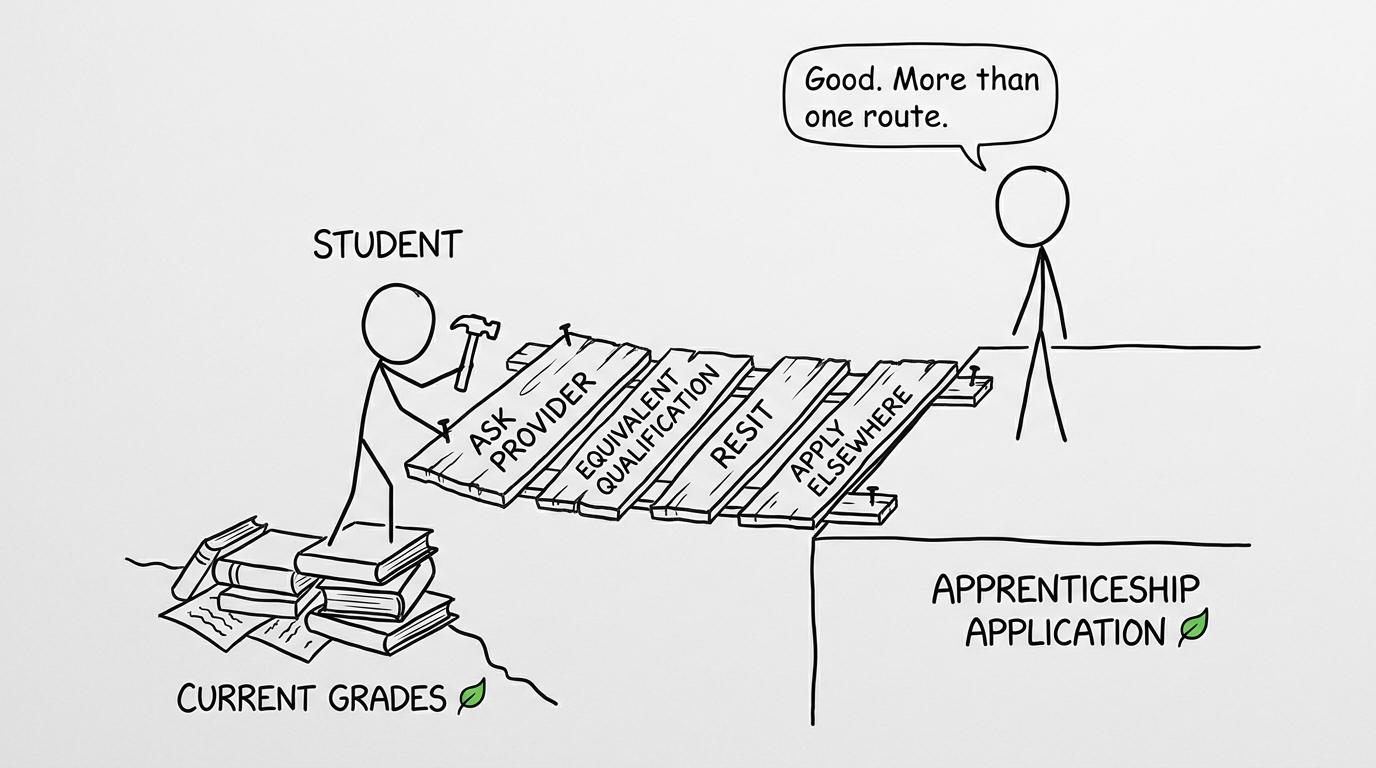 A student builds several routes from current grades towards an apprenticeship application
Do not forget the GCSE maths requirement
Students often focus on an unusual Literature condition and overlook the maths line immediately beneath it. Many advanced, higher and degree apprenticeship vacancies ask for GCSE maths at grade 444 or above, while competitive technical, engineering, digital or finance programmes may set a higher employer requirement.
Start by checking your exam board and tier. The GCSE maths revision hub includes free resources for Edexcel, AQA, OCR and Eduqas, with foundation and higher tier material.
If your current maths grade is below a vacancy's requirement, use evidence rather than guesswork. Complete a paper, mark it and identify where marks are being lost. MathsGenie's guide to using GCSE past papers properly explains how to turn each mistake into a revision target.
For shorter practice, Edexcel GCSE maths mini tests can help you retest individual skills without sitting a complete paper. If an examination is close, follow a structured one-week GCSE maths revision plan rather than trying to revise every topic at once.
Common mistakes when checking apprenticeship requirements
Treating “English” as meaning English Language
Some adverts mean Language, some accept Literature, and others accept either. The word alone is not precise enough.
Confusing an accepted qualification with a compulsory one
If a university lists English Literature as acceptable, that does not mean every applicant must have Literature. It may be one of several options.
Assuming national rules override the employer
Meeting the programme's general English rules does not guarantee that you meet a vacancy's recruitment criteria.
Rejecting yourself before asking
Ambiguous wording deserves a question, not an assumption. Contact the employer or provider before deciding you cannot apply.
Ignoring certificates and evidence
You may be asked for an examination-board certificate or official statement of results. Find your evidence early, especially if you completed the qualification several years ago.
Letting one subject consume all your revision time
English requirements matter, but so do maths, other GCSE subjects, predicted grades and the quality of your application. Use a balanced plan. If maths is your weaker condition, a GCSE maths revision timetable can keep your practice focused and realistic.
Make the requirement specific, then make a plan
The important lesson is not that GCSE English Literature never matters. It is that it matters when a specific employer, provider, university or mandatory qualification says it does.
Read the exact wording. Separate essential criteria from preferences. Ask which equivalents are accepted. If you are short of the grade, explore a resit, Functional Skills where appropriate, or another vacancy with broader entry requirements.
Then keep working on the grades you can still influence. MathsGenie gives you one free place to use revision lessons, practice questions, mini tests, past papers, predicted papers, mark schemes and video solutions. Start with the free MathsGenie revision platform, choose your exam board and tier, and turn the next lost mark into something you know how to fix.