AI Quiz GCSE Russian: Revise Safely and Effectively
AI quiz GCSE Russian revision can sharpen recall. Learn safe prompts, fact-checking habits and a practical routine that also protects your maths revision.
Revision often fails at the moment when a textbook cannot answer back. You recognise a Russian word on the page, but can you retrieve it without a clue? You understand a model answer, but could you construct your own under pressure?
An AI quiz GCSE Russian session can help with that gap. An AI tool can generate vocabulary questions, test grammar, simulate a conversation and give immediate feedback. But it is not an examiner, an official mark scheme or an infallible Russian teacher. Use it to practise retrieval and interaction, then verify anything important against your specification, teacher-approved resources and past assessment materials.
That distinction matters. A tool that sounds confident can still be wrong.
Your safe AI quiz checklist
Before beginning, keep this short checklist beside you:
- Confirm that your school permits the tool and that you meet its age requirements.
- Tell it your qualification, exam board, tier, theme and skill.
- Ask for one question at a time without revealing the answer.
- Answer from memory before requesting a hint.
- Make the tool explain corrections briefly.
- Check disputed vocabulary, grammar and marking advice independently.
- Never enter your full name, school, candidate details or personal information.
- Do not submit AI-generated work as your own.
The same discipline helps in maths. Strong revision is not passive exposure; it is an attempt, followed by reliable feedback and another attempt. The MathsGenie GCSE Maths revision hub is built around that loop through lessons, questions, papers and solutions.
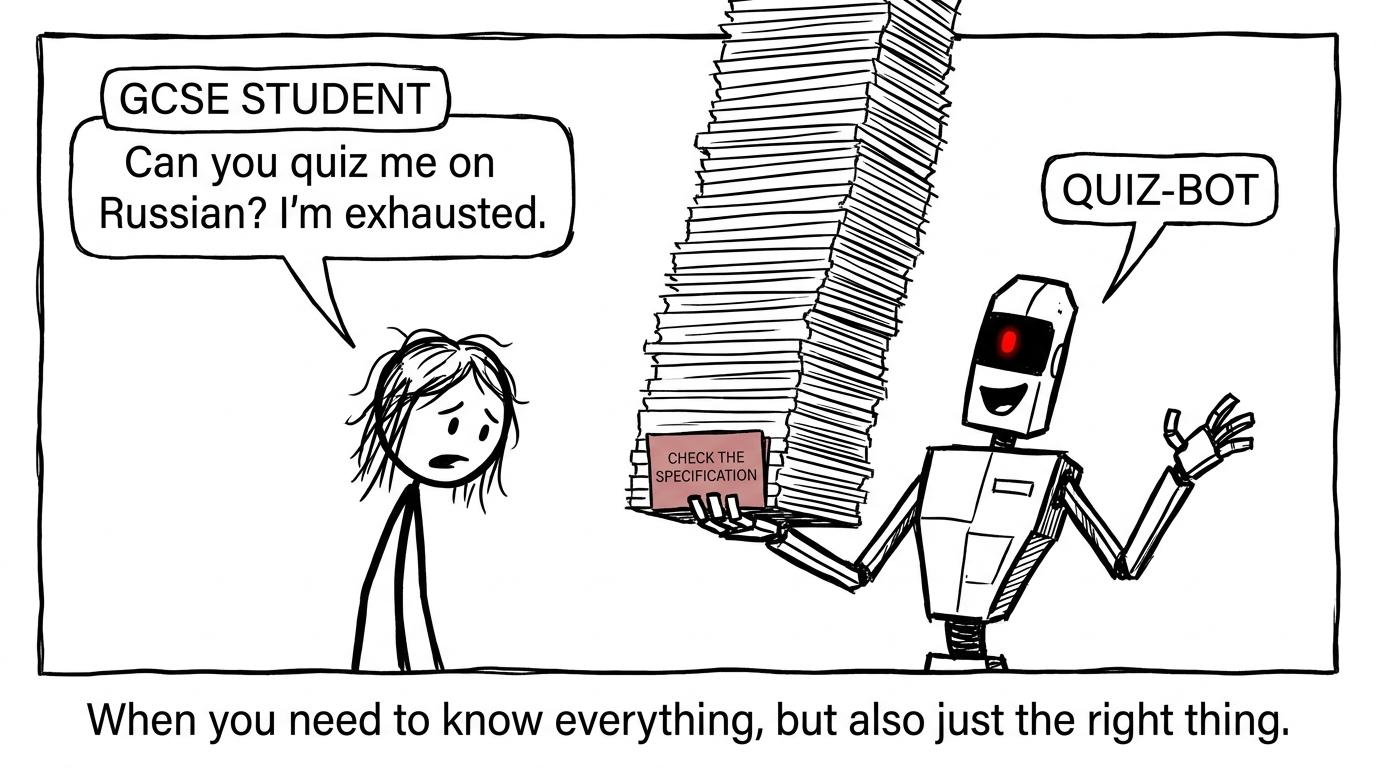 A student asks a robot for a Russian quiz and receives far too many flashcards
What an AI tool can quiz you on
Pearson Edexcel's current GCSE Russian specification, qualification code 1RU01\mathrm{RU}01RU0, assesses four skills: listening, speaking, reading and writing. Each contributes 25%25\%25% of the qualification. Foundation and Higher tiers are available, and candidates enter the same tier across all four papers. Dictionaries are not permitted in the assessments, including preparation time for speaking.
That structure gives an AI quiz a useful job, but also exposes its limits.
Vocabulary retrieval
AI is well suited to short vocabulary tests. It can give you an English meaning and ask for the Russian word, reverse the direction, test phrases in context or revisit words you previously missed.
Ask it to stay within one specification theme, such as school, identity and culture, travel, future aspirations or the international dimension. Otherwise, it may introduce obscure vocabulary that is linguistically valid but not particularly useful for your course.
Make retrieval harder gradually. Start with recognition, move to production, then require the word inside an original sentence. The goal is not to win an easy quiz. It is to discover what your memory cannot yet produce.
Grammar and sentence construction
You can ask for questions on cases, adjective agreement, verb conjugation, tense formation, word order or negation. A productive tool should let you answer before showing a correction and should identify the precise feature that needs attention.
Be cautious when it labels something as the only acceptable answer. Languages allow context, nuance and alternative phrasing. If its correction conflicts with your teacher, course materials or a trusted dictionary, investigate rather than automatically accepting the AI's verdict.
Speaking practice
A text or voice-enabled tool can play the role of a hotel employee, friend or interviewer. It can ask follow-up questions and encourage spontaneous answers, which is valuable because speaking cannot be developed by reading silently.
However, speech recognition is not the same as expert pronunciation assessment. It may misunderstand a correct accent or accept unclear pronunciation. Use it to increase how often you speak, not as the final authority on stress, sound quality or examination marks.
Reading and translation
AI can create short passages and ask comprehension questions or translations. Request language appropriate to GCSE rather than simply asking for “a Russian text”. Specify your tier, theme, approximate length and whether questions should be answered in English or Russian.
Generated texts are best treated as additional practice. Official past papers remain the better guide to authentic question formats, command words and expected difficulty.
Listening
If the tool can produce audio, it may provide useful extra listening. Ask for natural but clear speech and request a second version at a slightly faster pace. Yet synthetic audio may have unnatural stress or rhythm, so it should not replace recordings selected or produced for the qualification.
How to write a useful GCSE Russian quiz prompt
A vague request produces a vague quiz. “Test me on Russian” gives the tool too much freedom. A stronger prompt defines the boundaries and the feedback process.
You could use this reusable structure:
Act as a GCSE Russian revision quiz, not as my examiner. I am preparing for Pearson Edexcel GCSE Russian at [Foundation/Higher] tier. Test me on [theme or grammar point]. Ask one question at a time and wait for my answer. Do not reveal the answer unless I attempt the question. After each response, identify one thing I did well, correct any error briefly and keep a list of topics I should revisit. If you are uncertain, say so rather than guessing.
For speaking, add: “Ask unpredictable but specification-relevant follow-up questions.” For vocabulary, add: “Repeat missed words later in a different context.” For writing, ask it to comment separately on communication, vocabulary range and grammatical accuracy rather than awarding a confident invented grade.
This is similar to choosing a precise maths topic instead of saying, “Quiz me on algebra”. MathsGenie's guide to finding your weakest GCSE topics explains why revision improves when the target is narrow enough to diagnose.
A productive AI quiz routine
The best session is short enough to repeat and strict enough to reveal mistakes.
Start with closed-book recall
Choose one theme and answer without notes. Do not ask for multiple-choice options immediately; recognition is easier than recall. If you cannot answer, request a small hint before seeing the solution.
A focused session might contain 101010 to 151515 questions. The precise number matters less than whether you examine your errors afterwards. Maths students can use the same principle through a twenty-minute GCSE maths revision routine.
Keep an error log
Record the word, structure or skill you missed, why you missed it and the source used to verify the correction. Useful categories include:
- vocabulary not known;
- ending or agreement error;
- verb form confused;
- question misunderstood;
- answer known but not retrieved quickly;
- AI correction requiring verification.
This turns a chat transcript into a revision plan. Without an error log, every session feels new. With one, recurring weaknesses become visible.
Verify before memorising
Check questionable answers against your course vocabulary, specification-aligned materials, teacher guidance or an authoritative dictionary. This is particularly important for case endings, aspect, stress, idiom and claims about what an examiner would award.
Do not ask the tool, “Are you sure?” and treat its second confident answer as verification. Verification requires an independent source.
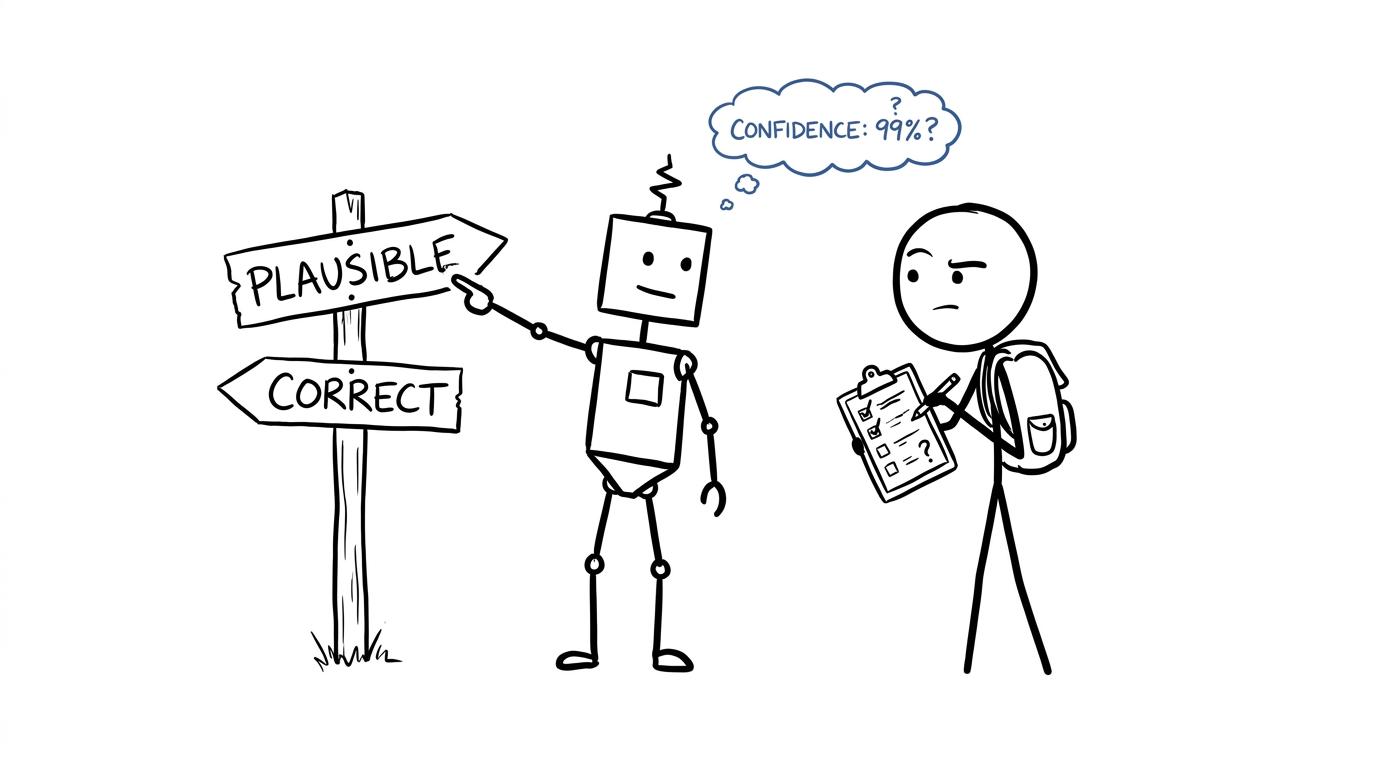 A robot confidently chooses plausible while a student looks for what is correct
Re-test after a gap
End by asking for your missed items again in a changed order. Then return on another day and test them without displaying the old conversation.
Spacing matters because immediate success can be misleading. The answer may still be sitting in your short-term memory. MathsGenie's guide to stopping GCSE content from being forgotten uses the same cycle: retrieve, check, correct and revisit.
Where AI tends to give bad information
Generative AI produces plausible language rather than guaranteed truth. Department for Education guidance warns that outputs may be inaccurate, biased, unsafe, out of date or detached from the curriculum. It can also present invented information as fact, often called a hallucination.
For GCSE Russian, be particularly careful when AI:
- invents an official vocabulary requirement;
- confuses Foundation and Higher expectations;
- claims that a particular phrase guarantees a grade;
- fabricates a quotation from a specification or examiner report;
- gives unreliable stress or pronunciation guidance;
- overlooks a valid alternative translation;
- applies a grammar rule without considering context;
- awards marks using a made-up scheme;
- describes an old assessment format as current.
Ask the tool to admit uncertainty and provide the exact basis for syllabus claims. Even then, check those claims yourself. A citation can also be invented or misrepresented.
The principle is familiar in maths: an answer is not reliable merely because it is presented neatly. You check it against a correct method, mark scheme or video solution. Edexcel GCSE Maths past papers place official papers and mark schemes together so that feedback has a trustworthy reference point.
Common mistakes when using an AI quiz
Letting the tool answer too quickly
If you reveal every answer after a few seconds, the AI becomes an animated revision guide rather than a quiz. Attempt first. Request hints in stages.
Revising outside the specification
Interesting Russian is not always useful GCSE Russian. Give the tool a theme, tier and skill, and compare its choices with your current course.
Trusting an invented mark
AI feedback may help you notice patterns, but it cannot replace your teacher or an official mark scheme. Ask for descriptive feedback rather than a grade prediction.
Copying polished answers
Reading a sophisticated response can create the feeling that you could have written it. Instead, close the response and produce your own version from memory.
JCQ guidance requires submitted assessment work to be a student's own. AI tools cannot be used in examinations or other assessments where the rules prohibit them, and unacknowledged AI-generated work can constitute malpractice. Follow your teacher's instructions and your centre's policy.
Sharing personal information
Do not paste candidate numbers, teacher comments, identifiable schoolwork or private conversations into a public tool. Use a school-approved service where required and follow its age restrictions.
Allowing Russian revision to consume maths time
A responsive quiz can keep producing questions forever. Set an end time. GCSE revision has competing priorities, and a timetable protects them. The MathsGenie revision timetable guide can help you balance lessons, practice and timed papers across the week.
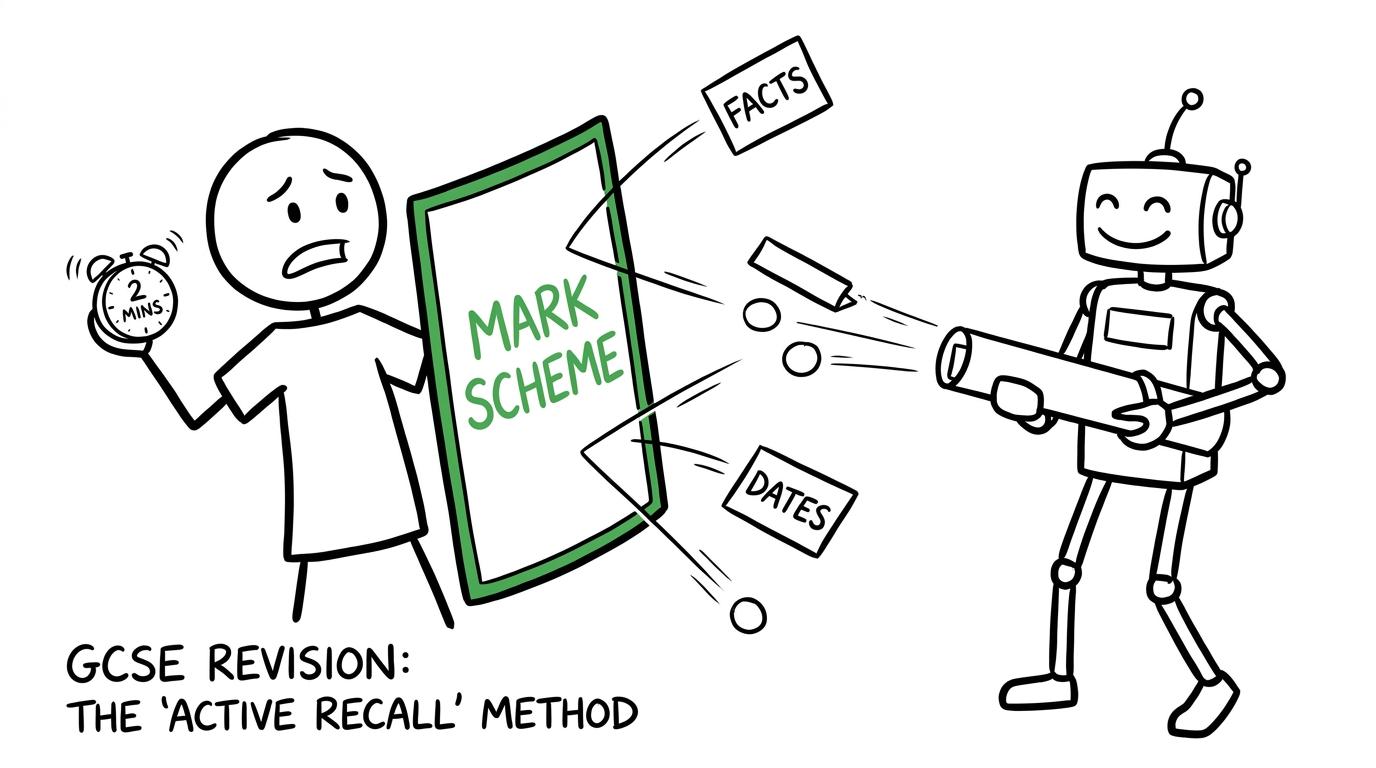 A student uses a timer and mark scheme to defend against a robot firing endless flashcards
Use AI as a practice partner, not a source of truth
An AI quiz is most useful when it creates effort. It asks the next question, changes the context and makes you retrieve a word before you feel ready. Its speed is an advantage. Its confidence is not.
Build every session around a simple sequence: specify the course, answer from memory, record errors, verify corrections and re-test later. Keep official materials and human expertise above generated feedback.
Then bring the same habit back to maths. Choose one weakness, learn the method, complete practice questions, mark them honestly and revisit the mistake. Start with MathsGenie's free GCSE maths revision resources, then build exam readiness with revision lessons, mini tests, practice questions, past papers, predicted papers, mark schemes and video solutions. The tool may begin the quiz, but improvement comes from what you do after getting an answer wrong.