AI Quiz GCSE Geography: How to Use It Safely
AI quiz GCSE geography guidance for productive self-testing, safer prompts, fact-checking and linking geographical skills with GCSE maths revision.
Revision can feel convincing without being useful. You read a case study, recognise every heading and assume the knowledge is secure. Then someone asks you to explain it without notes, and the details disappear.
An AI quiz GCSE geography session can help close that gap. Yes, you can ask an AI tool to test you with specification-matched questions, give one question at a time and revisit weak areas. But you should not trust it as an examiner, mark scheme or source of current facts. The productive approach is simple: let AI generate retrieval practice, while your specification, class materials and official mark schemes remain the authority.
Your quick AI geography quiz checklist
Before starting, make sure you can answer yes to these questions:
- Do you know your exam board and specification?
- Have you named the exact topic and case studies you studied?
- Will the tool ask one question at a time rather than reveal everything?
- Have you told it not to invent missing facts?
- Can you check its answers against trusted materials?
- Will you record weak topics and test them again later?
- Are you avoiding personal information and assessed work?
That final distinction matters. AI can be a useful revision partner. It should not become the person doing the thinking.
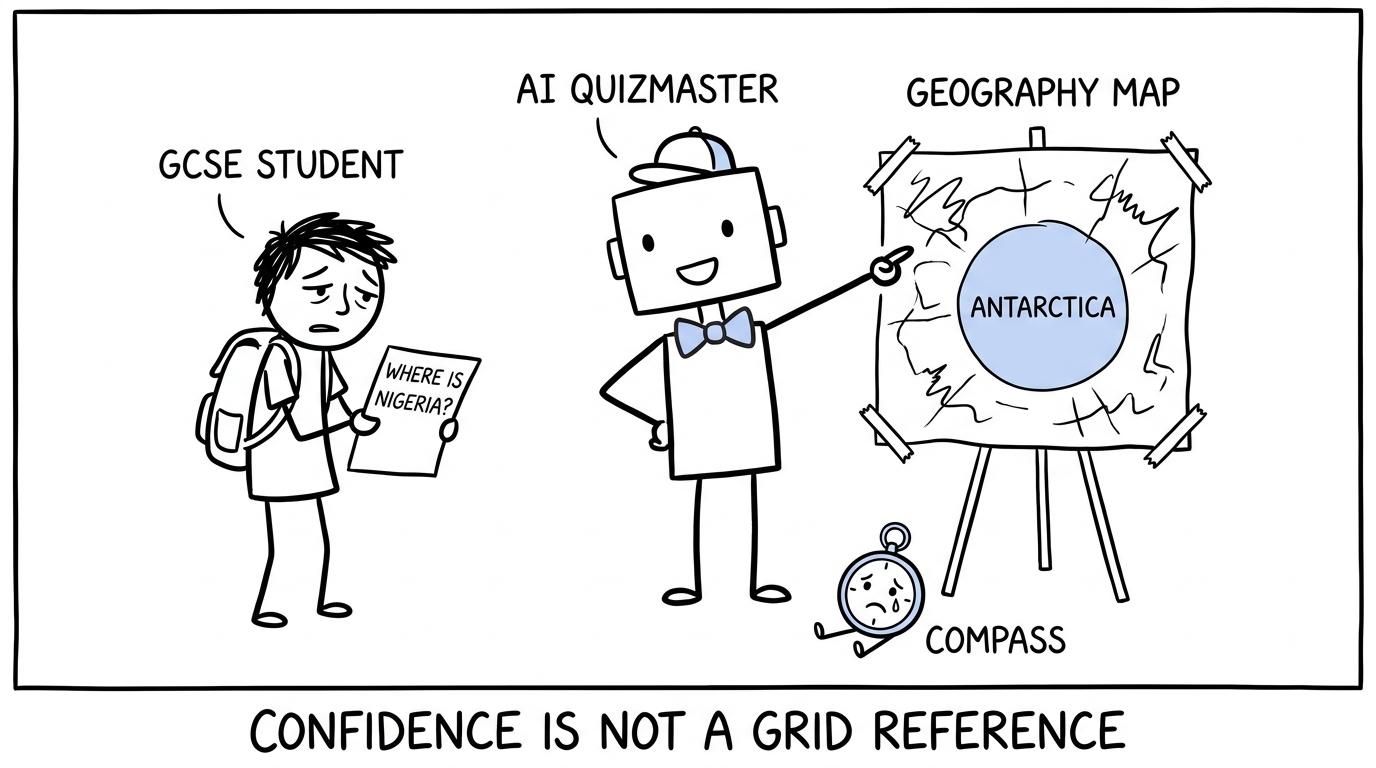 A robot confidently misplaces a map while a student checks its answer
What an AI quiz can do well
AI tools are useful when the task is narrow and easy to verify. They can turn a topic list into short-answer questions, shuffle definitions, alternate physical and human geography, or return to facts you previously missed.
This is particularly helpful for retrieval practice. Instead of rereading a page on river processes, you close the notes and retrieve terms, sequences and explanations from memory. The effort is not evidence that revision is failing. It is the part that makes the session useful.
A well-directed tool can quiz you on:
- definitions and geographical vocabulary;
- sequences within physical processes;
- causes, effects and management strategies;
- comparisons between places;
- fieldwork methods, limitations and improvements;
- map, graph and data interpretation;
- the specific case studies selected by your school.
GCSE Geography specifications from AQA, Pearson Edexcel, OCR and Eduqas include a mixture of knowledge, understanding, application, evaluation and geographical skills. The balance and paper structure vary. That is why asking for a generic “GCSE geography quiz” is weaker than naming your board, specification, component and topic.
How to create a productive AI quiz GCSE geography session
Give the tool a precise boundary
Start by stating your exam board and the material you want assessed. A useful instruction might be:
Quiz me on the coastal landscapes section of my GCSE Geography specification. Ask one question at a time. Begin with recall, then move to application and evaluation. Do not introduce case studies unless I name them. If information is uncertain, say so rather than guessing.
You can then provide a short teacher-approved topic checklist. Avoid pasting personal data, unpublished assessed work or large sections of copyrighted textbooks into a public tool. Department for Education guidance warns that generative AI systems can retain input data, may not be aligned with the curriculum and can produce false information confidently. Follow your school’s policy and use an age-appropriate, school-approved service where possible.
Make yourself answer before receiving help
Tell the tool not to show a model response immediately. A stronger sequence is:
- it asks one question;
- you answer without notes;
- it identifies what appears secure or incomplete;
- you check the feedback against your notes or mark scheme;
- it asks a related question later.
You can also ask for hints in stages. The first hint might identify the relevant concept; the second might offer a sentence starter. This preserves some of the useful struggle instead of turning the session into assisted copying.
Separate recall from exam practice
Short AI questions can build knowledge, but geography papers also require interpretation, judgement and extended writing. Use different modes deliberately:
- Recall mode: terminology, locations and factual details.
- Connection mode: links between causes, processes and consequences.
- Data mode: interpretation of figures, maps and unfamiliar resources.
- Evaluation mode: weighing evidence and reaching a justified conclusion.
- Fieldwork mode: methods, sampling, risk, presentation, conclusions and limitations.
An AI tool may create all five, but it is usually most dependable for the first two. For extended answers, an official mark scheme and teacher feedback carry more weight than an AI-generated score.
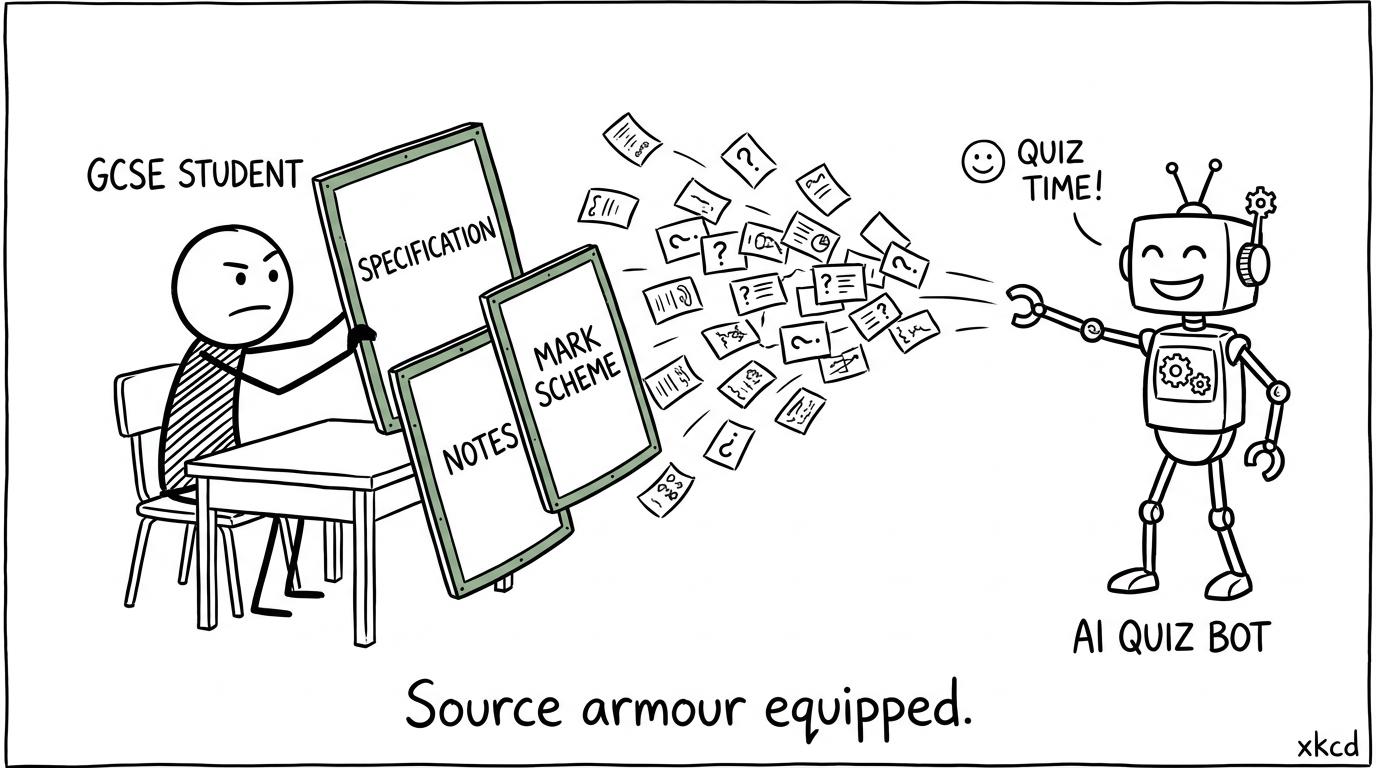 A student uses specification notes and a mark scheme as source armour
Where AI tends to give bad geography information
It invents plausible case-study details
A fabricated date, population figure or management scheme can sound completely believable. This is especially risky when different schools use different located examples. Tell the tool exactly which case study you studied and supply only the key facts already approved in your notes.
Treat every precise statistic as unverified until you check it. More detail does not automatically mean more accuracy.
It mixes specifications and exam boards
A topic may appear under different components, choices or question styles across AQA, Edexcel, OCR and Eduqas. AI can blend these into a confident but imaginary universal course. Keep your official specification beside you and ask the tool to identify which supplied bullet point each question tests.
It marks extended answers too generously
Generative AI often rewards fluent writing even when geographical evidence is thin. It may overlook an unsupported judgement, vague place detail or failure to use the resource provided. It can also claim that one rigid paragraph structure is required when examiners actually reward the content described by the level descriptors.
Use AI feedback diagnostically: ask what evidence is missing or which claim needs justification. Do not treat its mark as official.
Its “current” facts may be outdated
Population, economic, climate and policy information can change. AI may combine information from different years without making the difference clear. Verify time-sensitive facts through your teacher’s materials and authoritative sources before learning them.
It can misunderstand diagrams and fieldwork context
A tool may misread axes, overlook units or assume a fieldwork method that your class did not use. Your own fieldwork enquiry is specific. Revise what you actually investigated, how the data were collected and what limitations genuinely applied.
Use geography quizzing to strengthen GCSE maths
Geography contains more mathematics than it first appears to. Maps involve ratio and unit conversion. Fieldwork uses sampling, averages and graphs. Data-response questions may require percentages, rates and comparisons.
Useful relationships include:
percentage change=new value−original valueoriginal value×100\text{percentage change}=\frac{\text{new value}-\text{original value}}{\text{original value}}\times 100percentage change=original valuenew value−original value×100and
mean=total of the valuesnumber of values.\text{mean}=\frac{\text{total of the values}}{\text{number of values}}.mean=number of valuestotal of the values.When an AI quiz includes a calculation, do not accept its final answer automatically. Check the method, units, rounding and whether the original value has been used correctly.
Maths Genie has a dedicated GCSE Geography numerical and statistical skills guide covering percentages, ratios, averages, spread and geographical data. You can also strengthen map work through the scale drawings revision lesson and AQA scale drawing practice questions.
For broader data skills, use the GCSE Statistics revision hub. If uncertainty and expected outcomes are weak, revisit the GCSE probability revision guide. The goal is not to replace geography with maths revision. It is to prevent a manageable calculation from costing you geography marks.
Build a revision loop rather than a one-off quiz
A single quiz tells you what happened today. A revision loop changes what you remember next week.
After each session, sort questions into three groups:
- Secure: answered accurately without help.
- Uncertain: broadly correct but missing precision or evidence.
- Weak: incorrect, guessed or dependent on hints.
Revisit uncertain and weak questions after a gap. Change the wording so that you retrieve the idea rather than memorise the previous answer. If the tool keeps asking easy questions, request mixed difficulty and unfamiliar contexts.
This same diagnose to repair to retest cycle is valuable for maths. The best order to learn GCSE maths topics helps you organise gaps, while a one-month GCSE maths revision plan turns them into a realistic routine.
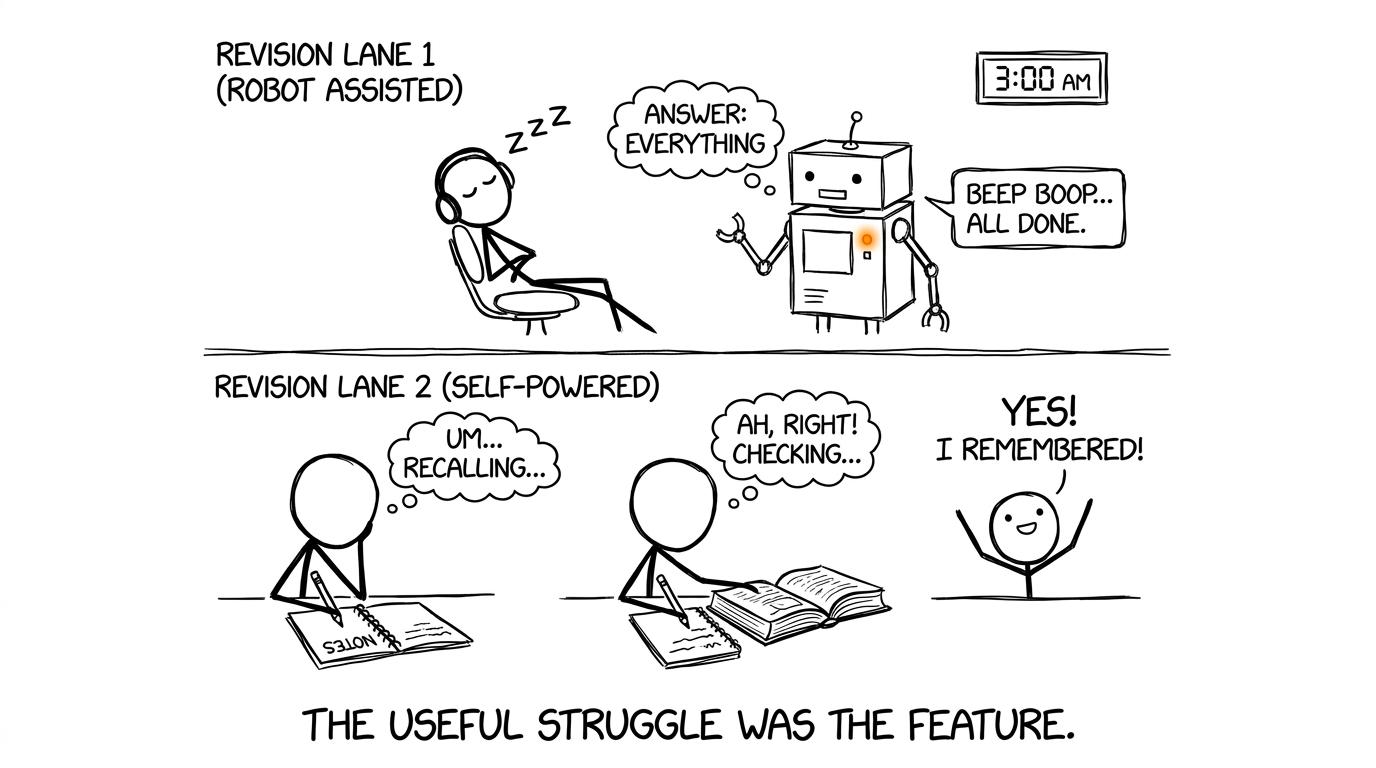 One student passively watches AI while another retrieves and checks knowledge
Common mistakes when using AI for revision
Letting the tool choose the curriculum: Start from your specification and school topic list, not from whatever the model remembers.
Reading answers instead of retrieving them: Recognition feels easy but does not prove that you can produce an answer in an exam.
Learning unverified statistics: Check dates, figures, locations and named schemes before adding them to flashcards.
Accepting an AI mark: Use official mark schemes and teacher feedback for reliable assessment decisions.
Ignoring command words: “Describe”, “explain”, “assess” and “evaluate” require different kinds of response. Ask for questions using the wording found in your specification and papers.
Sharing personal information: Do not enter names, school details, private fieldwork data or identifiable student work into an unapproved service.
Using AI in assessed work without permission: JCQ guidance requires submitted assessment work to be your own. AI tools are not permitted in an examination, and unauthorised or unacknowledged use in assessment can constitute malpractice. Ask your teacher if any doubt remains.
Make AI the quizmaster, not the authority
The best use of an AI geography quiz is modest. It asks. You think. It challenges. You verify.
That division of labour matters because exams reward your knowledge and judgement, not the tool’s fluency. Keep your specification, class notes and official mark schemes at the centre, and use AI to create frequent opportunities to retrieve what you have learned.
Then carry the same habit into maths. Use Maths Genie’s free revision lessons and practice questions to repair weak topics, mini tests to check recall, and past papers, predicted papers, mark schemes and video solutions to build exam readiness. If you are approaching paper practice, the guide to when to start GCSE past papers will help you choose the right moment, while Edexcel GCSE Maths predicted papers provide structured practice under timed conditions.
AI can supply another question. Maths Genie helps you turn the answer into lasting progress.