AI Quiz GCSE Chinese: A Productive Revision Guide
AI quiz GCSE Chinese revision can test vocabulary, reading and speaking. Learn how to write better prompts, check answers and avoid unreliable feedback.
Revision often begins with a simple problem: you know you should test yourself, but nobody is available to ask the questions. An AI quiz GCSE Chinese session can solve that problem quickly. Give an AI tool your exam board, tier, topic and vocabulary list, then ask it to quiz you one question at a time without revealing each answer too soon.
That can be genuinely useful for vocabulary retrieval, character recognition, translation and speaking prompts. But AI is a quiz partner, not an examiner. It can invent vocabulary, mishandle tones, accept unnatural Chinese and produce feedback that does not match your specification or mark scheme. Productive use therefore has two parts: answer from memory, then verify anything important against trusted course materials.
Your quick AI quiz checklist
Before starting, make sure the tool knows:
- your exam board and exact qualification;
- whether you are taking foundation or higher tier, where applicable;
- the topic or theme you want to revise;
- which skill you want to test: listening, speaking, reading or writing;
- whether you use simplified or traditional characters;
- the approved vocabulary or source material it must follow;
- that questions should appear one at a time;
- that answers and corrections must be hidden until you respond.
Keep your specification, school vocabulary list and teacher feedback beside you. If the AI disagrees with one of those sources, do not assume the AI wins.
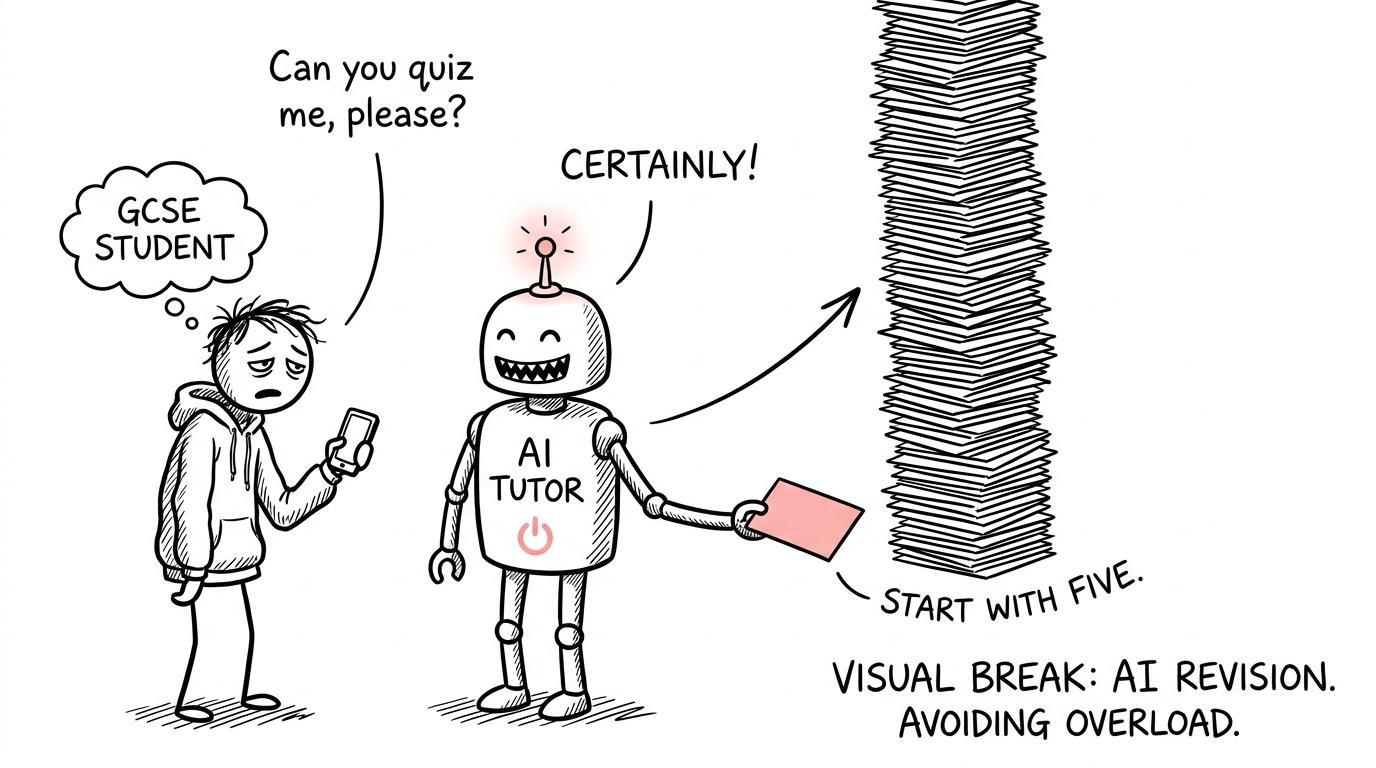 A GCSE student asks an AI robot for five flashcards and receives an enormous stack
What can an AI tool quiz you on in GCSE Chinese?
The strongest use of AI is retrieval practice. Instead of rereading a vocabulary page, you have to pull an answer from memory. That effort reveals what you actually know.
Vocabulary and character recognition
Ask for English-to-Chinese, Chinese-to-English or character-recognition questions based only on a vocabulary list you provide. You can also request distractors, missing-character questions or mixed-topic recall.
For tighter control, tell the tool not to introduce synonyms outside your list. This matters because a perfectly valid Chinese word may still be inappropriate for your course, unfamiliar at GCSE level or written in a different character system.
Reading and translation
AI can generate short passages followed by comprehension questions. It can also test translation in both directions. Specify the approximate difficulty, theme and vocabulary source, and ask it to separate factual understanding from inference.
Treat generated passages as practice material rather than authentic exam questions. Official papers have been written and checked under an awarding organisation's assessment process; an AI-generated passage has not.
Speaking preparation
An AI tool can act as an interviewer, provide conversation prompts and ask unpredictable follow-up questions. This is helpful when you need to practise responding without a script.
If the tool supports audio, it may also let you rehearse listening and pronunciation. However, do not treat automatic pronunciation judgements as definitive. Mandarin tones, pacing and natural expression require careful feedback, and the quality of speech recognition varies. Check uncertain feedback with your teacher or another trusted speaker.
Grammar and writing recall
You can ask the tool to test word order, time expressions, opinions, connectives, comparisons and the structures listed in your course materials. A useful quiz makes you produce language before showing a model response.
Avoid asking AI to write an entire answer for you to memorise. A polished paragraph can create the feeling of progress while doing most of the thinking on your behalf. The better approach is to write independently, request narrowly focused feedback, and decide which corrections are supported by your notes.
Match every quiz to your specification
“GCSE Chinese” is not one universal checklist. AQA GCSE Chinese (Mandarin), for example, assesses listening, speaking, reading and writing across three broad themes. Pearson Edexcel organises its Chinese qualification around five themes. Topic labels, prescribed content and assessment details can therefore differ.
Start by checking the current specification for your exam board and qualification. Then give the AI the relevant theme, vocabulary and skill. Do not merely ask for “a hard GCSE Chinese quiz”. The tool may blend exam boards, use content from another course or judge difficulty inconsistently.
A controlled prompt could say:
Quiz me on my GCSE Chinese vocabulary for the topic of school. Use only the list I paste below. Show one question at a time, wait for my answer, and do not reveal the correction beforehand. Keep a list of my errors and retest them at the end. Use simplified characters and include pinyin only after I answer.
This is not magic wording. It is simply a clear contract. The smaller and more specific the task, the easier it is to notice when the tool goes wrong.
Use a revision loop rather than a chatbot conversation
A long conversation with an AI can feel productive because something is always happening. Yet activity and learning are not the same thing. A reliable session needs a repeatable loop.
Choose one narrow target
Select one theme, one grammar feature or a short set of vocabulary. Do not combine every skill in every session. A narrow target makes your errors visible.
Answer before asking for help
Type or say a complete response from memory. Do not ask for a hint immediately. If you cannot answer, record that as useful evidence rather than treating it as failure.
Make the tool explain its judgement
After answering, ask the AI to distinguish between:
- an incorrect meaning;
- an incorrect character;
- a grammar problem;
- an unnatural but understandable expression;
- an alternative answer that may also be acceptable.
Then request a short reason. Explanations make questionable feedback easier to detect.
Verify and record
Check corrections against your specification vocabulary, textbook, class notes or teacher guidance. Add genuine errors to a short revision list. If a correction cannot be verified, label it “check with teacher” rather than learning it automatically.
Retest without support
Finish by asking for only the questions you missed, in a different order and without pinyin or hints. Return to them on another day. The goal is not to complete a chat; it is to remember the language when the chat is gone.
This same diagnose, practise, mark, repair rhythm is valuable in maths. MathsGenie's guide to using GCSE past papers properly explains why the learning often happens after a test, when mistakes are classified and repaired.
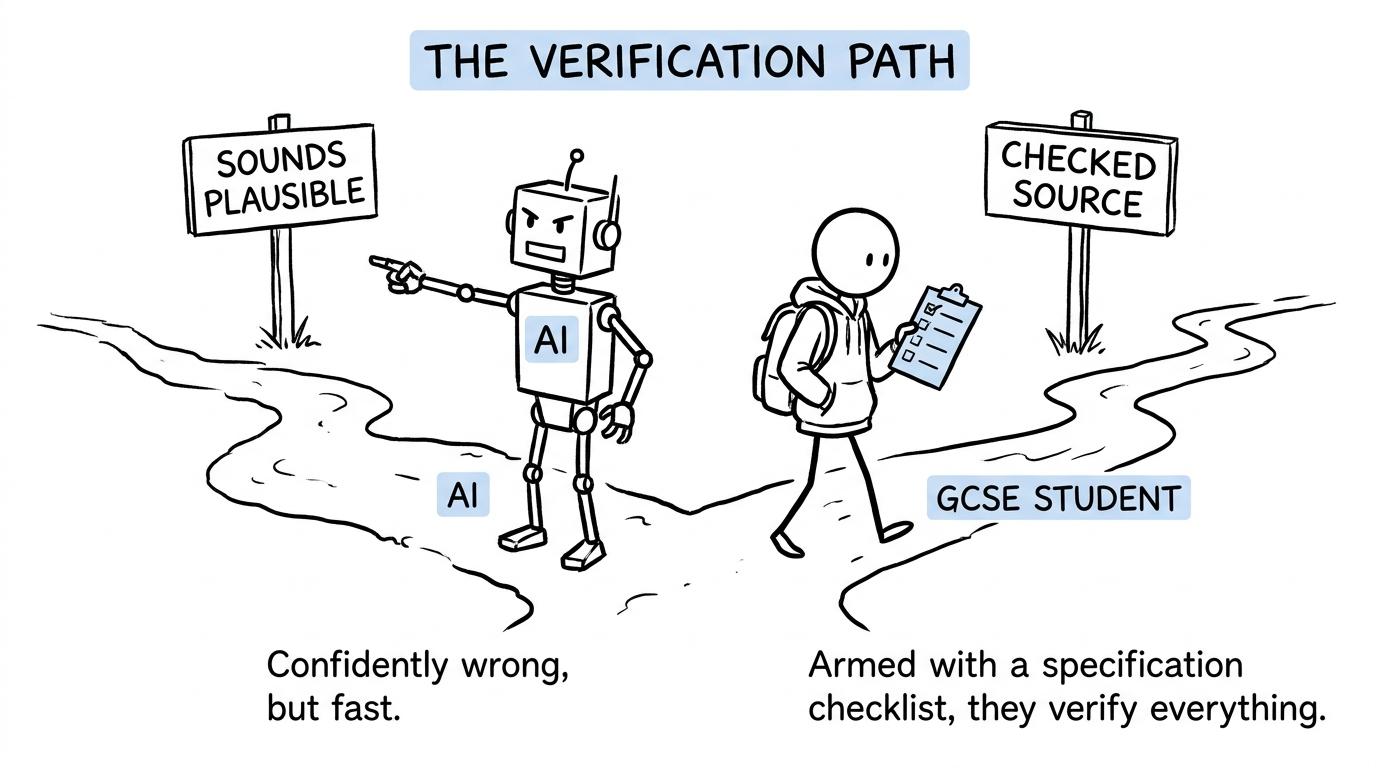 An AI confidently chooses the plausible route while a student checks the source
Where an AI quiz tends to give bad information
AI language can sound fluent and certain even when the content is wrong. Watch particularly carefully in the following areas.
Vocabulary scope and character forms
A tool may introduce advanced words, regional usage or a mixture of simplified and traditional characters. It may also claim that only one translation is correct when several natural answers exist. Tell it which character system and source list to use, then verify unfamiliar words.
Pinyin, tones and pronunciation
Incorrect tone marks or weak pronunciation feedback can reinforce mistakes. Text-only tools cannot hear you at all, while voice-enabled tools can misrecognise speech. Use audio quizzing as rehearsal, not as the final authority on pronunciation.
Grammar and naturalness
AI may accept a sentence because its intended meaning is obvious, even though the wording is unnatural. It can also “correct” a valid sentence into its preferred version. Ask whether your answer is grammatically wrong, merely unusual or simply different from the model.
Exam-board marking
A chatbot should not predict your mark as though it were an official examiner. It may apply generic language advice rather than the assessment criteria for your paper. Use official mark schemes, teacher feedback and exemplars when judging exam performance.
Cultural and factual claims
Generated passages can contain oversimplified or inaccurate statements about Chinese-speaking communities. If a quiz introduces a fact that you have not seen in reliable course material, check it before repeating it in an answer.
Common mistakes when using AI for GCSE Chinese revision
Letting the AI show answers too early. Recognition is easier than recall. Make it wait until you have committed to an answer.
Using an unspecified “GCSE level”. Name your board, qualification, tier where relevant, theme and skill. Otherwise, the quiz may not resemble your course.
Trusting confident corrections. Confidence is a feature of the writing style, not proof of accuracy. Verify vocabulary, characters, tones and marking claims.
Pasting personal or sensitive information. Do not include your full name, school details, candidate information, private feedback or live assessment material. Follow your school's rules and the tool's age and privacy requirements.
Submitting AI-produced work as your own. Current JCQ guidance requires assessed work to be the student's own and treats misuse of AI as potential malpractice. Use AI for low-stakes practice, not to produce work you are expected to create independently. Ask your teacher if you are uncertain about an assessment.
Revising only through AI. A chatbot cannot replace authentic listening, teacher feedback, specification vocabulary or official past papers. It is one tool within a wider plan.
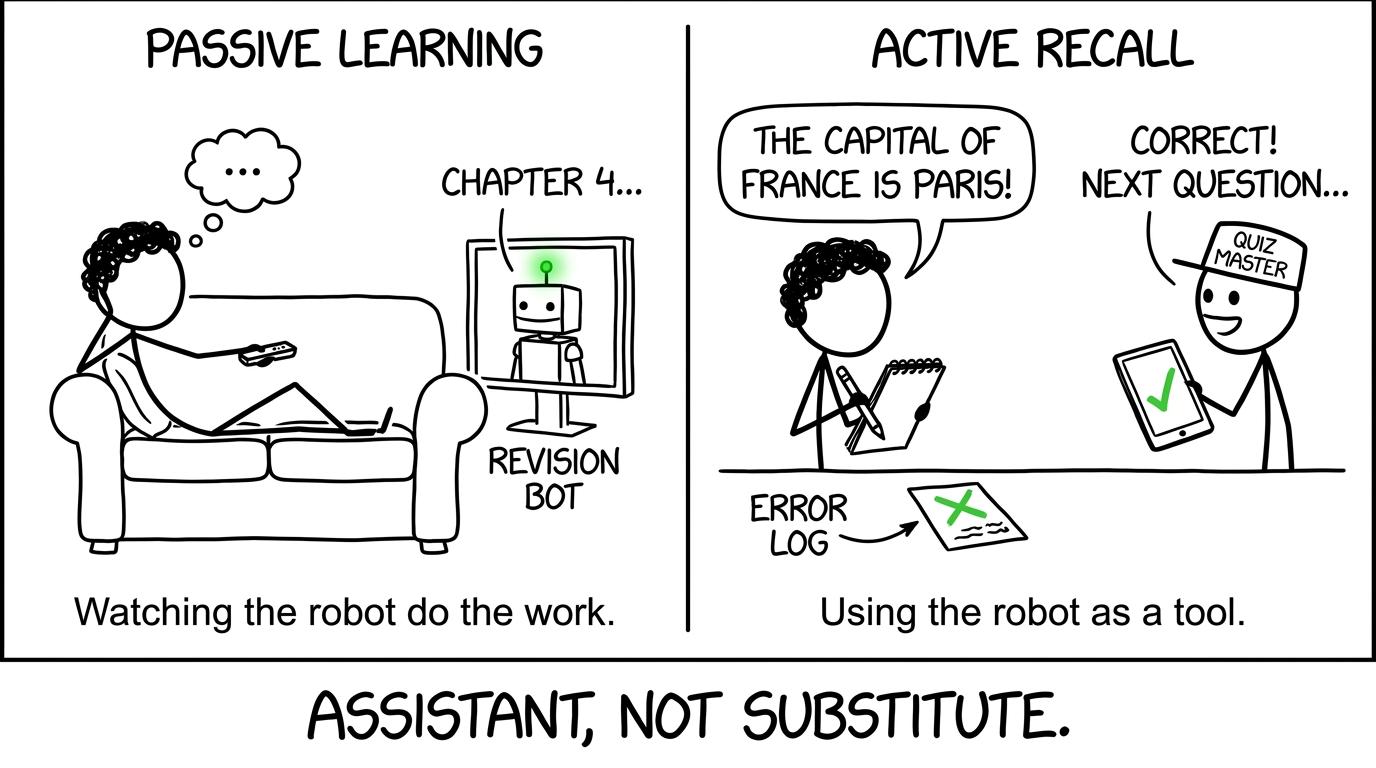 A student does the recalling while an AI acts as assistant rather than substitute
Bring the same method back to GCSE maths
Chinese and maths test different knowledge, but effective revision shares a structure: retrieve, check, diagnose and repeat. AI can ask questions, yet your official materials must remain the reference point.
For maths, begin with the MathsGenie GCSE and A Level revision hub, where teaching and practice are organised around the UK curriculum. Use GCSE predicted papers for fresh exam-style practice, while remembering that predictions supplement rather than replace official papers.
The MathsGenie past papers library helps you work with papers and mark schemes together. If you need a timetable, the one-week GCSE maths revision plan turns weak topics into daily actions. Students unsure when to introduce full papers can also read when to start GCSE past papers.
The principle is simple. Let a quiz expose the gap, then use an authoritative lesson or mark scheme to close it. If your maths grade feels stuck, MathsGenie's pass-grade revision advice provides a focused learn, practise, mark, fix cycle.
Make AI the assistant, not the source of truth
Yes, you can use an AI tool to quiz yourself on GCSE Chinese. It is most productive when the questions are narrow, based on material you supply and followed by independent checking. It is least reliable when you ask it to invent an entire course, assess pronunciation with certainty or award marks without an official mark scheme.
Keep the thinking on your side of the screen. Answer first. Check carefully. Record errors. Return later without hints.
Then apply the same discipline to your maths revision with MathsGenie's free revision lessons, practice questions, mini tests, past papers, predicted papers, mark schemes and video solutions. Start with one weak area today, test it honestly, and let the correction shape what you practise next.