Active Recall for GCSE Statistics: Does It Work?
Active recall GCSE statistics explained: why retrieval beats rereading and how to build an effective revision routine for graphs, formulae and questions.
A statistics page can feel familiar without being usable. You recognise the histogram formula, remember seeing cumulative frequency before and feel that box plots make sense. Then the notes close, an exam question appears, and the method vanishes.
That gap is exactly what active recall GCSE statistics revision is designed to address. Active recall means attempting to retrieve knowledge or a method from memory before checking your notes. Evidence from classroom research generally suggests that this kind of retrieval is more effective for long-term retention than simply rereading material. For statistics, however, it works best when recall leads into genuine exam questions, feedback and correction, not when it becomes a pile of definition flashcards.
The active recall checklist
A useful GCSE Statistics routine is simple:
- Choose one small topic, such as sampling, averages or histograms.
- Close your notes and retrieve the key facts, formulas and decisions.
- Answer a question without prompts.
- Check the answer using a mark scheme or video solution.
- Record the precise reason for any lost marks.
- Reattempt the question after a gap.
- Mix it with questions from other statistics topics later.
Start by choosing the right area from the GCSE Statistics revision hub. The aim is not to prove how much you know. It is to discover what your memory can produce independently, while there is still time to improve it.
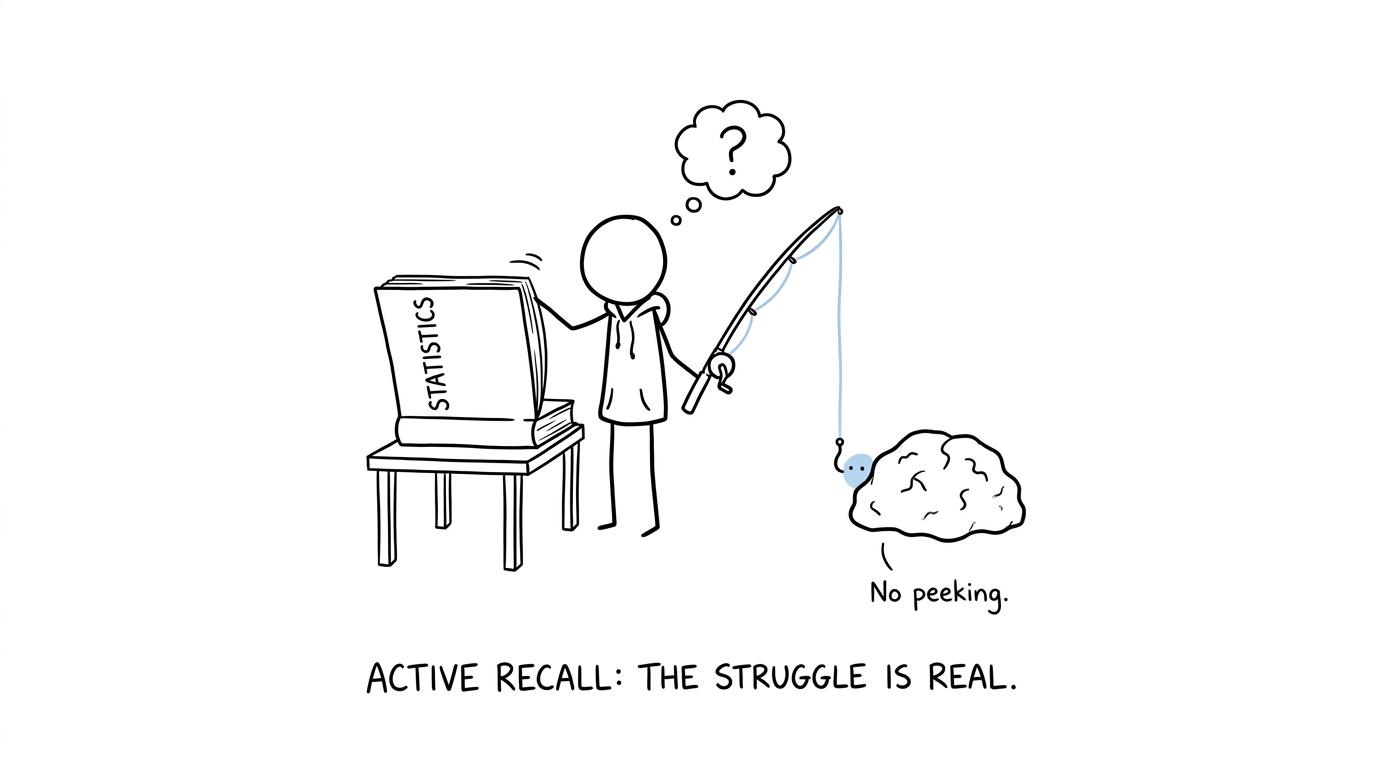 A student tries to retrieve a statistics fact without peeking at the book
What active recall actually means in statistics
Active recall is sometimes reduced to turning every sentence into a flashcard. That is too narrow for maths.
A GCSE Statistics exam tests several kinds of knowledge:
- Factual knowledge: definitions such as population, sample, bias, correlation and interquartile range.
- Procedural knowledge: how to estimate a mean, construct a cumulative frequency graph or calculate frequency density.
- Selection knowledge: deciding which graph, average or sampling method is appropriate.
- Interpretation: explaining a result in context and recognising the limitations of a conclusion.
Your revision should retrieve all four. A flashcard might ask you to recall
frequency density=frequencyclass width,\text{frequency density}=\frac{\text{frequency}}{\text{class width}},frequency density=class widthfrequency,but an exam-style question checks whether you recognise when the formula is needed, identify the correct class width and communicate the result accurately. Knowing the words is valuable. Being able to use them independently is what earns marks.
This is why the strongest version of active recall has two layers: short memory prompts followed by practice questions. The Edexcel GCSE Statistics revision page, for example, brings topic resources and exam practice together so retrieval does not remain detached from the specification.
Why active recall tends to beat rereading
Rereading is not useless. It can introduce a topic, clarify a difficult method or help you correct an error. The problem is that recognition feels remarkably similar to mastery.
When the formula is visible, each step seems obvious. When a completed graph is in front of you, its scale seems natural. That feeling does not tell you whether you could reconstruct the method tomorrow.
Retrieval removes the support. It forces you to answer a more honest question: Can I bring this idea to mind when the page is blank?
Research reviews of retrieval practice in schools and classrooms generally report positive effects on learning compared with restudy. Recent Education Endowment Foundation guidance also treats short, low-stakes quizzes as a promising way to strengthen retention and expose misconceptions. Yet the evidence calls for some restraint: implementation matters, classroom studies vary, and recalling isolated facts is not automatically enough for complex mathematical problem-solving.
So active recall should not replace explanation, guided learning or exam practice. It should connect them. Retrieve first, apply next, then use feedback to repair the gap.
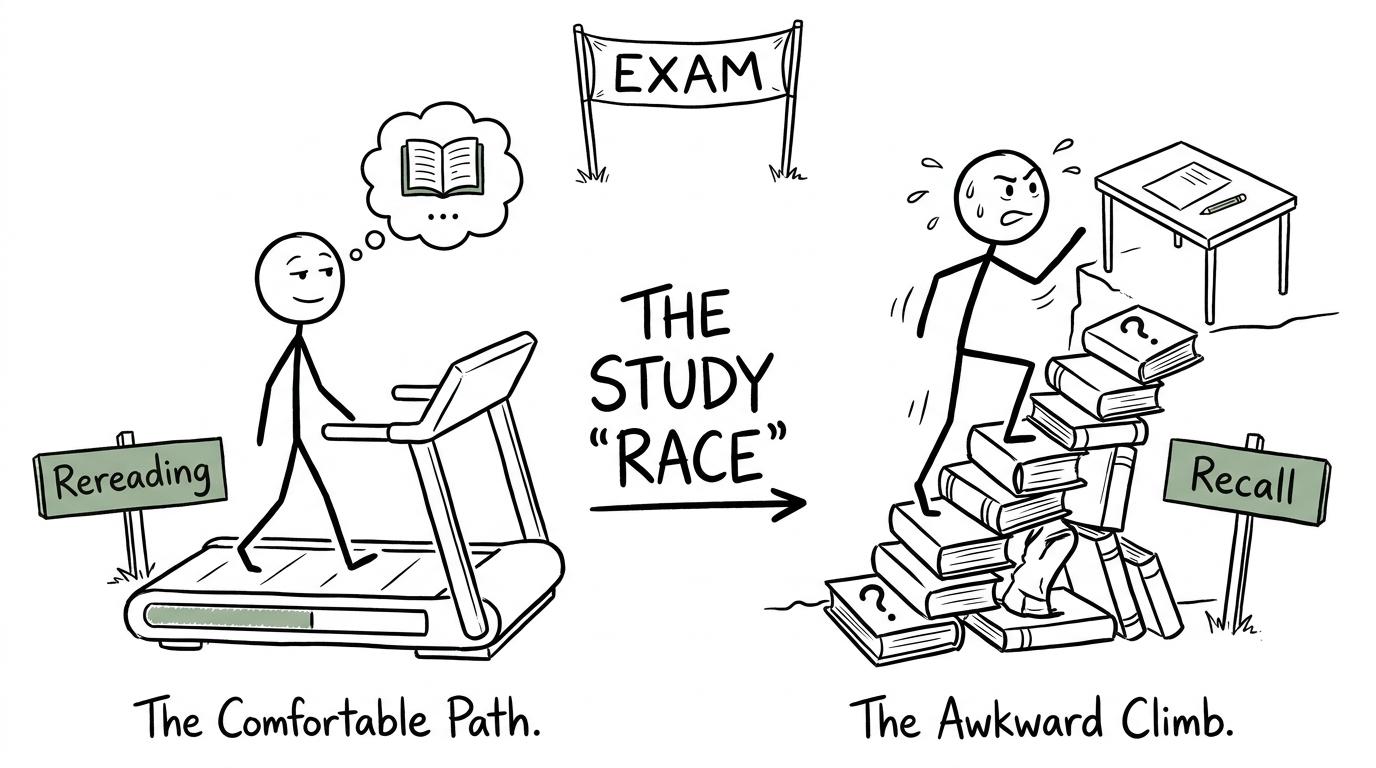 A comfortable rereading treadmill competes with an awkward recall staircase
How to apply active recall to GCSE Statistics
Retrieve definitions as contrasts
Statistics contains pairs of ideas that are easily blurred together. Rather than recalling each definition alone, ask yourself to explain the difference between:
- population and sample;
- discrete and continuous data;
- primary and secondary data;
- correlation and causation;
- interpolation and extrapolation;
- frequency and cumulative frequency;
- range and interquartile range.
Contrast questions make weak understanding visible. If you can state two definitions but cannot explain why one applies to a particular investigation, the knowledge is not yet exam-ready.
Retrieve formulas with their meaning
Do not make a formula card containing only symbols. The reverse should ask what every quantity represents, when the formula applies and what common error to avoid.
Useful prompts include:
estimated mean=∑fx∑f,\text{estimated mean}=\frac{\sum fx}{\sum f},estimated mean=∑f∑fx,where xxx represents a class midpoint for grouped data, and
IQR=Q3−Q1.\text{IQR}=Q_3-Q_1.IQR=Q3−Q1.After recalling a formula, say what it measures. The interquartile range describes the spread of the middle 50%50\%50% of the data, while frequency density determines bar height when histogram class widths differ.
Use the averages from frequency tables resources and the histograms revision guide to check your recalled method before attempting questions independently.
Draw structures from a blank page
Some statistics knowledge is visual. From memory, sketch the essential structure of a:
- cumulative frequency graph;
- box plot;
- histogram;
- scatter graph;
- frequency polygon.
You are not trying to reproduce a memorised picture. Label the axes, state what is plotted and note what information can be read from the diagram. For cumulative frequency, recall that quartile positions are based on the total frequency NNN:
N4,N2,3N4.\frac{N}{4},\qquad \frac{N}{2},\qquad \frac{3N}{4}.4N,2N,43N.Then compare your reconstruction with the cumulative frequency revision guide or review how the five-number summary is used in the box plots revision guide.
Practise choosing methods
Many difficult statistics questions do not announce the required technique. Active recall must therefore include decisions.
Create prompts such as:
- Which average is most affected by an extreme value?
- Which diagram suits grouped continuous data?
- What evidence is needed to compare two distributions?
- Why might a sampling method be biased?
- When would extrapolation be unreliable?
For a comparison, train yourself to retrieve both location and spread. Depending on the data provided, that may mean comparing medians alongside interquartile ranges, with conclusions written in context.
Use closed-book exam questions
Once you can retrieve the core idea, answer an exam-style question without notes. This matters because exam questions combine memory with reading, calculation, judgement and communication.
Mark the attempt carefully. A correct final answer does not always show that your reasoning is secure, while an incorrect answer may still contain a method worth preserving. The Edexcel GCSE Statistics past papers provide questions, official mark schemes and worked solutions where available.
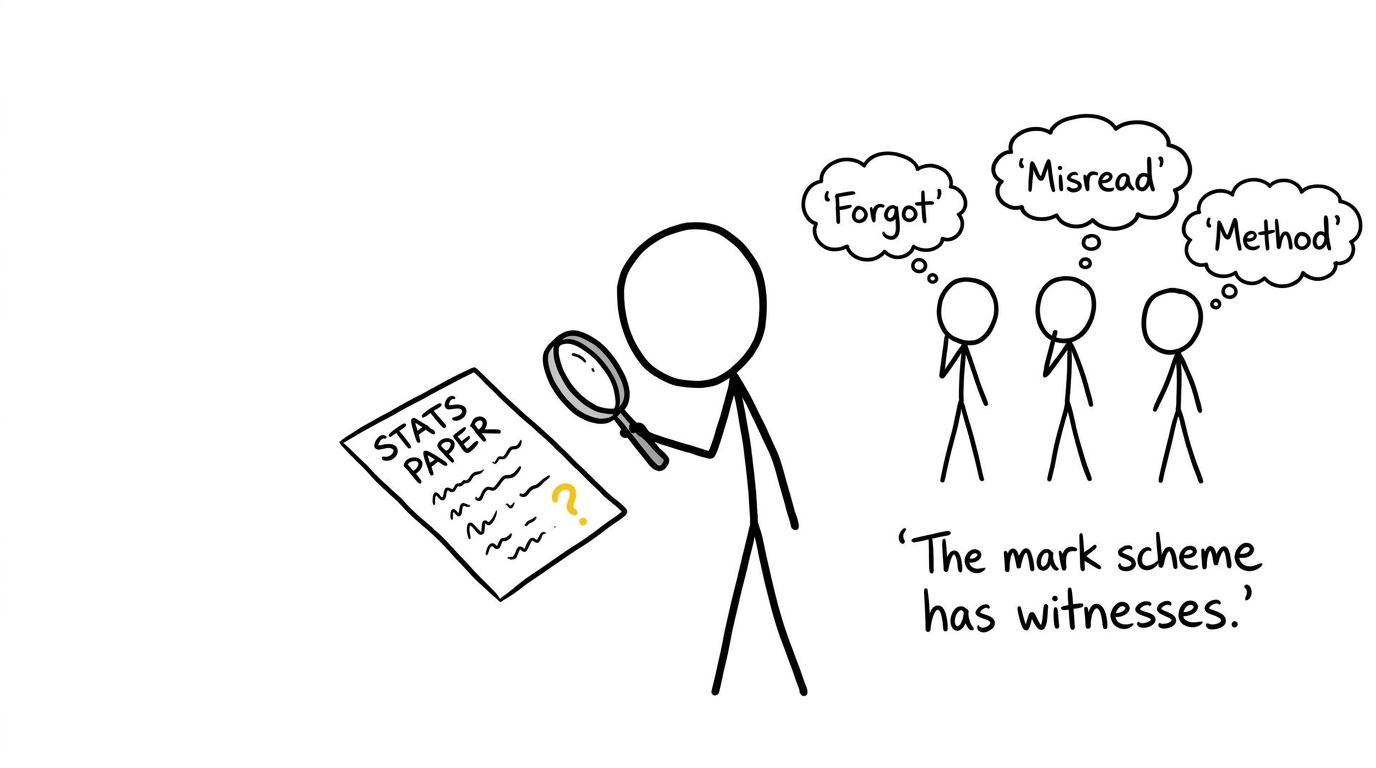 A student detective investigates why marks disappeared from a statistics paper
A revision cycle that makes recall stick
A productive session can fit into four stages.
Learn briefly
Use a revision lesson, guide or video to understand the method. This is not the time to test yourself on material you have never properly learnt.
Retrieve without support
Close everything. Write down the definition, formula, diagram structure or method from memory. Keep the attempt low-stakes: difficulty is useful information, not a verdict on your ability.
Apply and check
Complete a few focused questions, then mark them. Feedback is essential because repeated retrieval of an incorrect method can strengthen the error. Write a concise correction such as “used frequency instead of frequency density” or “compared medians but not spread”.
Return after a gap
Reattempt the weak prompt or question later without looking at the correction first. Spacing retrieval across several sessions is generally more useful for long-term retention than repeating the same card many times in one sitting.
As confidence grows, mix topics. Averages, sampling, graphs and interpretation should not always arrive in predictable blocks. The exam will require you to identify the method, and mixed practice gives you practice making that choice. Use the GCSE maths topics by exam board and tier guide to check that your revision covers the content relevant to your specification and Foundation or Higher tier.
Common active recall mistakes
Turning revision into a memory contest
Struggling to remember something is not failure. The purpose is to expose a gap early. Check the correct explanation, understand it and schedule another attempt.
Making cards too easy
A card showing almost the whole method tests recognition. Use minimal prompts and require a complete response, including meaning and context where appropriate.
Recalling formulas but avoiding questions
Statistics marks depend on application and interpretation as well as memory. Every set of formula prompts should lead to closed-book questions.
Checking the answer too quickly
Give yourself enough time to search your memory. Immediate peeking removes the retrieval attempt and turns the task back into rereading.
Ignoring the mark scheme
Mark schemes reveal whether you lost a mark through missing knowledge, an unsuitable method, weak interpretation or inaccurate communication. Classifying the error gives your next recall session a clear target.
Revising only your favourite topics
Comfort creates blind spots. Keep a short topic tracker and give more retrieval time to the areas that repeatedly cost marks, while still revisiting stronger topics occasionally.
Build revision around honest attempts
Active recall works because it replaces the feeling of knowing with evidence. For GCSE Statistics, the best evidence is not a colourful stack of cards. It is being able to retrieve a definition, select a method, complete a question and explain the result without hidden support.
Begin at the MathsGenie GCSE Statistics hub. Choose your exam board, learn one topic through a free revision lesson, test it with practice questions and check your work using mark schemes or video solutions. Then revisit it through mini tests, past papers and predicted papers where available. Add each return date to your revision planner.
The first blank page may feel uncomfortable. That is often the moment revision becomes useful.