

A 12-Week GCSE Maths Revision Plan
A 12-week GCSE Maths revision plan with weekly priorities, past papers, rest days and simple ways to catch up when revision slips off schedule.
Revision plans often fail before revision begins. A student looks at twelve empty weeks, lists every GCSE Maths topic, then creates a timetable so demanding that one difficult Tuesday ruins the whole thing.
A 12-week GCSE Maths revision plan should work differently. Begin by identifying weak topics, spend the middle weeks improving them through focused practice, and use the final weeks for timed papers and careful review. Protect rest days throughout. If you fall behind, adjust the plan rather than trying to repay every missed session.
We will follow a hypothetical student, Sam, through that process. Sam is preparing for GCSE Maths while balancing other subjects, homework and ordinary life. The plan is realistic because it expects interruptions rather than pretending they will not happen.
Your 12-week plan at a glance
The twelve weeks have four distinct phases:
- Weeks 1-2: diagnose strengths and weaknesses.
- Weeks 3-6: rebuild weak topics and practise related questions.
- Weeks 7-9: move towards mixed, timed exam practice.
- Weeks 10-11: complete and review full past papers.
- Week 12: consolidate key methods and protect confidence.
This structure matters more than a perfectly decorated calendar. Early revision should reveal what needs work. Later revision should test whether that work survives under exam conditions.
MathsGenie's GCSE Maths revision timetable guide provides the wider principles for balancing lessons, practice questions and papers across a weekly routine.
Weeks 1-2: complete honest topic triage
Sam's first instinct is to begin with a familiar topic. Familiar work feels productive because the answers arrive quickly. But a revision plan should be shaped by evidence, not comfort.
Start with a mixed assessment, mini test or selection of exam questions. Mark the work and sort topics into three groups:
- Red: you cannot start the question or regularly use the wrong method.
- Amber: you understand the method but make errors or need prompts.
- Green: you can answer independently and explain the method.
Check that your list matches your exam board specification and tier. Edexcel, AQA, OCR and Eduqas specifications are not identical, while foundation and higher tier students need different coverage. Your teacher can confirm your entry tier if you are uncertain.
Sam discovers that fractions, simultaneous equations and transformations are red. Percentages and probability are amber. Basic algebra is green. That short list gives the next month a purpose.
A mistake log is useful here. For each lost mark, record the topic, what went wrong and what you will do next. Keep the categories simple: knowledge gap, wrong method, arithmetic error, misread question or incomplete working.
The GCSE Maths mini tests can help with focused diagnosis, while the wider GCSE papers collection includes past papers, predicted papers and shorter tests organised by exam board.
Weeks 3-6: repair weak topics
The next four weeks are where most improvement is built. Sam chooses two red topics and one amber topic each week. Each topic moves through the same cycle:
- Review the method using a revision lesson or video.
- Attempt practice questions without copying the example.
- Mark the questions and correct every mistake.
- Return to the topic several days later with a short mini test.
This is more effective than watching several videos in succession. Watching can make a method feel familiar, but independent questions reveal whether it can actually be used.
A realistic school-night session might last 35-45 minutes. Sam uses roughly ten minutes to recall a method, twenty minutes for questions and ten minutes to mark and correct the work. Longer weekend sessions are divided into two blocks rather than becoming an unfocused revision marathon.
The aim is not to turn every red topic green immediately. Moving a topic from “I cannot begin” to “I can complete the standard questions” is meaningful progress. MathsGenie's guide to stopping GCSE Maths content from being forgotten explains why returning to material matters.
A weekly GCSE Maths revision timetable
Sam builds each week around four revision sessions and two protected spaces:
- Monday: learn or revisit one weak topic.
- Tuesday: practise questions on that topic.
- Wednesday: rest from maths.
- Thursday: work on a second weak topic.
- Saturday: complete a mixed mini test and review mistakes.
- Sunday: use as a rest day or catch-up buffer.
Friday remains available for other subjects or downtime. Rest is part of the timetable, not a reward that disappears whenever revision becomes busy. A plan with no spare capacity is simply a plan to fall behind.
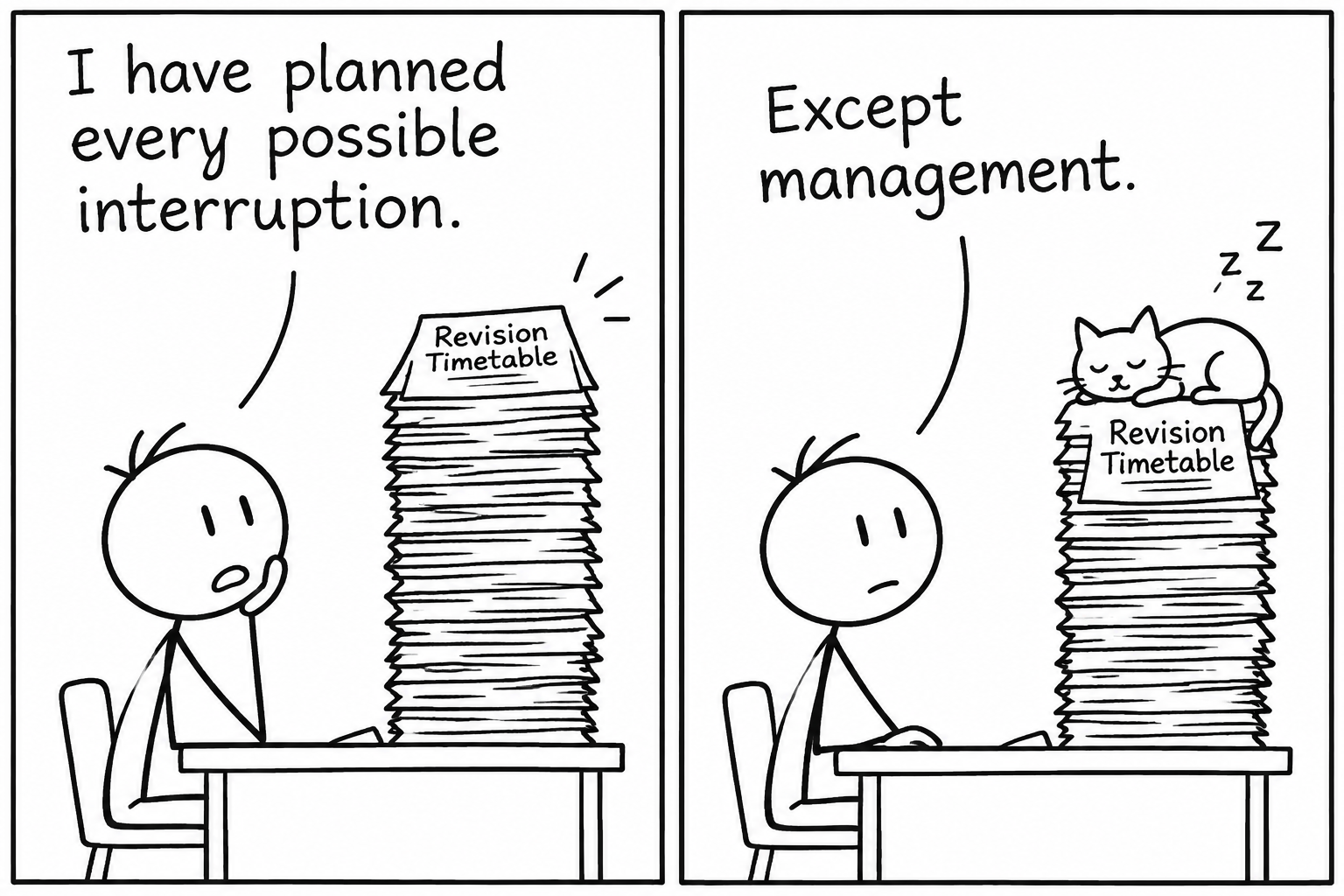 A GCSE student discovers that a cat has defeated an excessively detailed revision timetable
If you want the twelve-week structure without drawing every session by hand, build your schedule in the MathsGenie Revision Planner.
Weeks 7-9: connect topics under time pressure
By week seven, isolated topic practice is no longer enough. Real papers do not announce which method to use. A question may combine ratio with area, or algebra with a graph, and deciding how to begin is part of the challenge.
Sam now keeps two targeted sessions but replaces the Saturday mini test with a timed mixed assessment. A 45-minute test can bridge the gap between short worksheets and a full paper. MathsGenie's 45-minute GCSE Maths tests provide timed practice with mark schemes and worked solutions where available.
After each test, Sam spends at least as much care reviewing errors as recording the mark. The useful questions are:
- Which topics caused the lost marks?
- Was the method missing, or was the execution inaccurate?
- Did time pressure change the quality of the working?
- Which two topics should return next week?
A score is a snapshot. The corrections determine what happens next.
Weeks 10-11: use full past papers properly
Full papers become the priority in weeks ten and eleven. Complete them under realistic conditions, using the correct time allowance and permitted equipment for that paper. Choose papers for your own exam board and tier.
Do not rush through paper after paper. Sam completes one, marks it carefully, revises the weaknesses it exposes and then attempts another. The advice in when to start GCSE past papers supports this phased approach, beginning with diagnosis before moving towards full-paper practice.
A productive paper review includes correcting wrong answers, completing questions that were left blank and comparing working with the mark scheme or video solution. The number completed is less important than the quality of that review, a point explored in how many GCSE past papers you should do.
Week 12: consolidate rather than cram
The final week is not the moment to rebuild the entire course. Sam reviews the mistake log, practises a small number of recurring weaknesses and rehearses reliable exam habits.
Useful final-week tasks include:
- completing short mixed sets rather than several exhausting papers;
- checking calculator functions and essential equipment;
- revisiting methods that are nearly secure;
- reviewing common command words and showing clear working;
- keeping the final evening light and protecting sleep.
The purpose is readiness, not panic. New learning may still happen, but it should not displace the methods most likely to turn into marks.
How to adjust when you fall behind
At some point, Sam misses two sessions. The wrong response would be to place both on Sunday and begin the next week exhausted.
Instead, use three rules:
- Keep: retain the session linked to your weakest or most frequently assessed skill.
- Shrink: turn a long session into fifteen focused minutes or a mini test.
- Move: transfer only one important task into the following week.
Never rewrite the entire GCSE revision plan because of one disrupted week. Review the schedule at the end of each week and choose the next priorities using recent evidence. The related guide to creating a GCSE revision timetable you can stick to offers further help with making revision sustainable.
Common revision-plan mistakes
Planning topics without planning questions
“Revise algebra” is too vague. Write a specific action such as reviewing quadratic graphs, completing practice questions and marking the answers.
Saving all past papers for the end
Early mini tests and partial papers expose weaknesses while there is still time to address them. Full timed papers can follow once more content is secure.
Ignoring the mark scheme
Mark schemes reveal where method marks are available and whether your working communicates the correct idea. Marking is part of revision, not administration after it.
Removing every rest day
An overcrowded GCSE Maths revision timetable is fragile. Keep at least one genuine rest day and one movable buffer so a missed session does not become a crisis.
Treating the timetable as fixed
Your plan should respond to evidence. If probability becomes secure but vectors remain difficult, the next week's priorities should change.
Build your twelve weeks
Sam's plan becomes manageable when it stops being a promise to revise everything and becomes a sequence of decisions: diagnose, practise, test, review and adjust. Knowing that structure is the first step; following it across twelve busy weeks is the harder one.
Your exam date is fixed, so every unplanned week reduces the time available. Build your 12-week schedule in the MathsGenie Revision Planner.















