Carbon dioxide gas is produced in the lab when dilute hydrochloric acid is reacted with marble chips (calcium carbonate).
The word equation for the reaction is:
calcium carbonate+hydrochloric acid→calcium chloride+carbon dioxide+water \text{calcium carbonate} + \text{hydrochloric acid} \rightarrow \text{calcium chloride} + \text{carbon dioxide} + \text{water} calcium carbonate+hydrochloric acid→calcium chloride+carbon dioxide+waterWrite a balanced chemical equation for this reaction, including state symbols.
A student sets up the apparatus shown below to prepare and collect a sample of carbon dioxide gas:
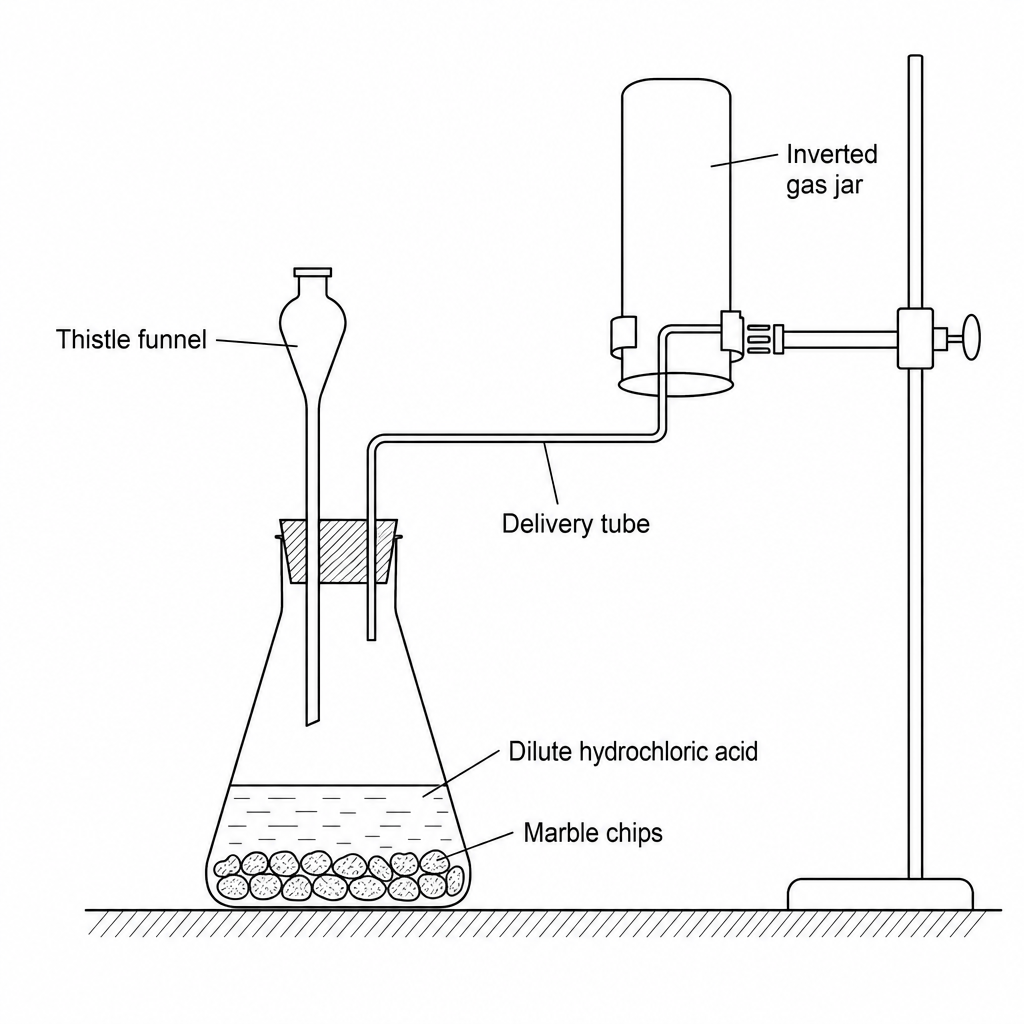
State two reasons why this set-up is unsuitable for preparing and collecting carbon dioxide.
If the student replaces the dilute hydrochloric acid with dilute sulfuric acid, the reaction quickly slows down and stops, even though there is still an excess of marble chips and unreacted acid in the flask. Explain why this happens.
When some carbon dioxide gas is bubbled into a solution of limewater (calcium hydroxide), a white precipitate forms, making the solution cloudy. Which of the following substances is responsible for this cloudiness?
Carbon dioxide consists of simple molecules where the atoms are held together by covalent bonds.
State what is meant by the term covalent bond.
Explain, in terms of structure and bonding, why carbon dioxide has a low boiling point.
Describe how the outer shell electrons are shared in a molecule of carbon dioxide, CO2\text{CO}_2CO2.

