Skip to content
MathsGenie logo
Quick links
Open app

Course home

  1. IGCSE
  2. Chemistry Edexcel
  3. Question bank

Acids, bases and salt preparations

Medium
1234567891011121314151617181920212223242526272829303132333435363738394041
Question 28

This question is about the reactions of barium and some barium compounds.

a.

Barium reacts with cold water. The equation for the reaction is:

Ba(s)+2H2O(l)→Ba(OH)2(aq)+H2(g) \text{Ba(s)} + 2\text{H}_2\text{O(l)} \rightarrow \text{Ba(OH)}_2\text{(aq)} + \text{H}_2\text{(g)} Ba(s)+2H2​O(l)→Ba(OH)2​(aq)+H2​(g)

State two observations that are made when barium reacts with water.

[2]
b.

Explain a possible value for the pH of the solution formed.

[2]
c.

The diagram shows some reactions involving barium compounds.
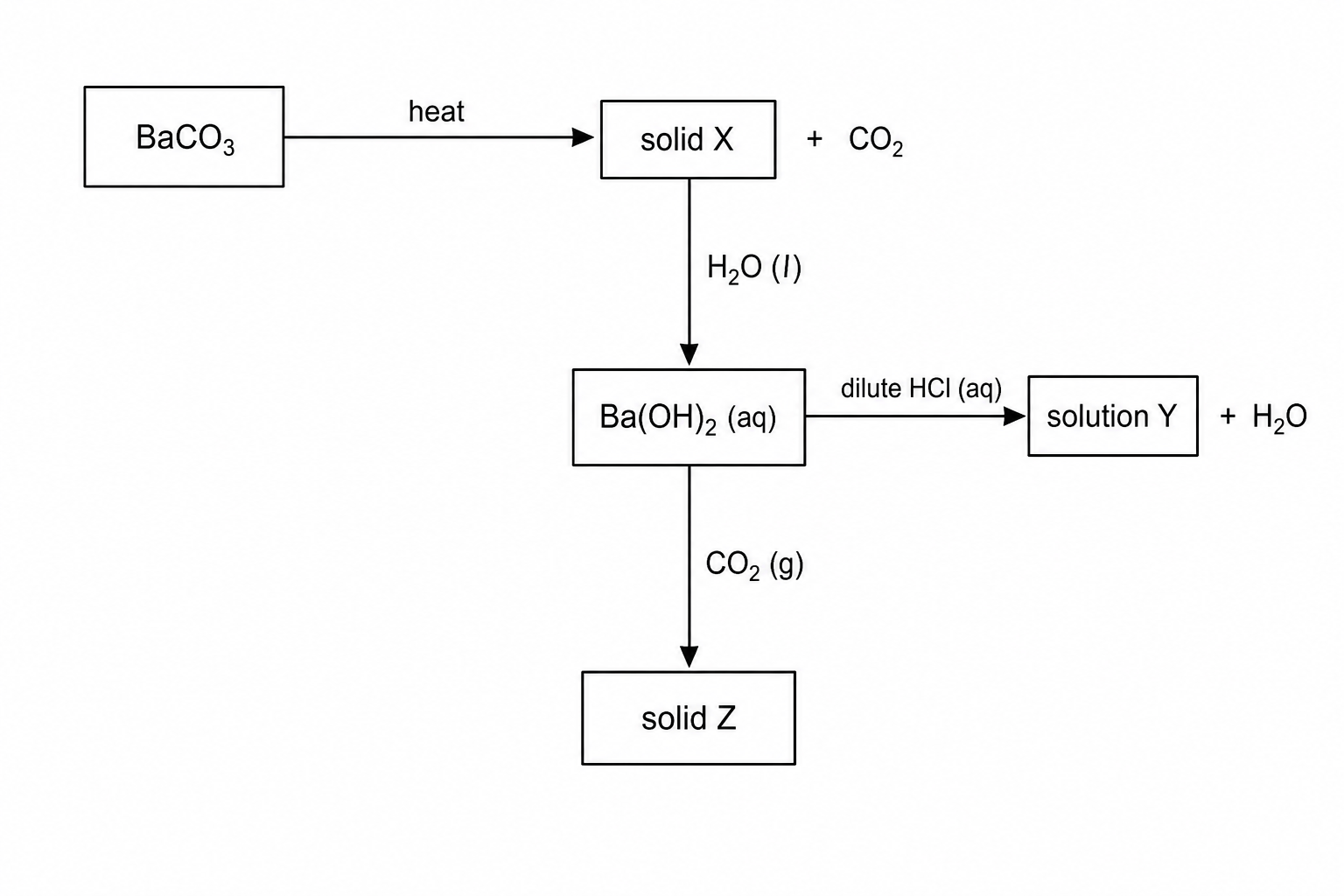
A block diagram showing the reactions of barium compounds. At the top left, a box containing 'BaCO3' has an arrow labeled 'heat' pointing to a box containing 'solid X' and another box with '+' 'CO2'. From 'solid X', an arrow labeled 'H2O(l)' points down to a box containing 'Ba(OH)2(aq)'. From 'Ba(OH)2(aq)', there are two pathways: one arrow points to the right, labeled 'dilute HCl(aq)', leading to a box containing 'solution Y' and another box with '+' 'H2O'. The other arrow points downwards, labeled 'CO2(g)', leading to a box containing 'solid Z'.

Identify solid X, solution Y, and solid Z.

[3]

Acids, bases and salt preparations Questions

  1. IGCSE
  2. /Chemistry
  3. /Acids, bases and salt preparations
