Dilute hydrochloric acid can be used to make soluble and insoluble salts.
A student plans an experiment to obtain a pure, dry sample of the soluble salt, potassium chloride, from dilute hydrochloric acid.
The student does a titration to find the volume of hydrochloric acid needed for complete reaction with the other reactant.
Describe the steps she should take in her titration. Refer to these pieces of apparatus in your answer:
The diagram shows the burette readings in one titration.
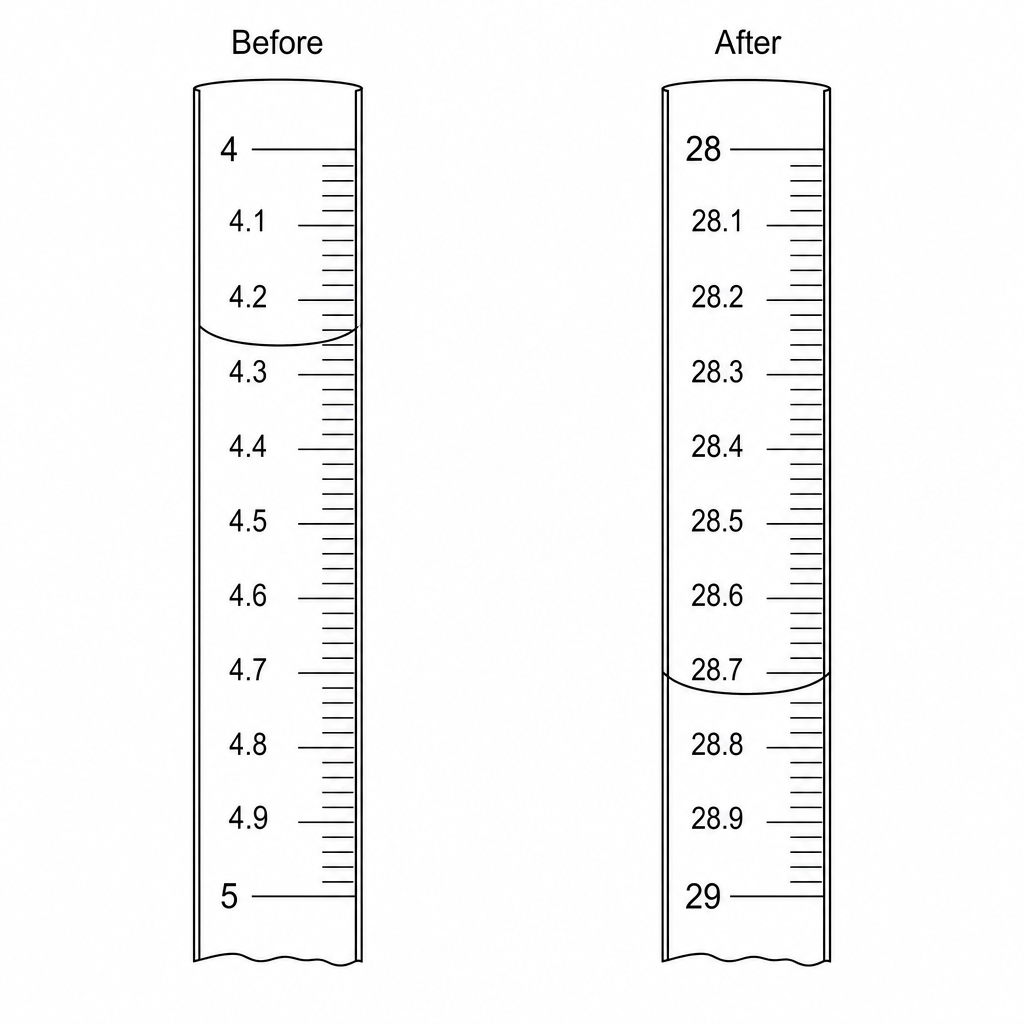
Use these readings to complete the table, giving all values to the nearest 0.05 cm30.05\text{ cm}^30.05 cm3.
| Observation | Volume (cm3\text{cm}^3cm3) |
|---|---|
| burette reading after adding solution | |
| burette reading before adding solution | |
| volume of solution added |
The student plans a different experiment to obtain a pure, dry sample of the insoluble salt, silver chloride, from dilute hydrochloric acid.
Describe the steps she should take in her experiment.

