A student adds dilute sulfuric acid to a beaker containing calcium chloride solution. She obtains a mixture containing a precipitate of calcium sulfate in a solution of hydrochloric acid.
Complete the equation for this reaction by inserting state symbols.
CaCl2(............)+H2SO4(............)→CaSO4(............)+2HCl(............) \text{CaCl}_2(\text{............}) + \text{H}_2\text{SO}_4(\text{............}) \rightarrow \text{CaSO}_4(\text{............}) + 2\text{HCl}(\text{............}) CaCl2(............)+H2SO4(............)→CaSO4(............)+2HCl(............)The student uses this apparatus to separate the mixture into a residue and a filtrate.
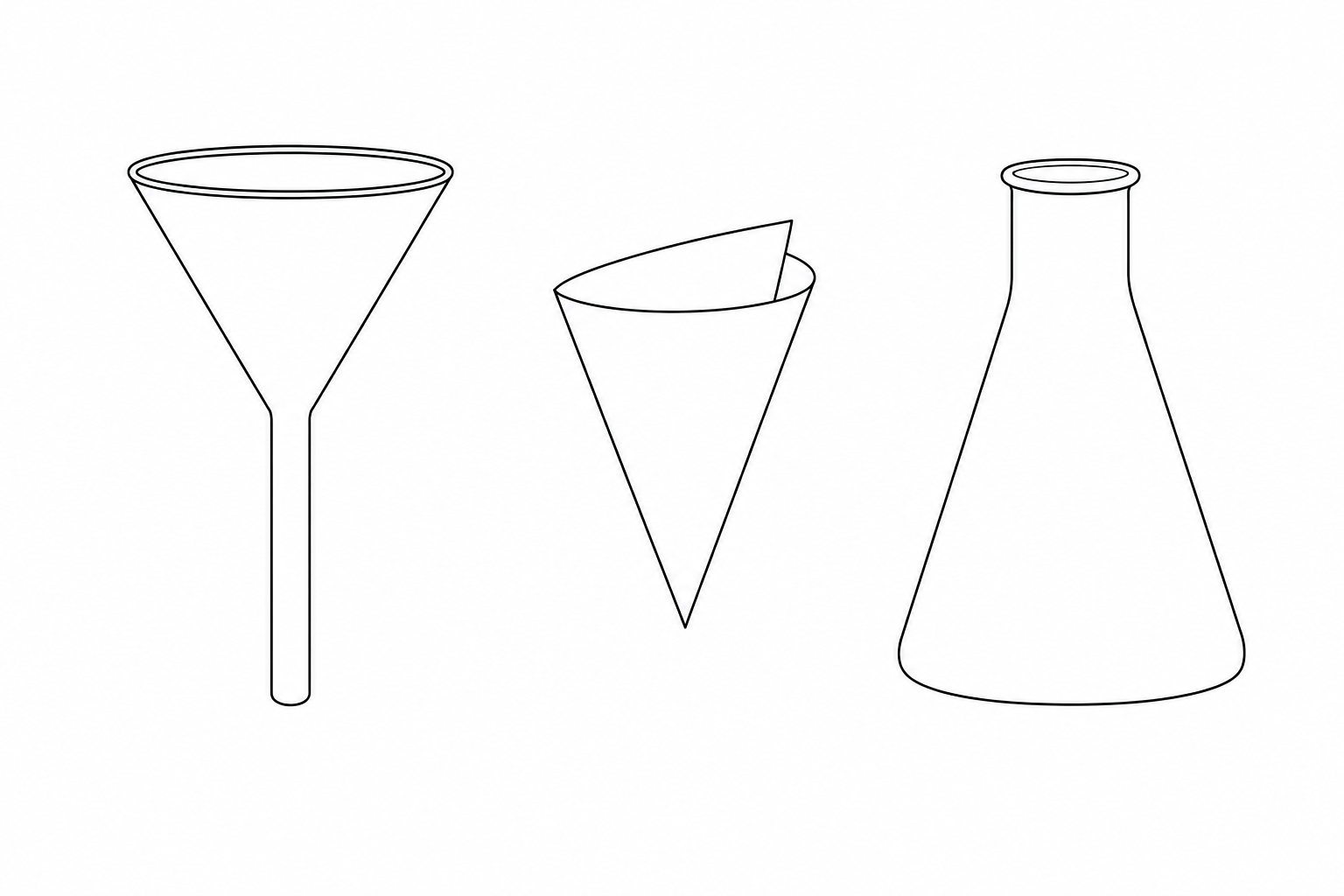
Describe how she should assemble this apparatus for the filtration.
The student carries out a flame test on the filtrate she obtains and observes a brick-red colour.
(i) Identify the ion responsible for this colour.
(ii) Suggest why this ion is present in the filtrate.
The student tests the filtrate for chloride ions by adding silver nitrate solution.
(i) State what she would observe in this test.
(ii) State the name of the substance responsible for this observation.
(iii) She reads in a textbook that dilute nitric acid should be added before the silver nitrate solution in the test. Suggest why the student does not need to add dilute nitric acid in this test.
The calcium sulfate residue she obtains is impure because it contains some hydrochloric acid. Describe how she can obtain a pure, dry sample of calcium sulfate from this residue.

