A student draws a diagram to show how they plan to prepare and collect hydrogen gas in a laboratory.
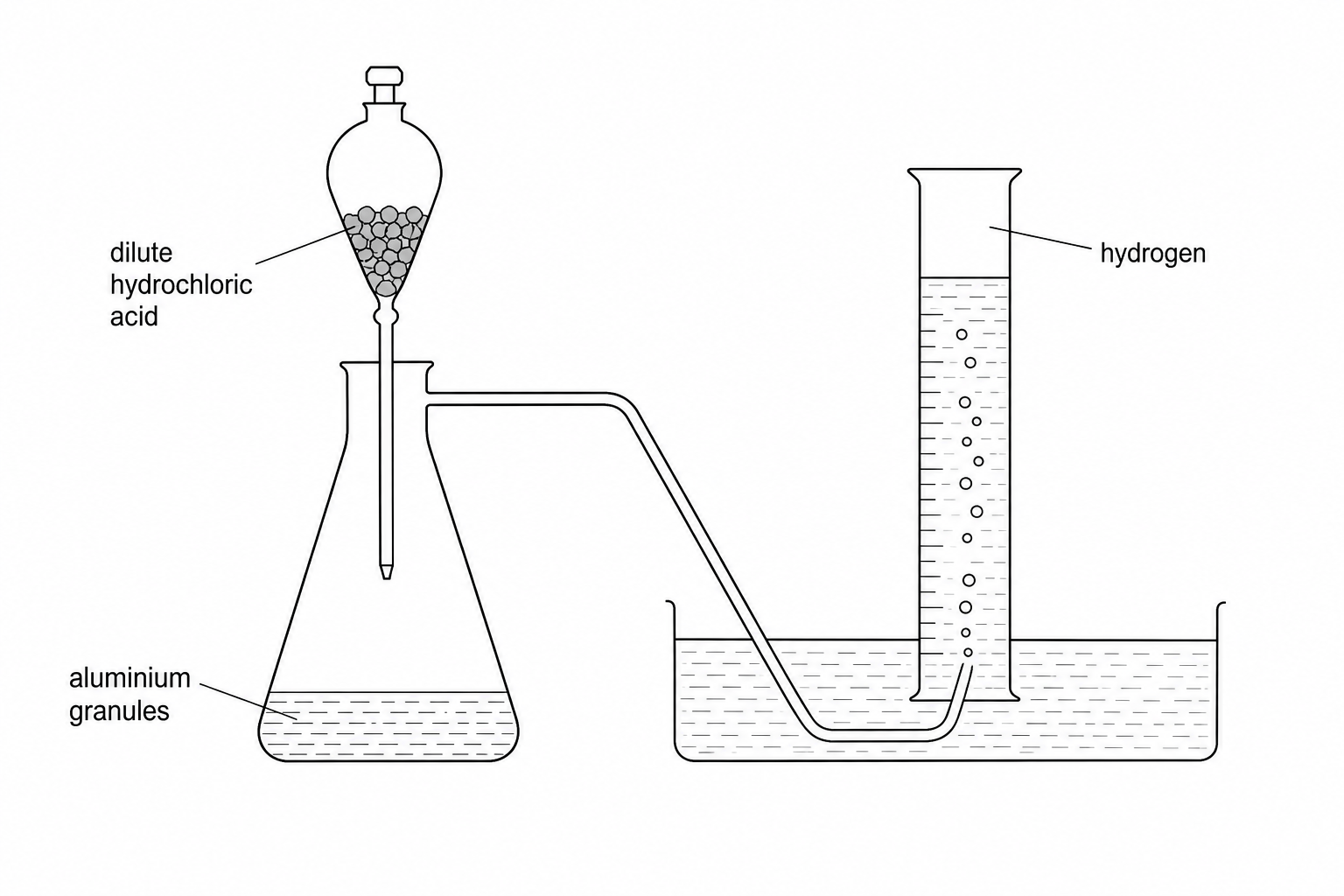
The student makes a mistake in the labelling. They also miss out a key piece of apparatus.
State the mistake in the labelling of the diagram.
Identify the piece of apparatus missing from the neck of the conical flask.
State why this piece of apparatus is necessary.
The student adds the missing piece of apparatus, then collects some hydrogen gas. This hydrogen gas contains water vapour. Suggest how they could alter the apparatus so that they could collect dry hydrogen gas.
Balance the equation for the reaction used in this preparation of hydrogen:
…Al+…HCl→…AlCl3+…H2 \dots\text{Al} + \dots\text{HCl} \rightarrow \dots\text{AlCl}_3 + \dots\text{H}_2 …Al+…HCl→…AlCl3+…H2A few drops of copper(II) sulfate solution can be added to act as a catalyst. What is meant by the term catalyst?
The diagram below shows the reaction profile for the reaction of aluminium with hydrochloric acid without a catalyst.
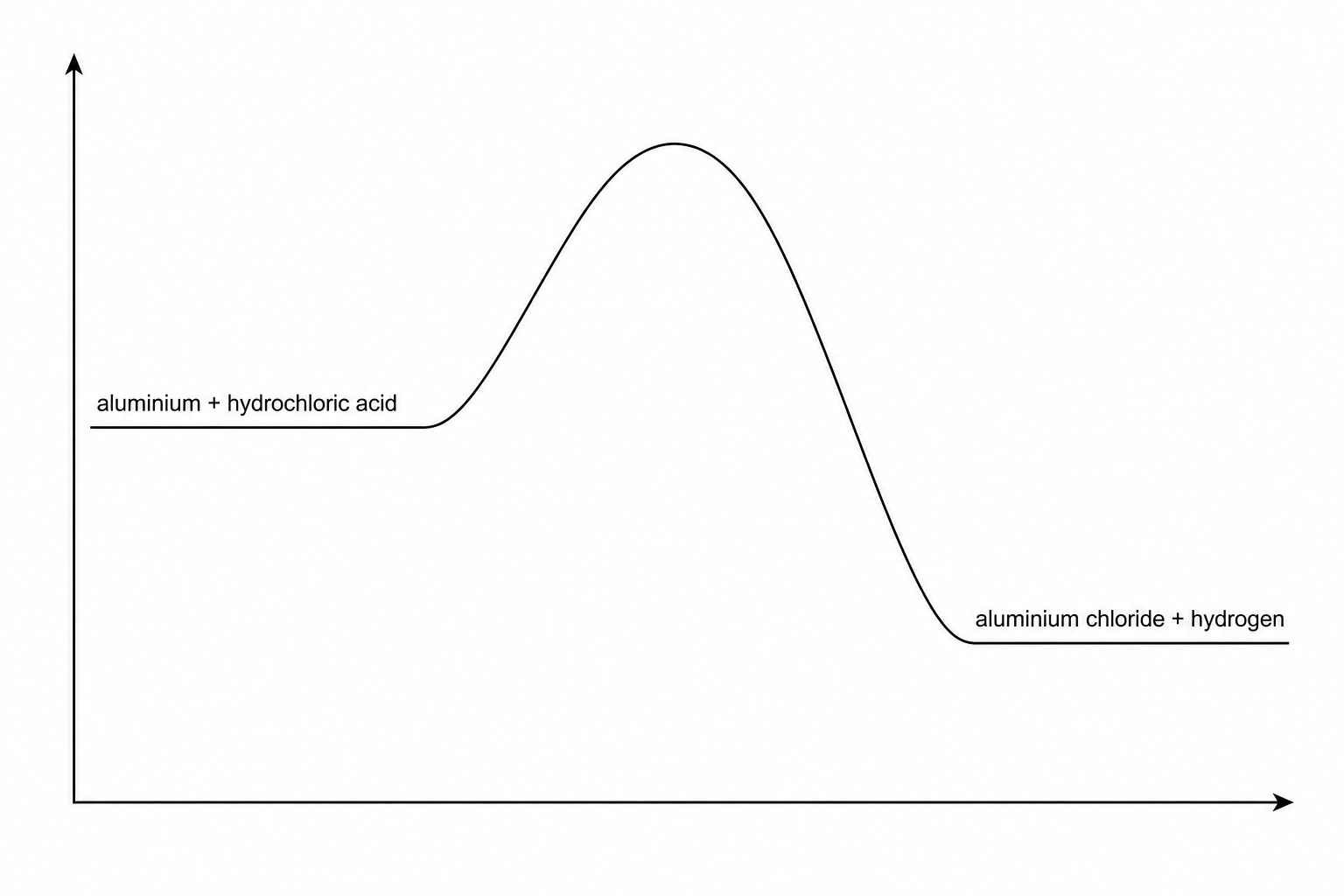
Describe how to label the diagram to show the activation energy (EaE_aEa) for this reaction.
Describe how the curve would be drawn on the diagram to represent the reaction profile for the same reaction when a catalyst is used.

