This question is about the insoluble salt lead(II) bromide.
A student uses the precipitation method to prepare lead(II) bromide.
The equation for the reaction they use is:
Pb(NO3)2(aq)+2NaBr(aq)→PbBr2(s)+2NaNO3(aq) \text{Pb(NO}_3)_2\text{(aq)} + 2\text{NaBr(aq)} \rightarrow \text{PbBr}_2\text{(s)} + 2\text{NaNO}_3\text{(aq)} Pb(NO3)2(aq)+2NaBr(aq)→PbBr2(s)+2NaNO3(aq)Describe how they could use solutions of lead(II) nitrate and sodium bromide to obtain a pure, dry sample of lead(II) bromide. Identify two suitable pieces of apparatus they would use to carry out this process.
The student's teacher uses this apparatus to electrolyse a pure sample of molten lead(II) bromide.
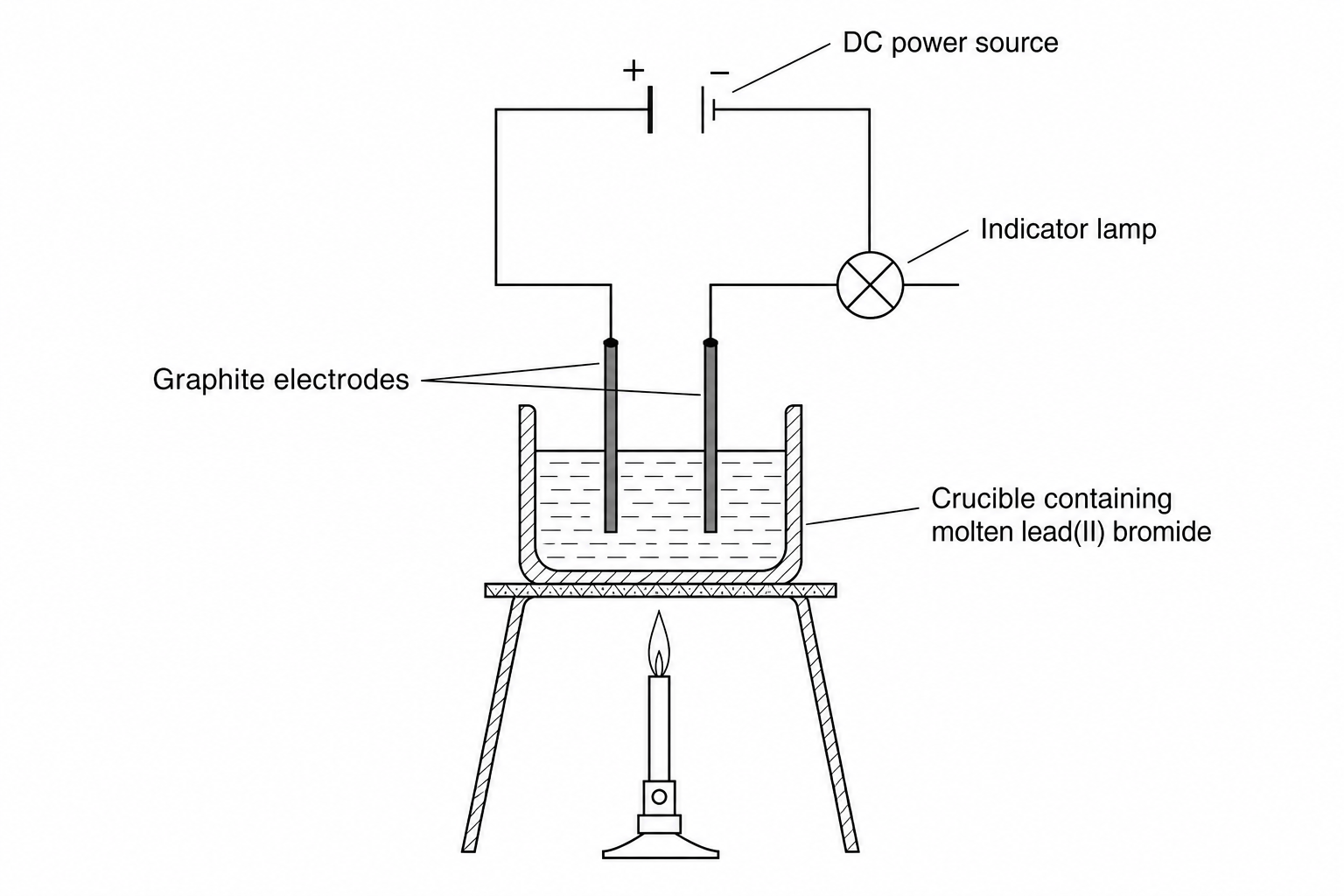
Observations during the experiment:
Which is the correct statement about this electrolysis?
The student writes this half-equation to show the reaction in which the orange-brown vapor forms:
2Br−+2e−→2Br 2\text{Br}^- + 2\text{e}^- \rightarrow 2\text{Br} 2Br−+2e−→2BrIdentify the two mistakes in their half-equation.
Explain why the lamp stops working soon after the teacher stops heating the lead(II) bromide.

