An experimental atmospheric probe of mass 120 kg120 \text{ kg}120 kg is launched vertically upwards from a research facility using a high-tension launch pad. The propulsion is provided by three identical stretched elastic cables that behave like springs.
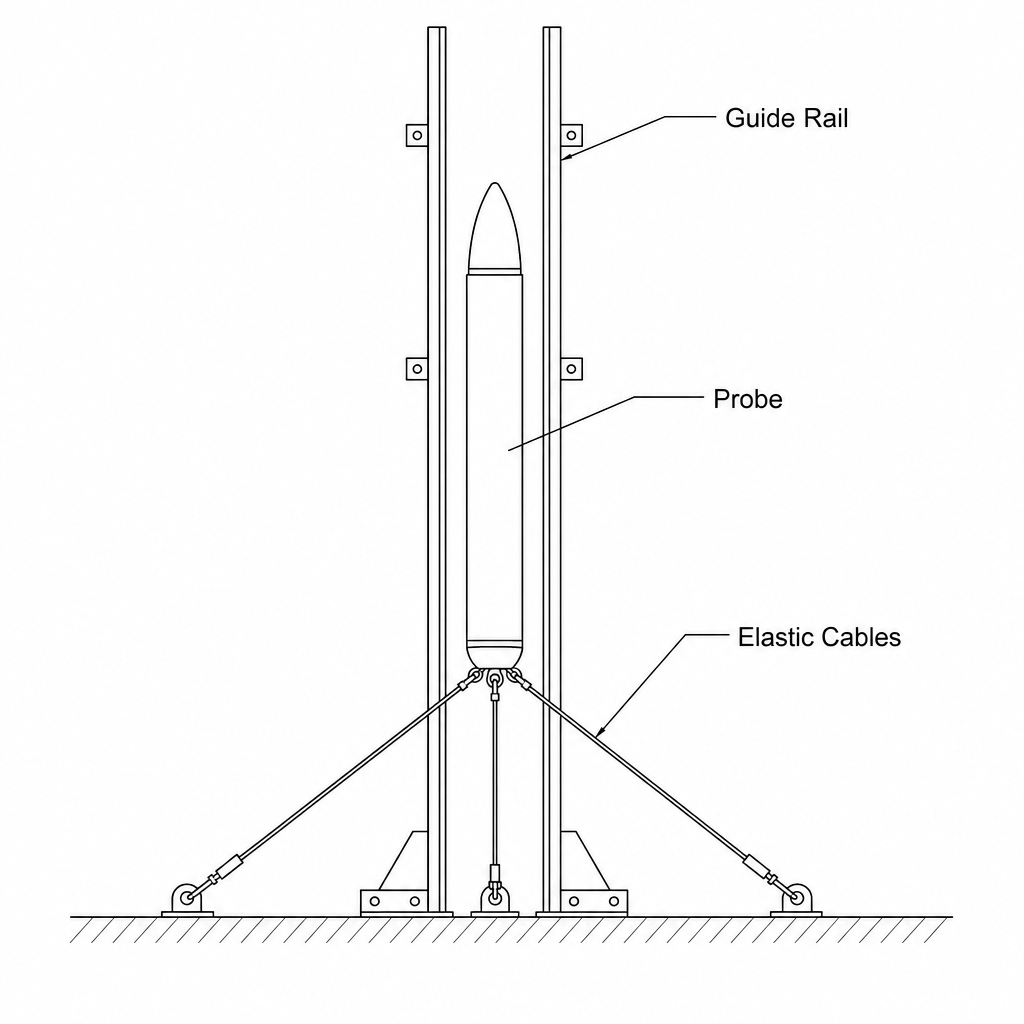
Before the launch, each of the three elastic cables is stretched by an extension of 12.0 m12.0 \text{ m}12.0 m. The spring constant of each individual cable is 450 N/m450 \text{ N/m}450 N/m.
Calculate the total elastic potential energy stored in all three cables combined before release.
Use the equation: elastic potential energy=0.5×spring constant×(extension)2\text{elastic potential energy} = 0.5 \times \text{spring constant} \times (\text{extension})^2elastic potential energy=0.5×spring constant×(extension)2
At its maximum vertical height, the probe has 52,920 J52,920 \text{ J}52,920 J of gravitational potential energy.
Calculate the maximum height reached by the probe above its launch point.
Use the equation: gravitational potential energy=mass×gravitational field strength×height\text{gravitational potential energy} = \text{mass} \times \text{gravitational field strength} \times \text{height}gravitational potential energy=mass×gravitational field strength×height
Take the gravitational field strength as g=9.8 N/kgg = 9.8 \text{ N/kg}g=9.8 N/kg.
Explain why the maximum gravitational potential energy of the probe is significantly less than the total initial elastic potential energy stored in the cables. State two distinct reasons.