Energy changes in a system, and the ways energy is stored before and after such changes

EasyMedium
123456789101112131415161718192021222324252627282930313233343536373839404142434445464748495051
Question 42
Medium

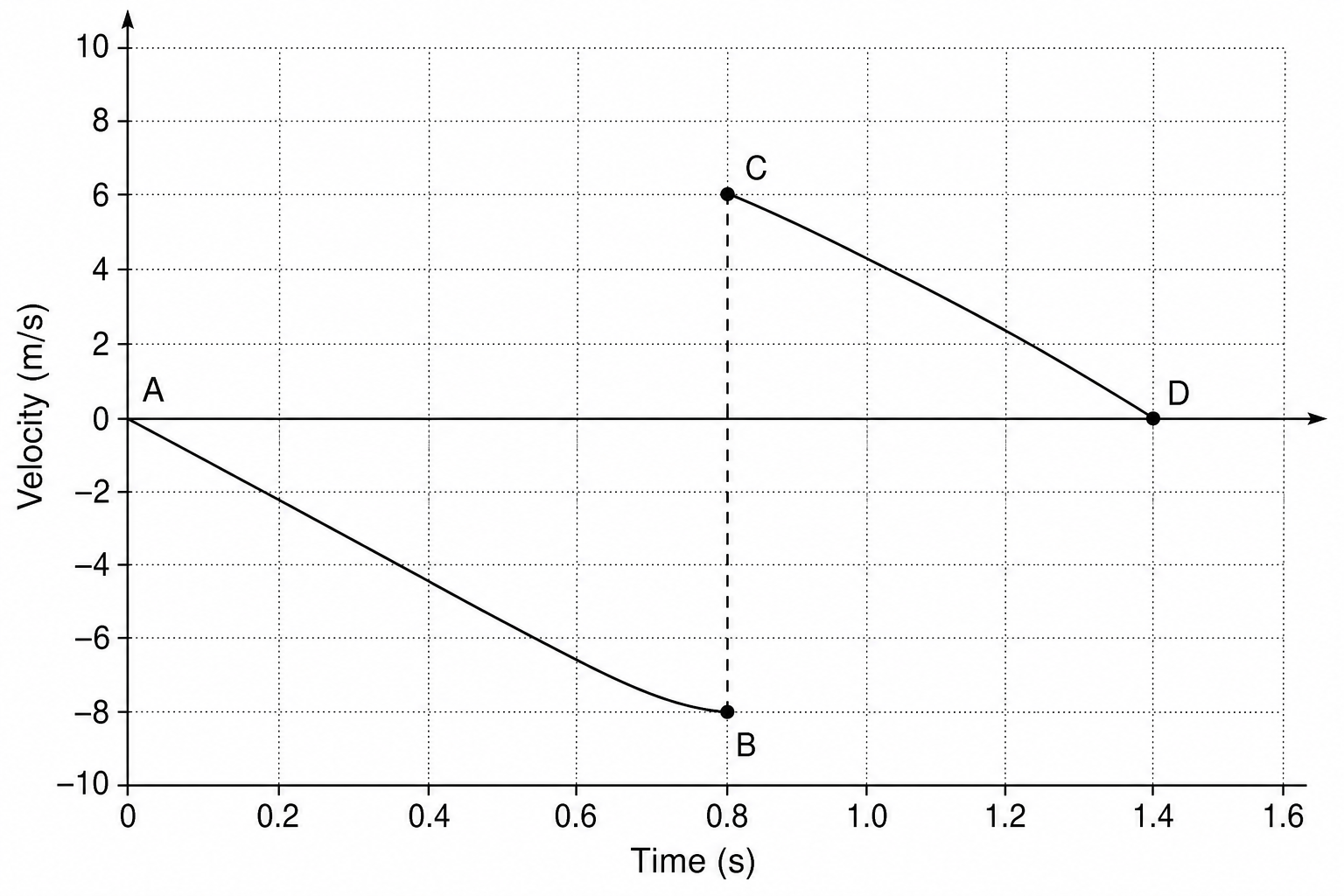
A student drops a ball from a balcony. The ball hits the ground and bounces. Figure 1 shows the velocity-time graph for the ball from when it is dropped until it reaches the maximum height of its first bounce. Air resistance is negligible. A velocity-time graph showing the motion of a bouncing ball. The vertical axis is labeled "Velocity in m/s" and ranges from -10 to 10 with major grid lines every 2 units. The horizontal axis is labeled "Time in seconds" and ranges from 0 to 1.6 with major grid lines every 0.2 seconds. A solid line starts at the origin, point A (0, 0), and goes diagonally down and to the right to point B at (0.8, -8). A vertical line connects point B (0.8, -8) to point C at (0.8, 6). From point C, another solid line goes diagonally up and to the right, crossing the horizontal axis at point D at (1.4, 0).
a.

Describe the motion of the ball between points A and B on Figure 1.

[1]
b.

What direction is the ball moving between points C and D on Figure 1?

[1]
c.

The ball and the Earth form a system. What is meant by 'a system'? Select one option:

  • A single object moving at a constant speed.
  • A group of objects that interact.
  • A force field acting in a medium.
[1]
d.

When the ball hits the ground, energy is transferred. Explain how the data in Figure 1 shows that energy is transferred from the ball to the surroundings during the bounce.

[3]

Energy changes in a system, and the ways energy is stored before and after such changes Questions

  1. GCSE
  2. /Physics
  3. /Energy changes in a system, and the ways energy is stored before and after such changes