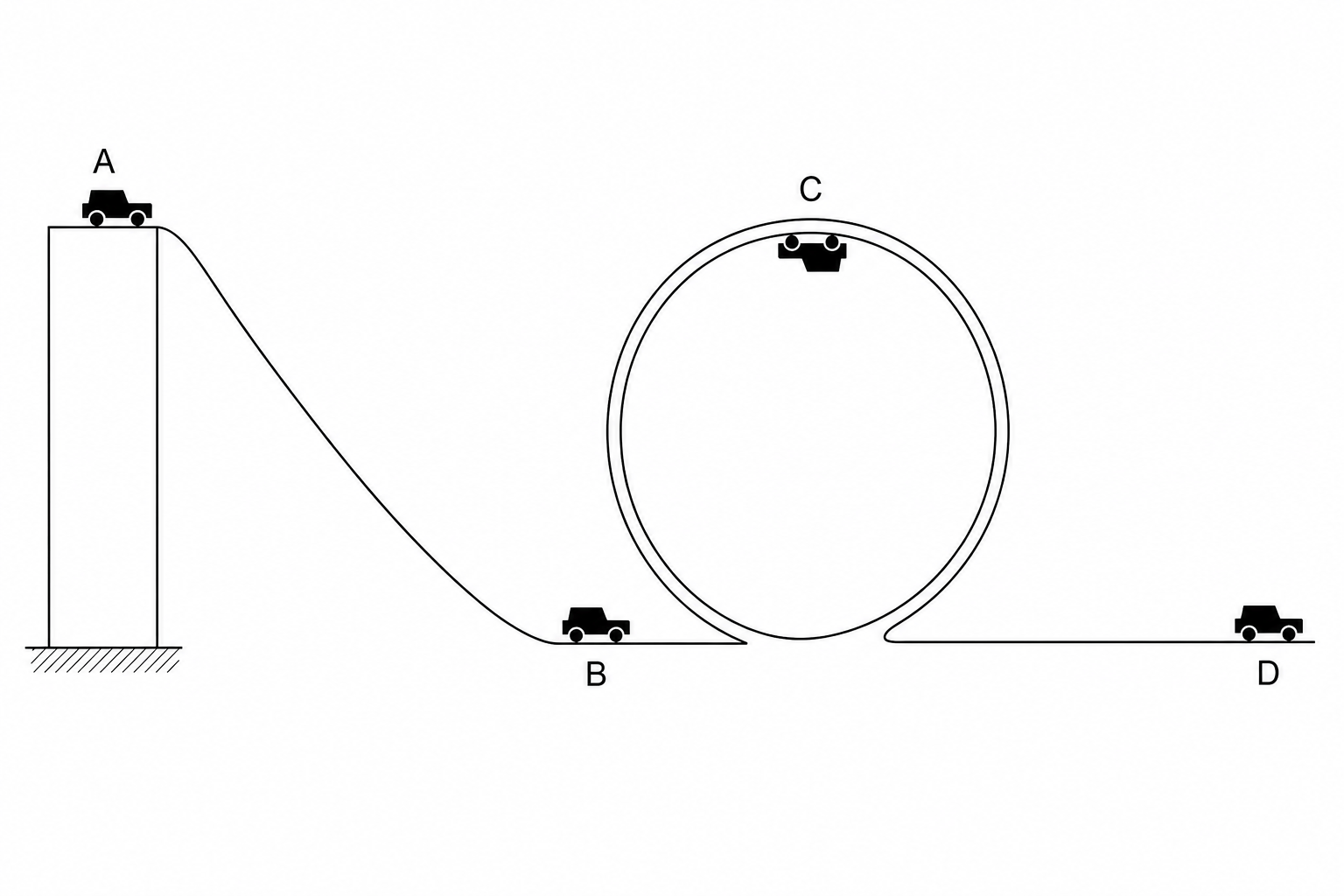
A toy stunt car and its track are modelled as a closed system.
a.[1]
Which statement explains why the toy car and its track can be considered a 'closed system'?
- No energy is transferred to or from the surroundings of the car and track.
- The chemical energy stored in the car remains constant.
- The kinetic energy of the car is equal to its gravitational potential energy at all times.
b.[4]
The car is released from rest at position A and accelerates down the track to position B.
- mass of the toy car =0.085 kg= 0.085 \text{ kg}=0.085 kg
- vertical height between position A and position B =60 cm= 60 \text{ cm}=60 cm
- gravitational field strength =9.8 N/kg= 9.8 \text{ N/kg}=9.8 N/kg
Calculate the maximum possible speed of the toy car when it reaches position B.
c.[2]
At position C, the car's gravitational potential energy is 0.32 J0.32 \text{ J}0.32 J greater than at position B. How much kinetic energy does the car need at position B to complete the loop of the track? Choose one option and give a reason for your answer.
- Less than 0.32 J0.32 \text{ J}0.32 J
- Exactly 0.32 J0.32 \text{ J}0.32 J
- More than 0.32 J0.32 \text{ J}0.32 J