A student is investigating the physics of a large playground slide. A diagram of the slide is shown below:
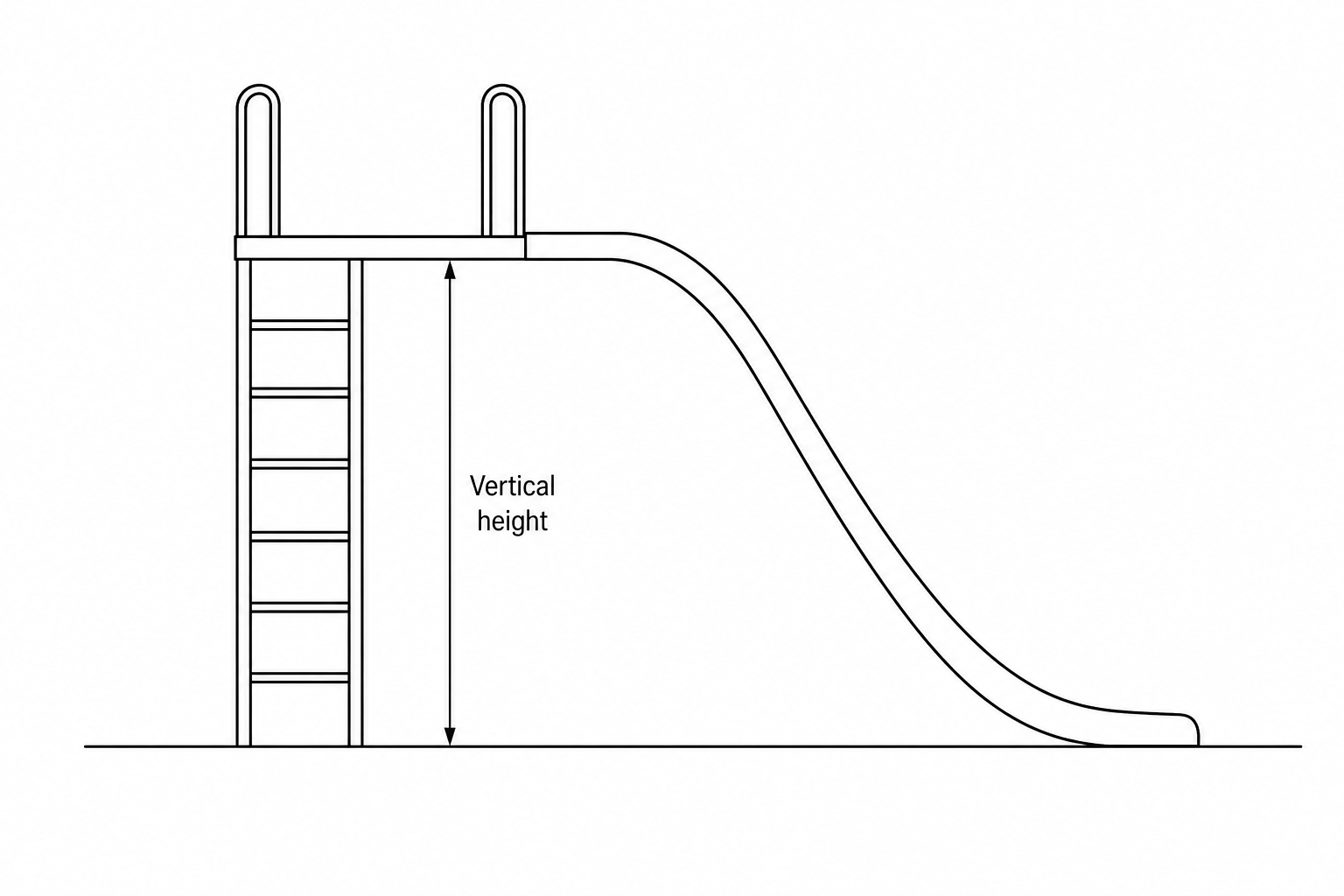
Describe how the vertical height of the slide's platform could be measured accurately.
A child of mass 48 kg48\text{ kg}48 kg slides down the slide, moving through a vertical height of 2.5 m2.5\text{ m}2.5 m. The gravitational field strength is 9.8 N/kg9.8\text{ N/kg}9.8 N/kg. Calculate the change in gravitational potential energy of the child. Use the equation: gravitational potential energy=mass×gravitational field strength×height\text{gravitational potential energy} = \text{mass} \times \text{gravitational field strength} \times \text{height}gravitational potential energy=mass×gravitational field strength×height
State three factors that affect the kinetic energy of the child as they reach the bottom of the slide.