An engineering laboratory tests the impact-absorption capacity of a protective safety helmet. A heavy dummy headform fitted with the helmet is dropped vertically from rest. It impacts a rigid steel anvil and rebounds.
Figure 1 shows the velocity-time graph for the headform from the moment it is released until it reaches the maximum height of its first rebound. Air resistance during the fall is negligible.
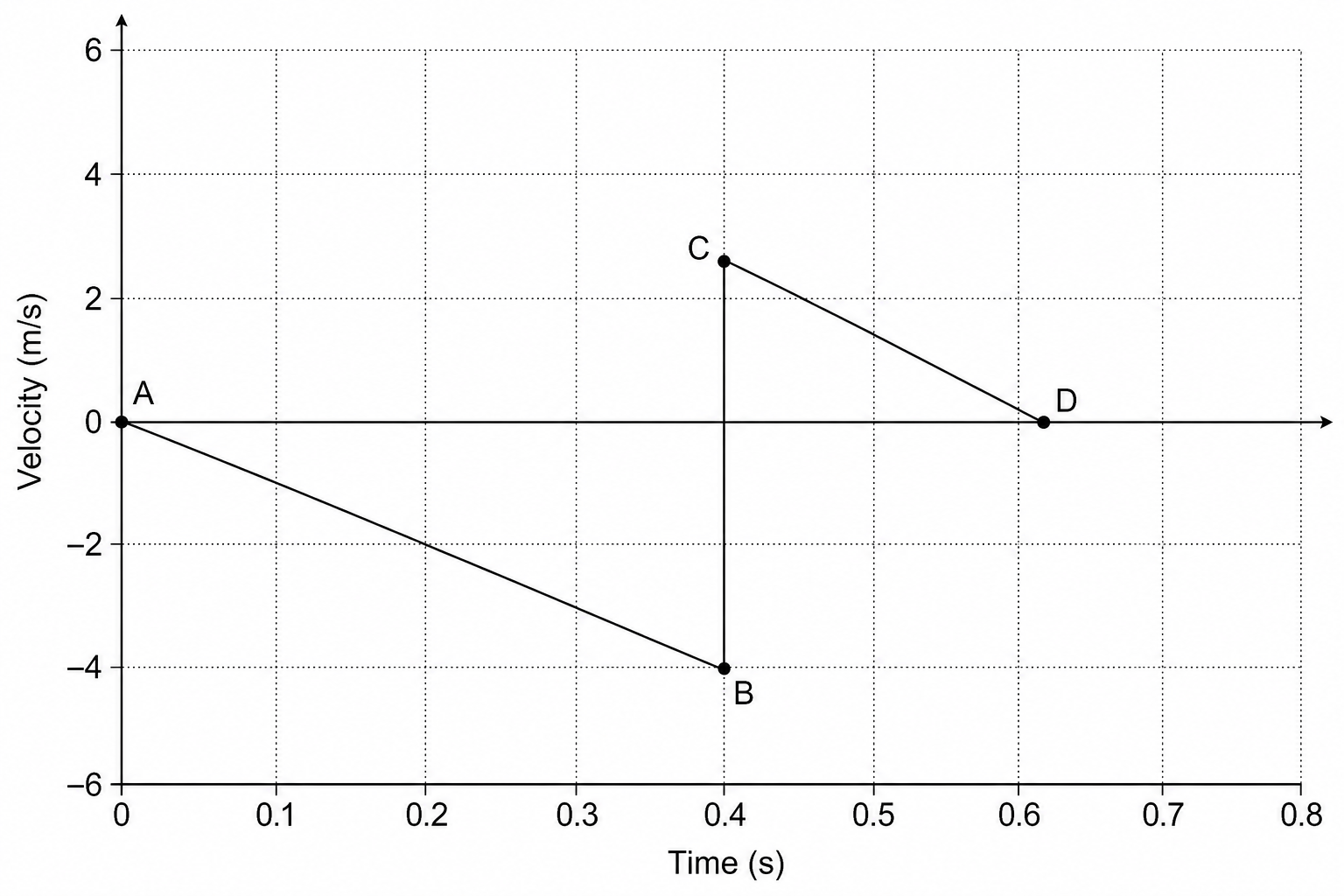
Describe the motion of the headform between points A and B on Figure 1.
What direction is the headform moving between points C and D on Figure 1?
The helmeted headform, the anvil, and the Earth can be modeled as a system. What is meant by 'a system' in physics? Select one option:
- A single object moving at a constant speed.
- A group of objects that interact.
- A force field acting in a medium.
When the helmet impacts the anvil, energy is transferred. Explain how the data in Figure 1 shows that energy is transferred from the headform to the surroundings (including the helmet's internal structure) during the impact.