Question 12
FA student sets up this apparatus to collect pure water from salt solution by simple distillation.
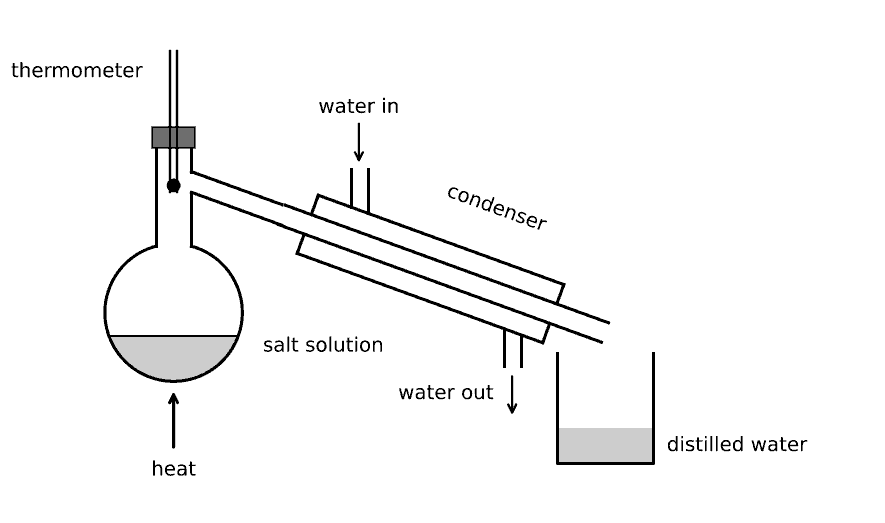
The apparatus has one mistake.
What change should the student make?
Move the thermometer so that its bulb is in the salt solution.
Make the cold water enter the condenser at the lower end and leave at the upper end.
Heat the beaker instead of the flask.
Make the condenser slope upwards from the flask to the beaker.
2.1 Purity and separating mixtures Questions
51 exam-style questions on OCR GCSE Chemistry 2.1 Purity and separating mixtures, covering 2.1.1 Pure substances and melting point data, 2.1.2 Relative formula mass and empirical formula, 2.1.3 Formulations as useful mixtures, 2.1.4 Techniques for separating mixtures, and 2.1.5 Chromatography and Rf values. Each one has a worked solution and a mark scheme showing where the marks go.