Question 2
FPure substance X melts at 69 ∘C69\,^\circ\mathrm{C}69∘C.
A student has three solid samples. Each sample is thought to be substance X.
The student melts each sample, then records its temperature as it cools and becomes solid. The graphs show the results.
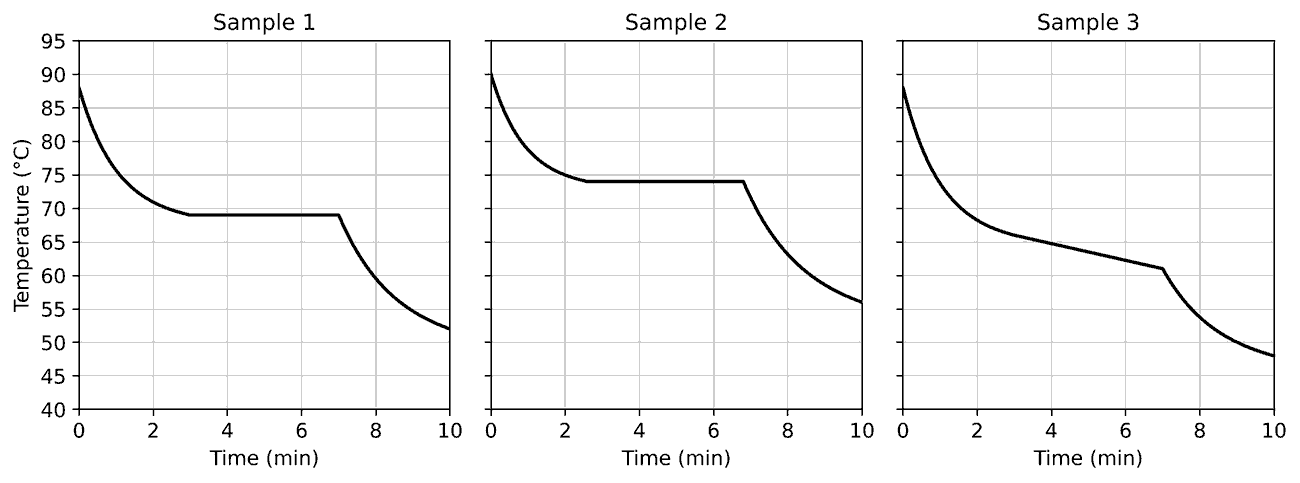
Which statement is correct?
Samples 1 and 2 are both pure X, because both stay at a constant temperature while they become solid.
Sample 1 is pure X. Sample 2 is a different pure substance. Sample 3 is impure.
Sample 2 is X containing an impurity, because the impurity has raised its melting point.
Sample 3 is pure X, because it becomes solid at a lower temperature than samples 1 and 2.
2.1 Purity and separating mixtures Questions
51 exam-style questions on OCR GCSE Chemistry 2.1 Purity and separating mixtures, covering 2.1.1 Pure substances and melting point data, 2.1.2 Relative formula mass and empirical formula, 2.1.3 Formulations as useful mixtures, 2.1.4 Techniques for separating mixtures, and 2.1.5 Chromatography and Rf values. Each one has a worked solution and a mark scheme showing where the marks go.