Skip to content
MathsGenie logo
Old site
Open app

Course home

  1. GCSE
  2. Chemistry Edexcel
  3. Question bank

Rates of reaction

EasyMediumHard
123456789101112131415161718192021222324252627282930313233343536373839404142434445464748495051525354555657585960616263646566676869707172737475767778798081828384858687888990919293949596979899100101102103104105106107108109110111112113114115116117118119120121
Question 113

The apparatus in Figure 1 can be used to measure the rate of the reaction between calcium carbonate and dilute nitric acid.
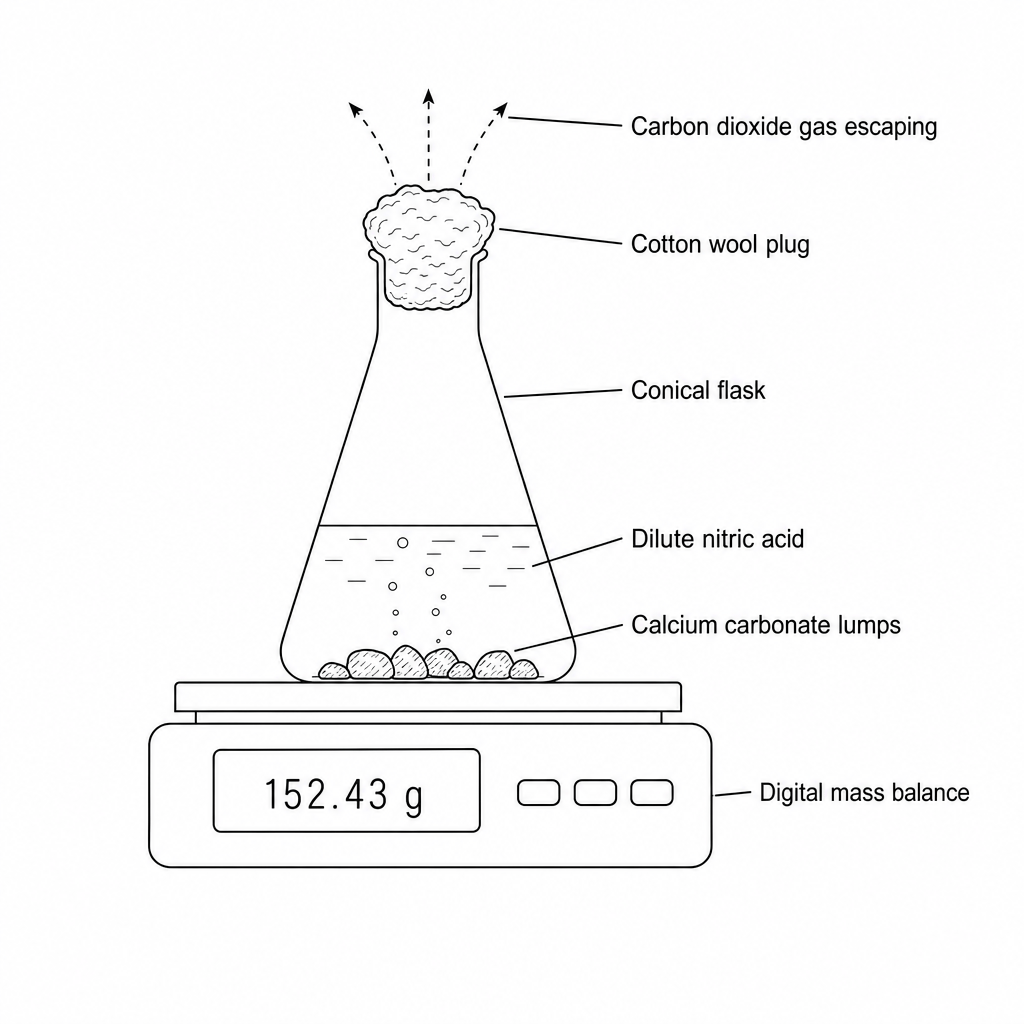
Figure 1: Diagram showing a conical flask containing calcium carbonate lumps and dilute nitric acid sitting on a digital mass balance. The neck of the flask is plugged with a wad of cotton wool to allow carbon dioxide gas to escape while preventing any liquid acid spray from being lost.

The student wants to investigate the effect of surface area on the rate of reaction. They start with very large lumps of calcium carbonate.

Describe how the student can prepare medium-sized chips and a fine powder from these large lumps of calcium carbonate.

[2]

Rates of reaction Questions

  1. GCSE
  2. /Chemistry
  3. /Rates of reaction

Practise Edexcel GCSE Chemistry Rates of reaction with exam-style questions for Foundation and Higher tier. 166 questions, matched to the Edexcel GCSE Chemistry (1CH0) specification and written in Paper 1 and Paper 2 style. Every question includes a full worked solution and mark scheme, so you can see where marks are awarded rather than just whether you got the answer right.


Question bank