A student is investigating how the concentration of hydrogen peroxide affects the rate of its catalytic decomposition.
The reaction produces oxygen gas according to the following equation:
2H2O2(aq)→2H2O(l)+O2(g) 2\text{H}_2\text{O}_2(\text{aq}) \rightarrow 2\text{H}_2\text{O}(\text{l}) + \text{O}_2(\text{g}) 2H2O2(aq)→2H2O(l)+O2(g)The diagram below shows the reaction mixture containing hydrogen peroxide solution and manganese(IV) oxide powder in a conical flask, which is currently open to the air.
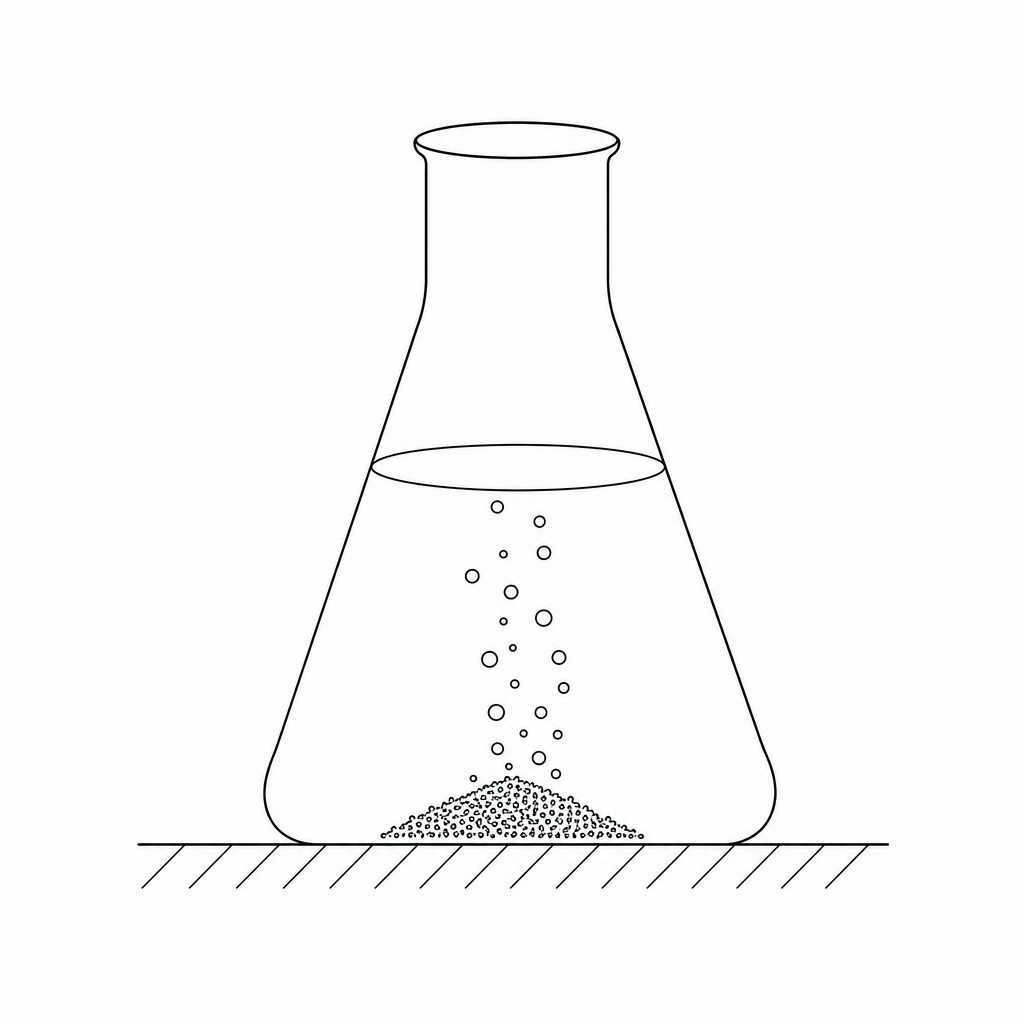
Complete the diagram to show how the student could collect the oxygen gas produced and measure its volume.
Practise Edexcel GCSE Chemistry Rates of reaction with exam-style questions for Foundation and Higher tier. 166 questions, matched to the Edexcel GCSE Chemistry (1CH0) specification and written in Paper 1 and Paper 2 style. Every question includes a full worked solution and mark scheme, so you can see where marks are awarded rather than just whether you got the answer right.

