Question 6
HThe diagram gives the masses of three gas samples in sealed containers. Container sizes are schematic and do not give information about gas volume or pressure.
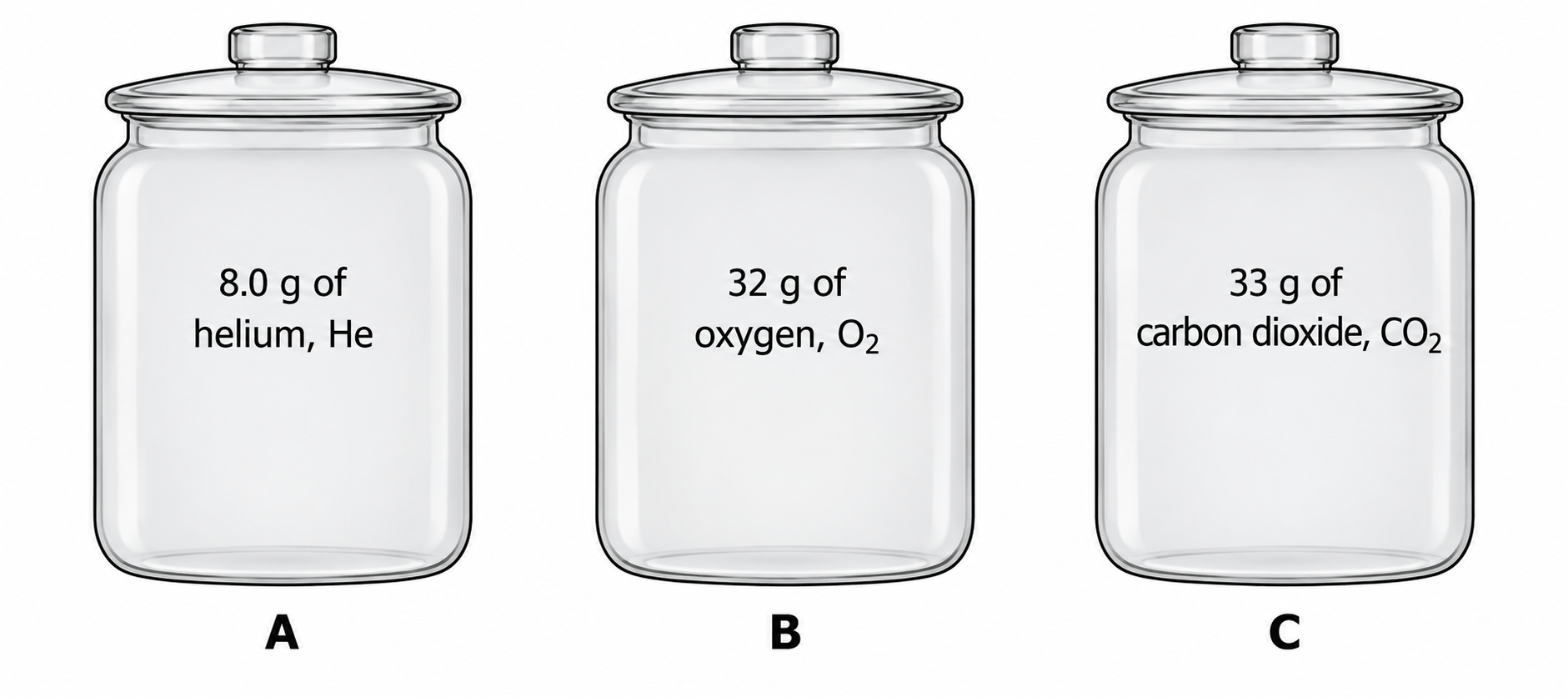
Use Ar(He)=4.0A_r(\mathrm{He})=4.0Ar(He)=4.0, Ar(C)=12.0A_r(\mathrm{C})=12.0Ar(C)=12.0, Ar(O)=16.0A_r(\mathrm{O})=16.0Ar(O)=16.0 and Ar(Mg)=24.0A_r(\mathrm{Mg})=24.0Ar(Mg)=24.0.
a.[4]
A student says, "A has the most gas particles, so A must also contain the greatest total number of atoms." Evaluate both parts of this statement by calculating the amounts of gas particles and atoms in all three samples. Treat one helium atom or one gas molecule as one gas particle.
b.[3]
Some carbon dioxide is removed from C. Calculate the mass that must be removed so that the remaining carbon dioxide contains the same total number of atoms as sample A.
c.[3]
In a separate experiment, all the oxygen originally in B is reacted with 36.0 g of magnesium:
2Mg+O2→2MgO\mathrm{2Mg+O_2\rightarrow2MgO}2Mg+O2→2MgO
Determine the limiting reactant and calculate the mass of magnesium oxide formed when the reaction is complete.
2.6 Calculations involving masses Questions
55 exam-style questions on Edexcel GCSE Chemistry 2.6 Calculations involving masses, covering 2.6.1 Relative formula mass and percentage composition, 2.6.2 Empirical and molecular formulae, 2.6.3 Conservation of mass, 2.6.4 Reacting masses and concentration in g dm⁻³, 2.6.5 The mole and the Avogadro constant, and 2.6.6 Limiting reactants and stoichiometry. Each one has a worked solution and a mark scheme showing where the marks go.