Question 7
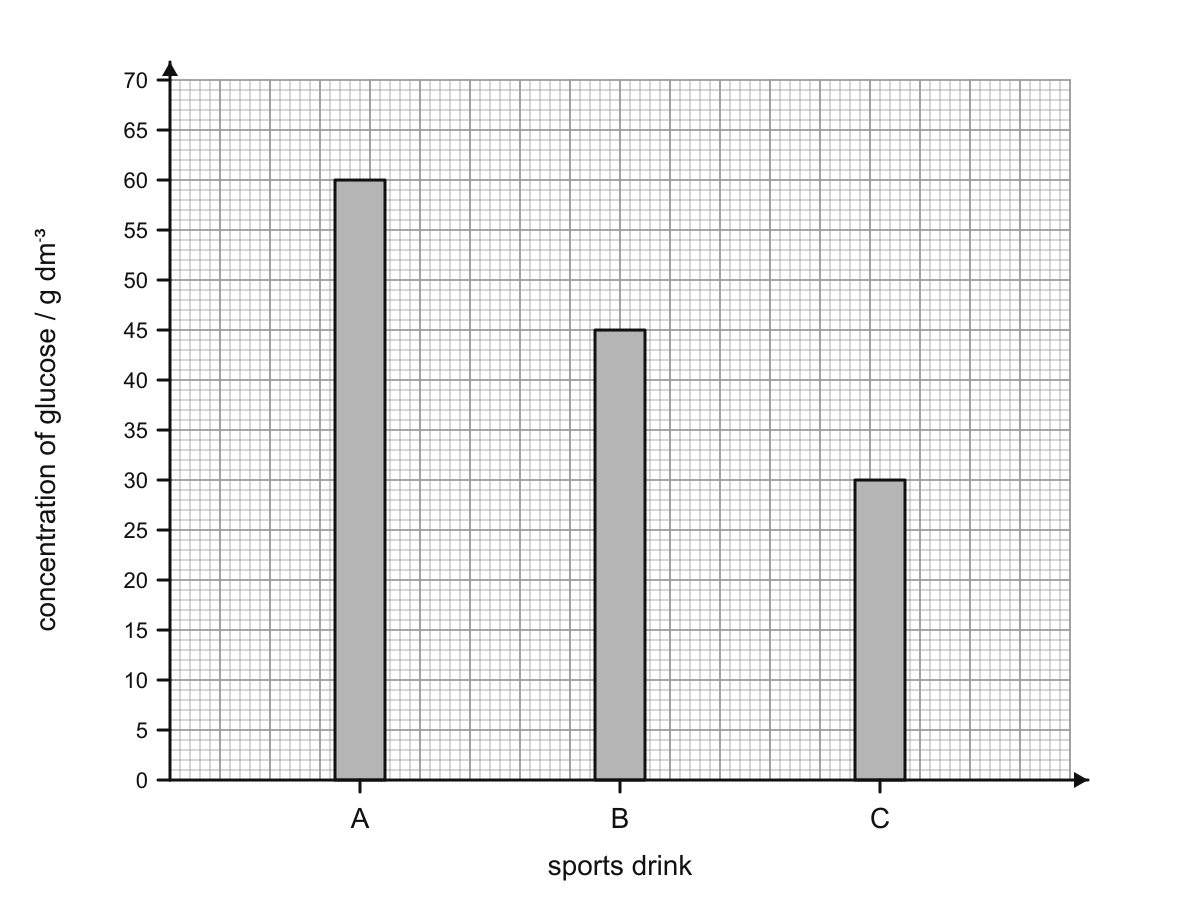
FThe graph gives glucose concentrations in three sports drinks. Assume that volumes add when drinks are mixed and that glucose does not react.
a.[4]
A technician mixes 200 cm3 of A with 300 cm3 of C. Use the graph to calculate the glucose concentration in the mixture, in g dm−3\mathrm{g\,dm^{-3}}gdm−3. Show your working.
b.[2]
Calculate the mass of glucose that must be dissolved in this mixture to give the same concentration as B. Assume its volume stays at 500 cm3.
c.[2]
A student instead averages the heights of the bars for A and C to predict the concentration in part (a). Explain why this gives the wrong answer for this mixture, and state when this method would be valid.
2.6 Calculations involving masses Questions
55 exam-style questions on Edexcel GCSE Chemistry 2.6 Calculations involving masses, covering 2.6.1 Relative formula mass and percentage composition, 2.6.2 Empirical and molecular formulae, 2.6.3 Conservation of mass, 2.6.4 Reacting masses and concentration in g dm⁻³, 2.6.5 The mole and the Avogadro constant, and 2.6.6 Limiting reactants and stoichiometry. Each one has a worked solution and a mark scheme showing where the marks go.