Antidiuretic hormone (ADH) is a peptide hormone synthesized by specialized neurones in the hypothalamus.
Describe how a neurone produces this specific polypeptide hormone from the information stored in its DNA.
Use terms from the list in your answer:
- transcription
- mRNA
- cytoplasm
- ribosome
- translation
- amino acids
Complete the sentences to explain the relationship between amino acids and proteins.
- Large macromolecules, such as polypeptides, constructed from repeating subunits linked by peptide bonds are categorized as …………………………\text{\dots\dots\dots\dots\dots\dots\dots\dots\dots\dots}………………………….
- The individual building-block molecules, such as amino acids, are referred to as …………………………\text{\dots\dots\dots\dots\dots\dots\dots\dots\dots\dots}………………………….
Drug K inhibits the release of ADH from the pituitary gland.
Patient A and Patient B both drank a large glass of water, but only Patient A took Drug K.
Look at the diagram showing a section of a kidney collecting duct in Patient A and Patient B:
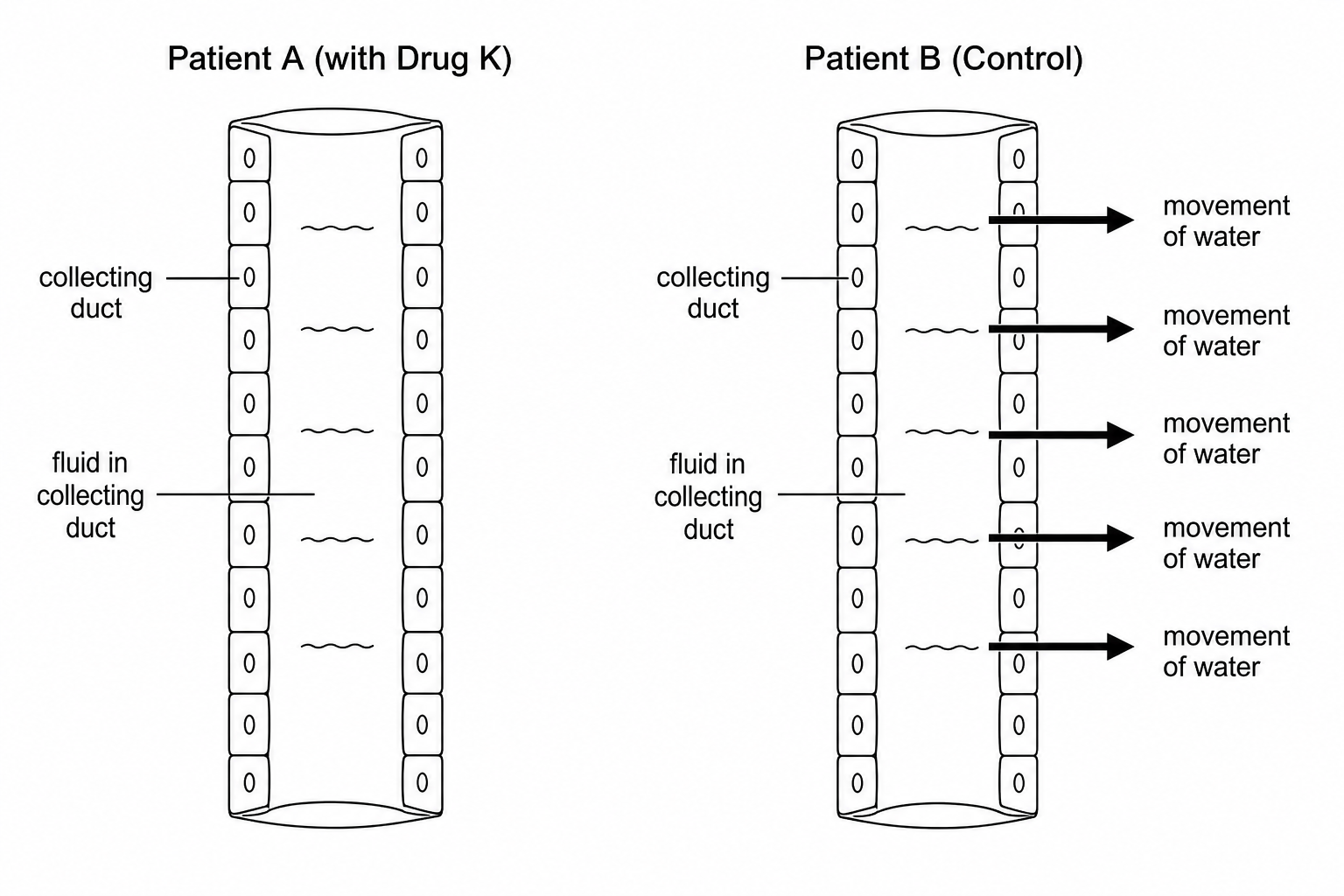
Explain how you can tell from the diagram that Patient A took Drug K.
Due to the action of Drug K, Patient A will produce a large volume of dilute urine. After Drug K has been fully metabolised and cleared from Patient A's body, the body's control mechanisms will act to restore the normal water potential of the blood, which has become dehydrated (having a low water potential).
Describe these control mechanisms.