Protein synthesis takes place inside cells.
Describe how a cell produces a specific protein from the information in DNA.
Use terms from the list in your answer:
- transcription
- mRNA
- cytoplasm
- ribosome
- translation
- amino acids
ADH is a protein hormone made up of amino acids.
Complete the sentences to explain the relationship between amino acids and proteins.
- Large molecules, like proteins, made of smaller repeating subunits are called …………………………\text{\dots\dots\dots\dots\dots\dots\dots\dots\dots\dots}………………………….
- The smaller subunit molecules, like amino acids, are called …………………………\text{\dots\dots\dots\dots\dots\dots\dots\dots\dots\dots}………………………….
Drug X stimulates the release of excess ADH.
Person C and D both drank a large glass of water, but only Person C took Drug X.
Look at the diagram showing a kidney tubule (nephron) in Person C and Person D:
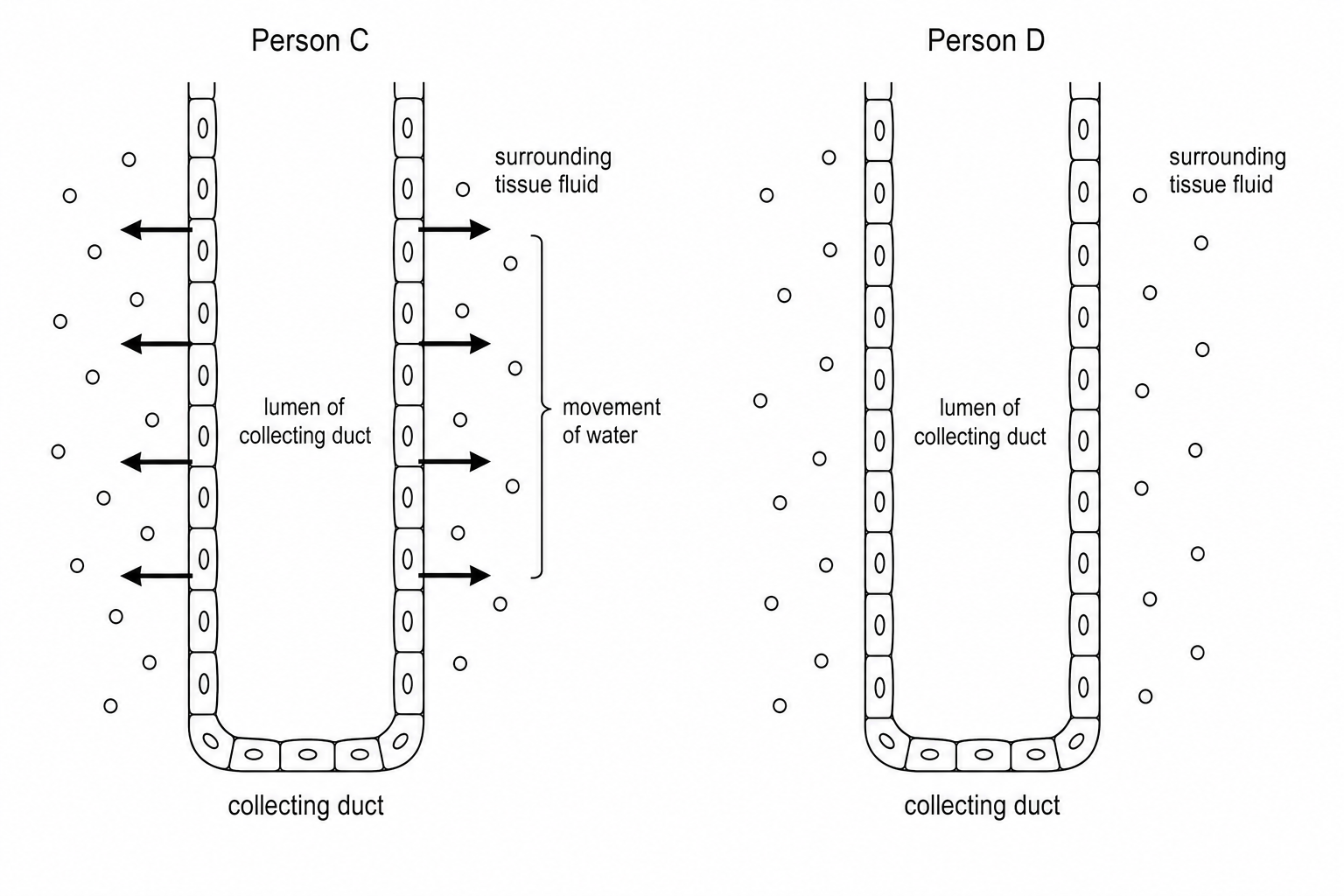
Explain how you can tell from the diagram that Person C took Drug X.
After Drug X has been cleared from Person C's body, the body's control mechanisms will correct the state of the blood, which has become over-hydrated (having a high water potential) due to the drug's effects.
Describe these control mechanisms.