Question 11
HA runner takes part in a 2-hour race on a hot day.
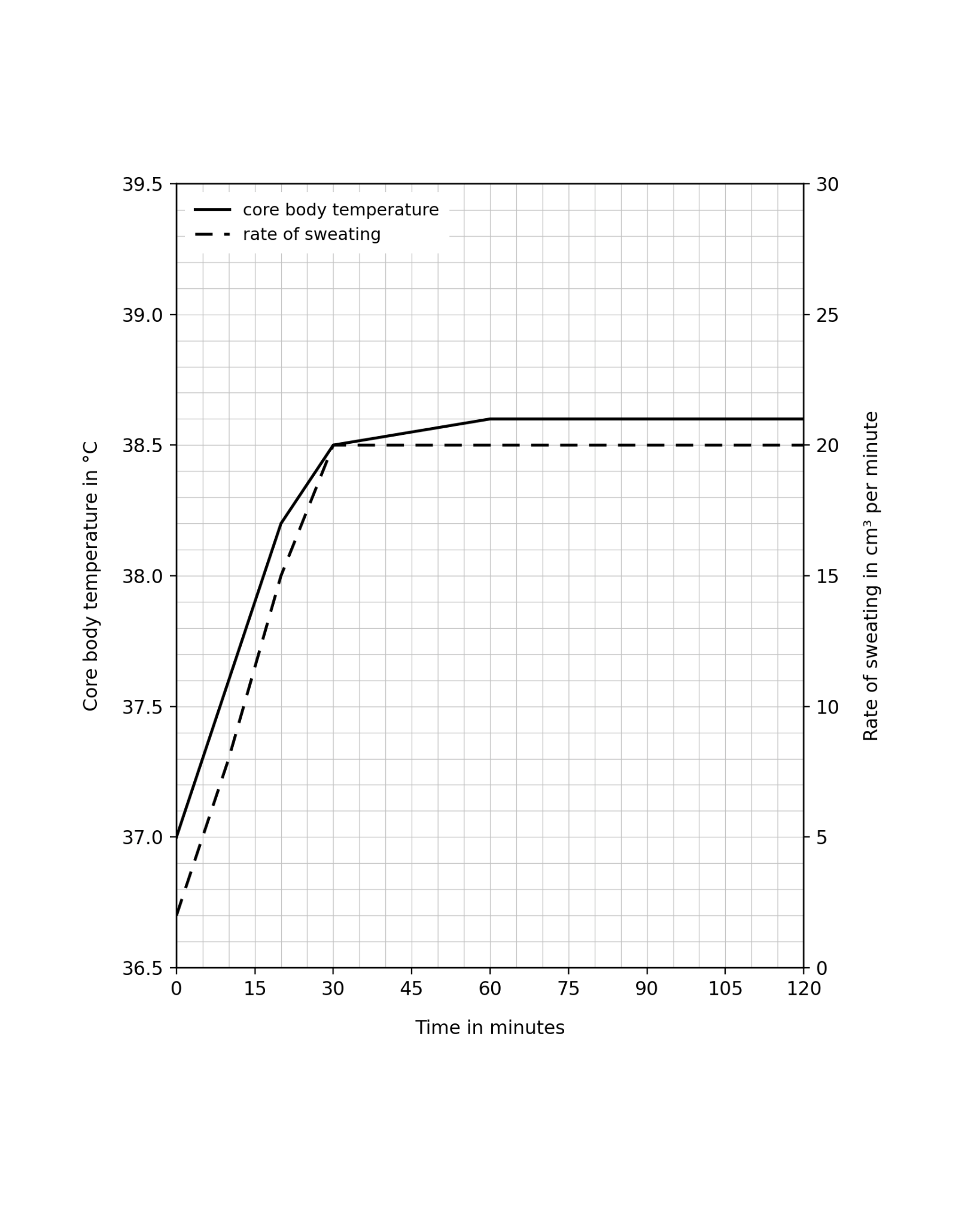
The Figure shows the runner's core body temperature and rate of sweating during the race.
Figure
a.[2]
Calculate the total volume of sweat produced between 30 minutes and 120 minutes.
Give your answer in dm3\text{dm}^3dm3.
b.[3]
Explain why the core body temperature stops rising after 30 minutes, even though the runner is still running.
c.[3]
The runner does not drink any water during the race.
Explain how the runner's kidneys respond to the water lost in sweat.
3.3 Maintaining internal environments Questions
72 exam-style questions on OCR GCSE Biology 3.3 Maintaining internal environments, covering 3.3.1 Importance of a constant internal environment, 3.3.2 The skin and body temperature, 3.3.3 Insulin and blood sugar, 3.3.4 Glucagon and blood sugar, 3.3.5 Type 1 and type 2 diabetes, 3.3.6 Osmotic changes in body fluids, 3.3.7 Kidneys and water balance, 3.3.8 Structure of the kidney and tubule, 3.3.9 ADH and kidney tubule permeability, and 3.3.10 Responses to temperature and osmotic challenges. Each one has a worked solution and a mark scheme showing where the marks go.