YouTube Channels GCSE Food and Nutrition: Enough?
YouTube channels GCSE Food and Nutrition can explain theory, but are they enough to pass? Learn what videos miss and build a complete revision plan.
A video can make revision feel wonderfully simple. Someone explains gelatinisation, demonstrates knife skills or summarises nutrients while you sit back and follow along. The difficult material begins to look familiar. Familiarity, however, is not the same as being able to recall, apply and evaluate it under assessment conditions.
If you are searching for YouTube channels GCSE Food and Nutrition revision, the short answer is this: videos can be extremely useful, but they are rarely enough on their own. GCSE Food Preparation and Nutrition assesses theoretical knowledge, practical competence, investigation, planning and evaluation. Watching can support these skills. It cannot replace practising them.
The strongest approach is to treat YouTube as one ingredient in a broader revision plan, not the entire meal.
What you actually need to pass
A complete preparation strategy should include:
- videos for explanations and demonstrations;
- your exam board specification as a content checklist;
- active recall without notes or playback controls;
- exam questions, past papers and mark schemes;
- practical cooking and food investigation experience;
- feedback from your teacher on technique and written analysis;
- targeted maths practice for ratios, percentages, data and graphs.
This distinction matters because the qualification is not assessed through recall alone. Across regulated GCSE Food Preparation and Nutrition qualifications in England, 50%50\%50% of the marks come from examination and 50%50\%50% from non-exam assessment. The assessment objectives cover knowledge, application, practical performance, analysis and evaluation.
A revision source that mainly helps you recognise information therefore covers only part of what you must eventually demonstrate.
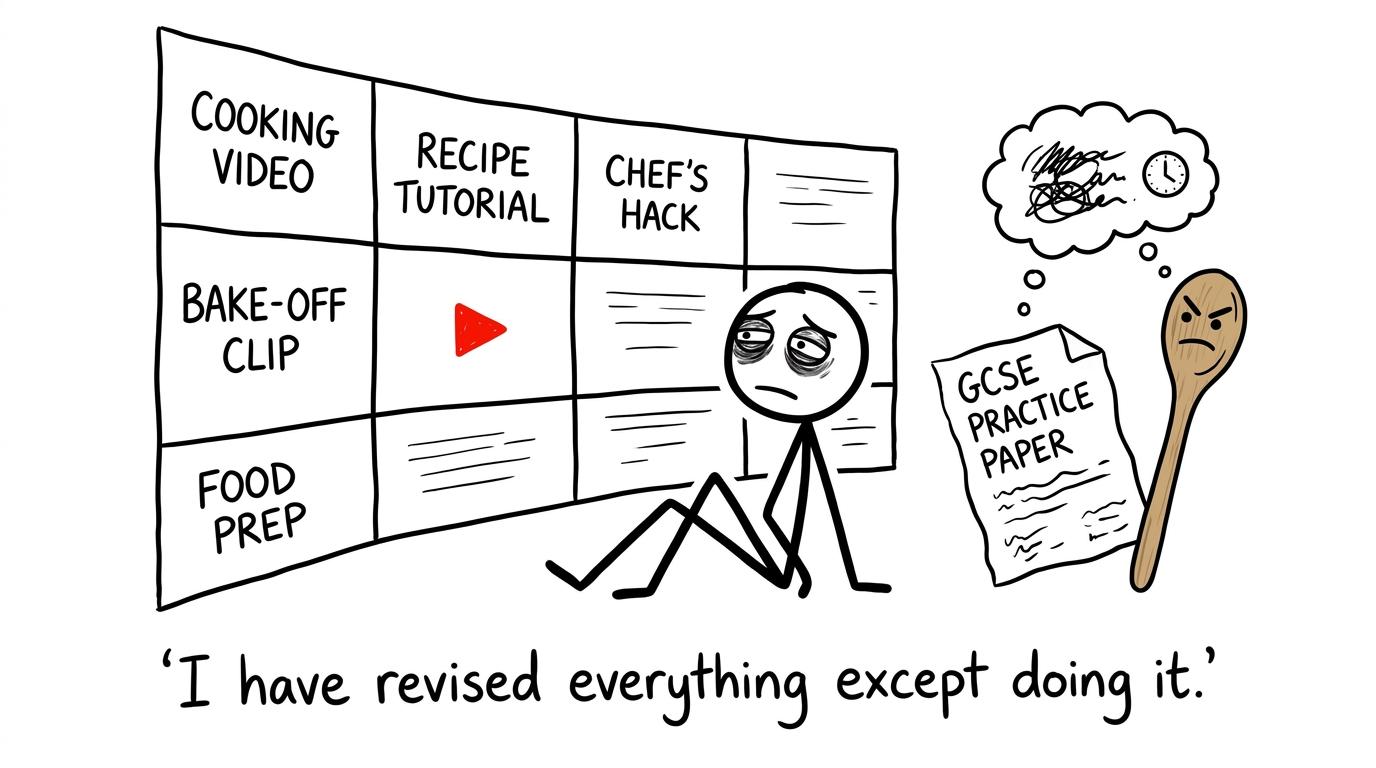 A student watching everything except doing practice
Why YouTube is genuinely useful
YouTube is particularly effective when a process is easier to understand by seeing it. A clear demonstration can show how a sauce changes as starch gelatinises, how gluten develops in dough or how equipment should be handled safely. Pausing and replaying a sequence can make an unfamiliar technique less intimidating before you practise it in the kitchen.
Videos can also help with:
- introducing a topic before a lesson;
- revisiting an explanation you did not understand initially;
- observing practical techniques from a useful camera angle;
- hearing technical vocabulary used in context;
- breaking a large specification into manageable sections;
- refreshing knowledge before answering questions.
There is an emotional benefit too. Starting a video has less friction than opening a blank page. On a difficult revision day, that can help you begin. But the ease of starting is precisely why you need a deliberate stopping point. After a short explanation, close the video and produce something yourself.
Why videos alone leave important gaps
The course includes substantial practical assessment
The exact structure and examination length depend on your exam board, so check whether you take AQA, OCR or Eduqas and use the correct current specification. However, the broad assessment balance is consistent: the written assessment accounts for half of the qualification, while non-exam assessment accounts for the other half.
That non-exam assessment includes a food investigation worth 15%15\%15% of the overall qualification and a food preparation assessment worth 35%35\%35%. It tests far more than whether you have seen a technique performed.
You need to plan, prepare, cook and present food safely. You also need to investigate ingredients, collect evidence, make justified decisions and evaluate outcomes. A creator can demonstrate a knife technique, but only practical repetition develops your own control, accuracy and timing.
Recognition can disguise weak recall
When a presenter names the functions of protein, the answer may seem obvious. Remove the presenter, the title card and the next suggested video, and the information can suddenly disappear.
This is the difference between recognition and retrieval. GCSE questions require you to retrieve relevant knowledge, select it and apply it to the context given. To test whether a video has produced learning, pause before the explanation and write what you already know. Afterwards, close it and reconstruct the main ideas from memory.
If you cannot explain the concept without replaying the video, it is not secure yet.
Videos are not automatically matched to your specification
A polished video may still be incomplete, outdated or aimed at another exam board. It might use different terminology, overlook a required content area or spend too long on material that your specification treats briefly.
Use the specification as the map and videos as possible routes through it. For every topic, ask:
- Is this required by my exam board?
- Has the video covered the full statement in the specification?
- Can I use the correct technical vocabulary?
- Can I answer an exam-style question on it?
Popularity is not evidence of complete specification coverage. Nor does a confident presentation guarantee accuracy. Cross-check explanations against your school materials, exam board documents and teacher guidance.
Watching does not teach mark-scheme precision
Food Preparation and Nutrition questions may ask you to describe, explain, justify, analyse or evaluate. Those commands are not interchangeable. An explanation needs connected reasoning; an evaluation needs a supported judgement rather than a list of facts.
Only answering questions and checking marking guidance reveals whether your knowledge is expressed precisely enough. This is the same lesson students discover through GCSE maths past-paper preparation: understanding a lesson is the beginning, while producing a mark-worthy response is a separate skill.
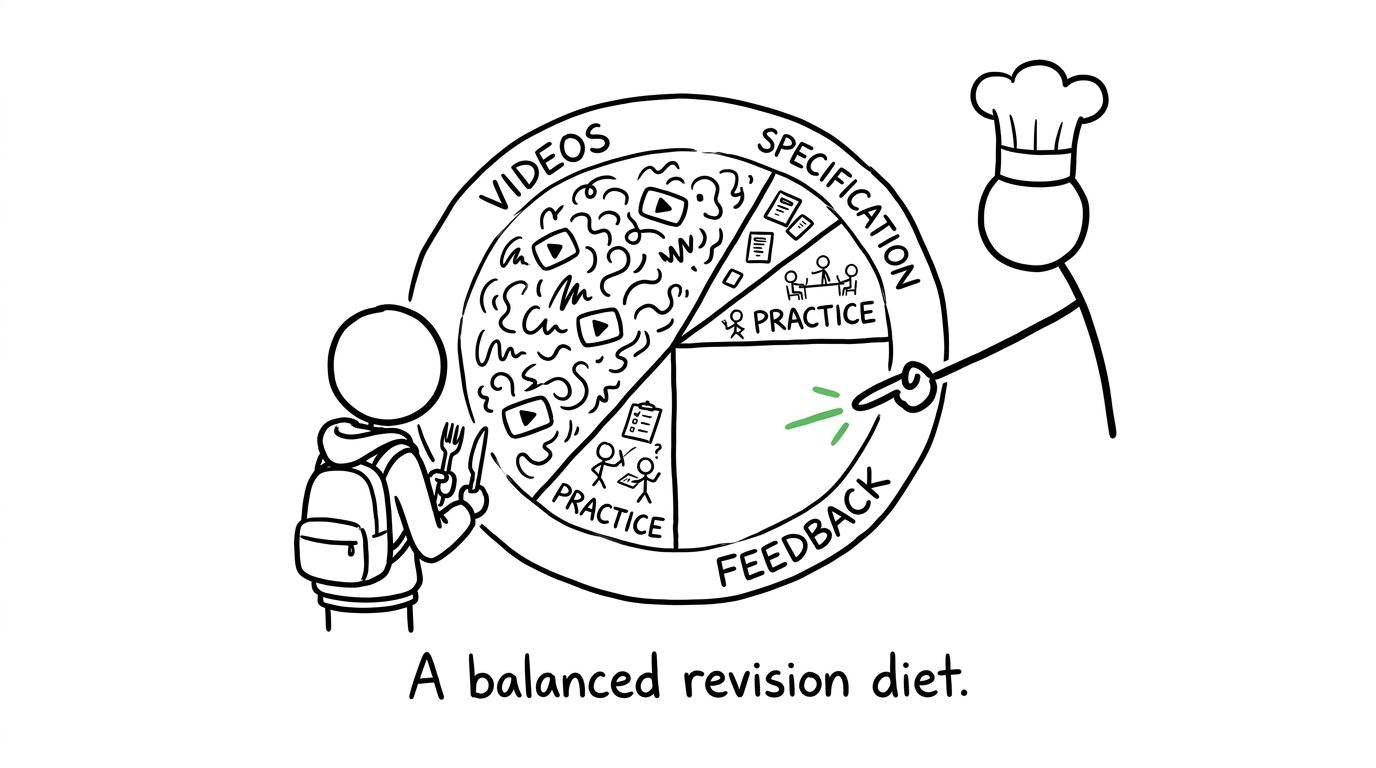 A deliberately unbalanced revision meal
How to turn a video into active revision
A useful video session has three stages.
Before watching
Choose one precise specification statement rather than browsing recommendations. Write down everything you can recall about it, then identify the question you want the video to answer.
This creates a purpose. Without one, it is easy to watch several related clips while never confronting the original gap.
While watching
Pause after each important section. Predict what comes next, label a diagram from memory or summarise the explanation in one sentence. Keep notes short enough that you must process the idea rather than transcribe the presenter.
A useful rule is that every few minutes of watching should create an action: retrieval, classification, comparison, planning or a question.
After watching
Close the video and complete one or more of these tasks:
- produce a blank-page summary;
- create and answer retrieval questions;
- explain a food-science process using a clear chain of reasoning;
- answer an exam question under a time limit;
- mark the response and rewrite weak sections;
- plan how the principle could be observed safely in practical work.
The principle resembles MathsGenie's approach to finding weak GCSE revision topics: diagnose the gap, repair one skill, test it and then return later to see whether it has stayed repaired.
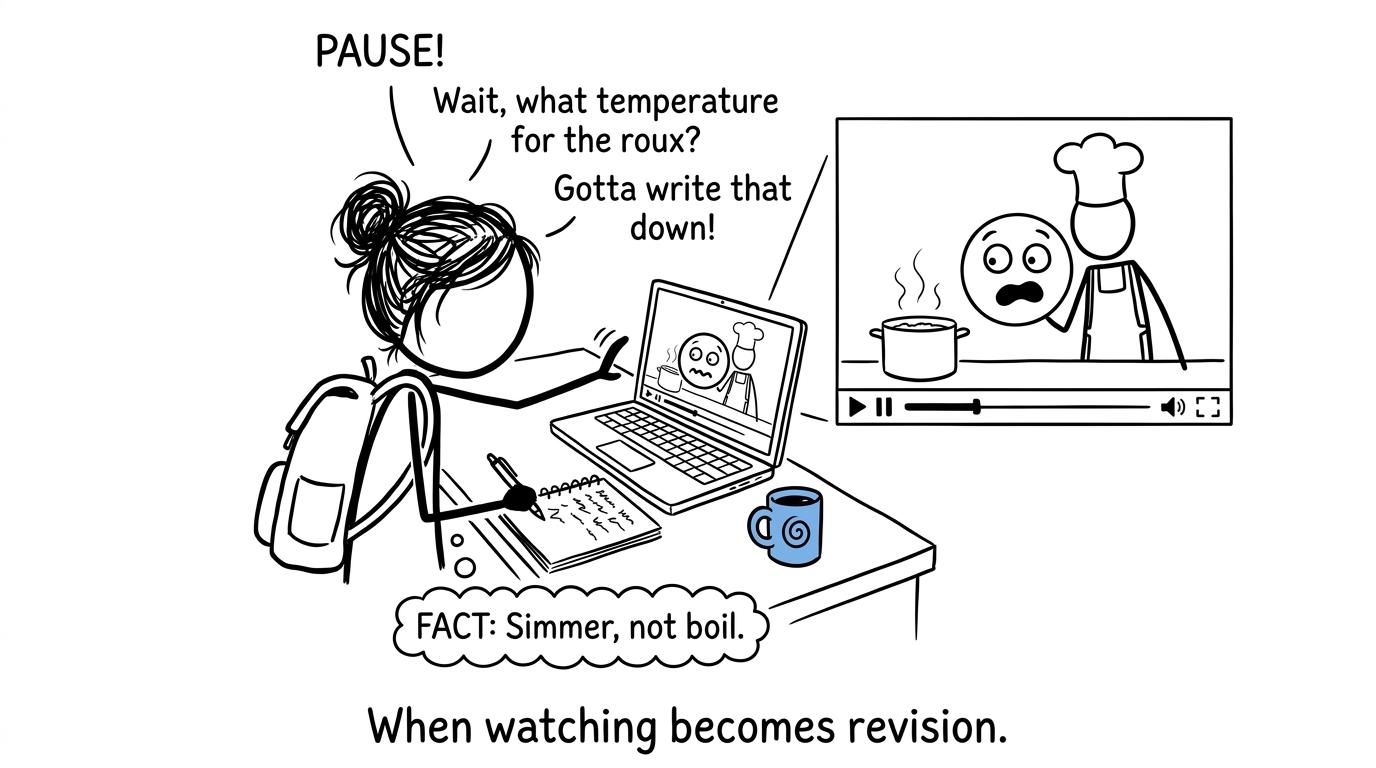 A surprised play button watching active revision happen
The maths you should not overlook
Food Preparation and Nutrition is not a GCSE maths paper, but quantitative skills still matter. Recipes, nutritional information, investigations and sensory data can involve:
- scaling quantities using ratio and proportion;
- converting units accurately;
- calculating percentages;
- interpreting tables, charts and graphs;
- calculating or comparing averages;
- describing patterns in experimental results.
For percentage calculations, the underlying relationship is:
percentage=partwhole×100\text{percentage}=\frac{\text{part}}{\text{whole}}\times 100percentage=wholepart×100For repeated measurements or sensory scores, the mean is:
mean=sum of valuesnumber of values\text{mean}=\frac{\text{sum of values}}{\text{number of values}}mean=number of valuessum of valuesThese skills should be practised separately so that the arithmetic does not obstruct the food knowledge. MathsGenie's averages from frequency tables revision can strengthen data handling, while the scatter graphs question bank develops careful interpretation of relationships.
Students taking GCSE Statistics can find further lessons and questions in the Edexcel GCSE Statistics revision hub, then practise complete assessments through the GCSE Statistics past-paper collection.
Build a balanced weekly routine
A realistic routine alternates input with output. You might use one session to learn or repair knowledge, another to retrieve it, and a later session to apply it under timed conditions. Practical work must fit around your school's facilities and teacher supervision, but theory revision can follow a repeatable cycle:
- select one specification area;
- use a short video or revision lesson;
- close all resources and retrieve the key knowledge;
- complete relevant questions;
- check the mark scheme;
- record the precise reason for each lost mark;
- revisit the topic after a gap.
Do not organise revision around what the algorithm recommends next. Organise it around evidence of what you cannot yet do.
If planning feels overwhelming, adapt the structure in MathsGenie's one-month GCSE revision plan. The subjects differ, but the underlying sequence: diagnose, practise, mark and revisit, transfers well. The best order for learning GCSE maths topics also shows how prerequisites and exam practice can be arranged rather than mixed randomly.
Common mistakes when revising with YouTube
Measuring progress in hours watched
Finishing a playlist shows that content played. It does not show what you can recall or apply. Measure completed questions, corrected misconceptions and securely demonstrated skills instead.
Copying attractive notes
Detailed notes can feel productive while demanding little retrieval. Reduce notes to prompts, questions and concise explanations that you can test later.
Following one creator as the entire course
Even an excellent channel may not cover every specification detail or your board's assessment language. Maintain a checklist based on official requirements.
Ignoring practical weaknesses
Watching skilled hands can create false confidence. Practise techniques under appropriate school or adult supervision, following food safety guidance and your teacher's instructions.
Avoiding past questions until the end
Questions reveal gaps early. Use them throughout the course, not merely as a final test. The wider reasoning is explored in MathsGenie's guide to GCSE predicted topics and exam practice.
Treating every error as a knowledge problem
Some marks are lost through weak command-word responses, vague vocabulary, poor data interpretation or missing justification. Classify the reason before choosing the remedy.
YouTube is a tool, not a complete strategy
Free videos can explain difficult concepts, model techniques and make revision easier to start. They may become one of your most valuable resources. But passing GCSE Food Preparation and Nutrition requires evidence of knowledge, application, practical competence, analysis and evaluation. No playlist can perform those actions for you.
Build your preparation around the specification, practical experience, active recall, exam questions, mark schemes and teacher feedback. Use videos where they genuinely improve understanding, then switch from watching to doing.
MathsGenie can support the numerical side of that journey. Explore the full list of GCSE maths topics by board and tier, use free revision lessons and practice questions to repair weak skills, and develop exam confidence with mini tests, past papers, predicted papers, mark schemes and video solutions. The aim is not to consume more revision. It is to become able to perform when the help is no longer on the screen.