

YouTube Channels for GCSE Astronomy: Are They Enough?
YouTube channels GCSE astronomy can explain key ideas, but videos alone are not enough. Discover the observations, maths and exam practice you need.
A video can make a difficult idea feel obvious. The animation moves, the narrator explains an orbit, and everything appears to click. Then you open an exam question and cannot decide what to write.
That gap matters. YouTube channels GCSE astronomy students use can be excellent for explanations, demonstrations and visualising space. But no, free YouTube content alone is unlikely to be enough for reliable exam preparation. You also need complete specification coverage, mandatory observational experience, active recall, calculation practice, past-paper questions and honest marking.
The issue is not that videos are poor. It is that watching and performing are different skills.
The short answer: what do you actually need?
A strong GCSE Astronomy revision system should include:
- videos for first explanations and difficult visual ideas;
- the current Pearson Edexcel specification as a coverage checklist;
- notes or retrieval questions that force you to recall information;
- one unaided and one aided astronomical observation completed through your centre;
- calculation, graph and data-analysis practice;
- official astronomy past papers and mark schemes;
- timed practice for short answers, calculations and extended responses;
- an error log showing exactly where marks are being lost.
YouTube can therefore be one part of the system. It should not be the whole system.
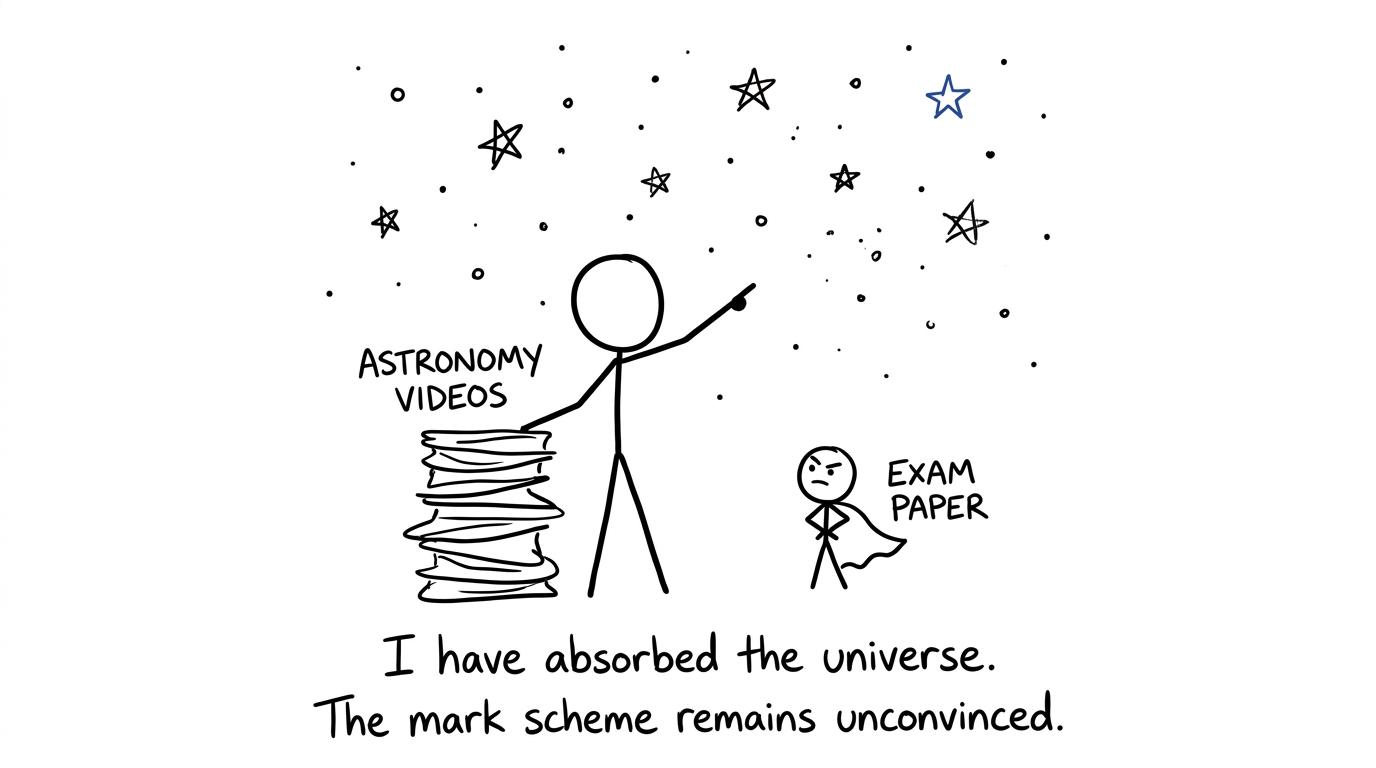 A student discovers that understanding the universe does not automatically impress a mark scheme
What GCSE Astronomy actually assesses
In England, the current qualification is Pearson Edexcel GCSE Astronomy, specification 1AS0. Unlike GCSE Maths, it is untiered: there are no separate foundation and higher papers.
The qualification has two equally weighted written examinations:
- Paper 1, Naked-eye Astronomy, covers the first eight specification topics;
- Paper 2, Telescopic Astronomy, covers the remaining eight topics;
- each paper lasts 111 hour 454545 minutes;
- each paper is worth 100100100 marks and 50%50\%50% of the qualification.
Questions can include multiple-choice items, short responses, calculations, graphs and extended open responses. Both papers also assess ideas across connected topics, so memorising each chapter as an isolated list is risky.
The assessment objectives explain why passive video viewing has limits. The current weighting is 40%40\%40% for knowledge and understanding, 40%40\%40% for applying that knowledge, and 20%20\%20% for analysing and evaluating information, data, methods and observations.
A clear video can support the first category. It cannot prove that you can apply an unfamiliar idea or evaluate an observational method without prompts.
What YouTube channels do well
Astronomy is unusually visual. Videos can show the changing appearance of the Moon, compare models of the Solar System, animate stellar evolution and make immense scales easier to imagine.
They are particularly useful when a textbook diagram feels static. A careful animation can help you understand that apparent motion depends on the observer's position, or that a star's life cycle depends on its initial mass. You can pause, replay and hear the idea expressed in different words.
Videos are also accessible. A student beginning independent revision can explore a topic without buying another resource. If one explanation does not work, another may.
But the useful question is not, “Did this video make sense?” It is, “What can I now produce without the video?”
After watching, close the tab and write the key idea from memory. Label a diagram. Explain a cause-and-effect chain. Answer a question. If nothing can be retrieved, the video created familiarity rather than durable knowledge.
Why videos alone leave important gaps
You cannot verify full coverage from a playlist title
A playlist may say “complete GCSE Astronomy” while following an older course, omitting observational skills or spending time on attractive material outside the specification. Individual videos may also use terminology that differs from the Pearson mark scheme.
Use the current specification as your master checklist. For every statement, classify your confidence as secure, uncertain or not started. A channel is useful when it helps you close those gaps. It should not decide what the gaps are.
Watching does not rehearse exam decisions
An examiner does not ask whether an explanation looked convincing on screen. You may have to select relevant information, interpret a graph, compare methods, show a calculation or build a reasoned conclusion.
Those decisions only become easier through questions. The same principle applies in maths: explanation begins the process, while practice reveals whether the method survives independently. MathsGenie's guide to using past papers at the right stage explains how paper practice can move from short diagnostic sections to timed examination work.
Feedback is missing
YouTube usually tells you what the presenter knows. It does not tell you why your response lost a mark.
A mark scheme can reveal that you omitted a comparison, failed to use data, gave an observation without an explanation, or rounded too early. That feedback turns a vague weakness into a repairable one.
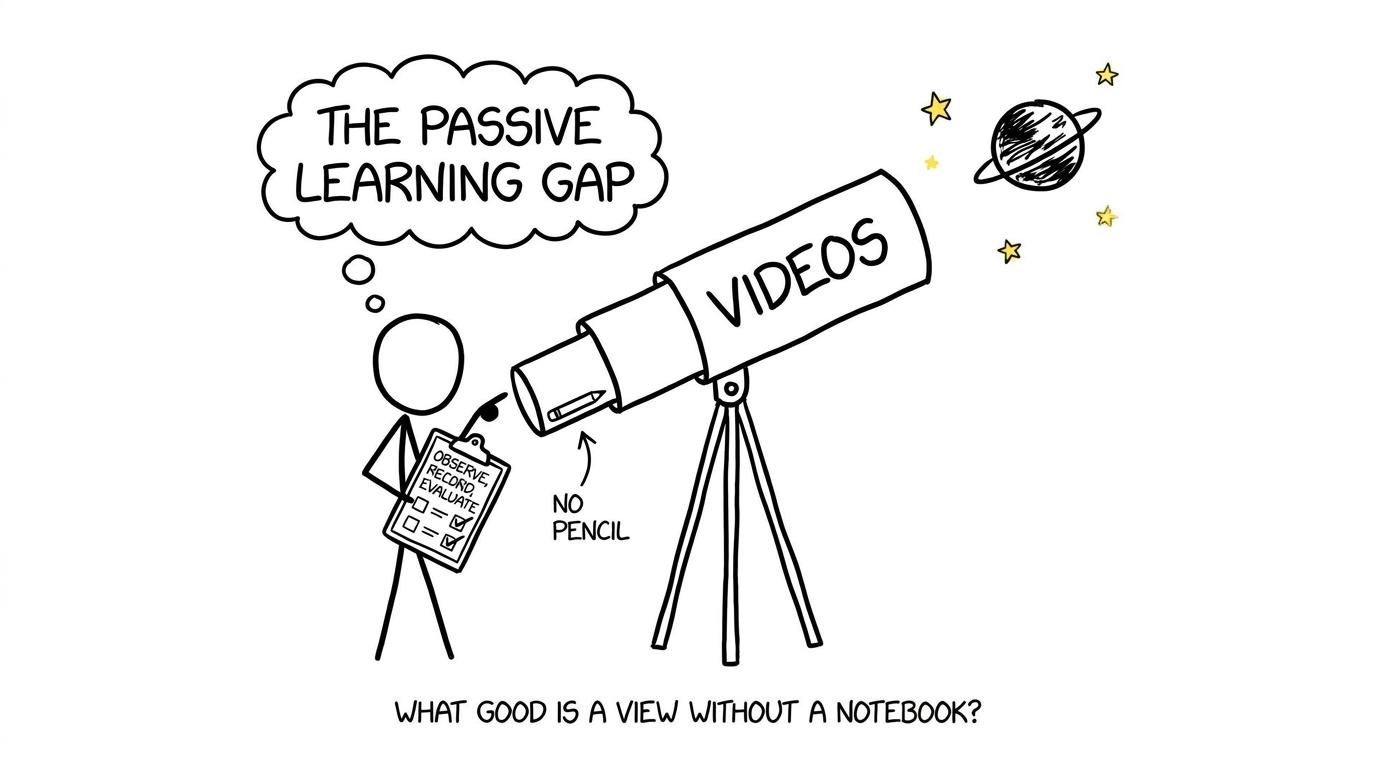 A telescope is useful, but it has forgotten to bring the observation checklist
The observational work YouTube cannot replace
GCSE Astronomy requires students to undertake at least one unaided and one aided observation. Centres certify that these have been completed. The activities are not coursework contributing separate marks to the final grade, but the knowledge and skills developed through them are assessed in the written papers.
The official subject requirements expect students to develop experience in planning, making, analysing and evaluating observations. That includes selecting suitable equipment, recording relevant conditions, presenting data, identifying limitations and suggesting improvements.
A video can demonstrate dark adaptation or show how a telescope is set up. It cannot give you your own experience of making decisions when visibility is poor, conditions change or the recorded data are less tidy than expected.
Complete these activities through your school, college or registered centre and follow its safety guidance. Never observe the Sun directly or improvise solar-viewing equipment. Your centre should provide appropriate instructions and supervision.
Treat each observation as exam preparation. Know the aim, variables, equipment, risks, recording method, likely errors and possible improvements. That knowledge is far more valuable than simply remembering that the activity happened.
Do not neglect the maths in GCSE Astronomy
At least 20%20\%20% of GCSE Astronomy marks reward mathematical skills in an astronomical context. The required skills include numerical computation, ratios, standard form, significant figures, graphs, geometry and trigonometric ideas.
Large and small quantities make standard form revision particularly useful. You should recognise the structure
a×10n,1≤a<10,a \times 10^n, \qquad 1 \leq a < 10,a×10n,1≤a<10,and work accurately with positive and negative powers.
You may also need to interpret scales, draw or read graphs and use proportional reasoning. If graph handling is uncertain, revisit drawing linear graphs. For angular and right-triangle skills, SOHCAHTOA revision can strengthen the underlying technique.
These MathsGenie resources support the mathematical machinery rather than replacing astronomy-specific teaching. Always return to GCSE Astronomy questions, where the difficulty often lies in choosing the correct mathematics from the scientific context.
A revision method that makes videos useful
The most effective approach is a repeating loop rather than a growing watch-later list.
Before watching
Choose one precise specification statement. Try to recall what you already know and write one question you want the video to answer. This prevents unfocused browsing.
During the video
Pause only to record essential definitions, diagrams or relationships. Do not copy every sentence. Notes that reproduce the narration can feel productive while requiring almost no thought.
Immediately afterwards
Close the video. From memory:
- summarise the idea in a few sentences;
- recreate one important diagram;
- list any conditions or limitations;
- answer several specification-matched questions.
Then mark the questions. Record the exact error, not merely the topic. “Forgot to compare both observations” is more useful than “bad at telescopes”.
Later in the week
Return to the topic without rewatching first. If retrieval fails, use a short section of the video as a repair tool. Then try another question.
This learn-practise-mark-revisit pattern is also central to MathsGenie's one-month GCSE revision plan. Astronomy and maths involve different content, but both reward a revision process built around retrieval, feedback and repeated performance.
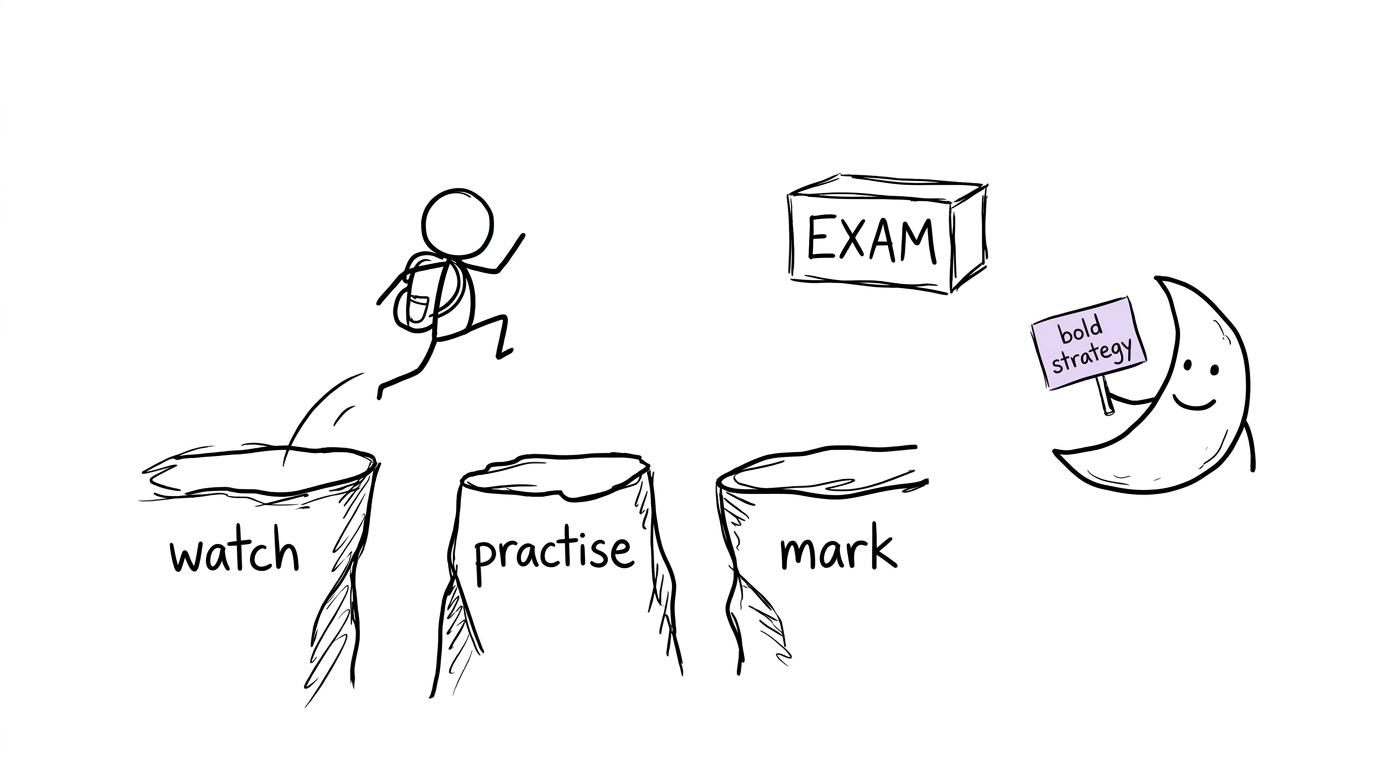 A student attempts to jump from watching directly into the exam
How to choose useful GCSE Astronomy videos
Do not judge a channel by subscriber count or production quality alone. Check whether each resource:
- names the current Pearson Edexcel 1AS0 specification;
- distinguishes examinable content from interesting extra astronomy;
- uses accurate diagrams and vocabulary;
- discusses observational planning and evaluation, not just facts;
- includes calculations, data and unfamiliar applications;
- avoids unsafe observational advice;
- encourages questions rather than promising that watching is enough.
A polished channel can still be incomplete. A modest video can be excellent for one stubborn concept. Build your revision around the specification and use individual videos according to need.
Common mistakes when revising astronomy online
Binge-watching an entire playlist: Long viewing sessions create familiarity but provide little evidence of recall. Break them into short topic-question cycles.
Ignoring the observations: Watching someone else's telescope recording is not the same as completing the required aided and unaided activities through your centre.
Using only summary videos: Fast recaps are helpful near the exam, but they may omit explanations, evaluation and less memorable specification details.
Avoiding calculations: If the science feels more interesting than the arithmetic, mathematical marks can quietly disappear. Use MathsGenie's broader GCSE maths revision resources to repair weak techniques.
Completing questions without marking them: Practice only improves performance when you identify why marks were lost. In maths, Edexcel GCSE past papers and mark schemes provide a clear model for this feedback loop.
Treating predicted content as certainty: Predictions cannot guarantee what will appear. MathsGenie's GCSE predicted papers are valuable for fresh maths practice, but they are not GCSE Astronomy papers and should never replace complete specification coverage in astronomy.
Build a complete system, not a perfect playlist
YouTube can help you pass GCSE Astronomy. It can make difficult processes visible, provide alternative explanations and lower the cost of getting started. But it cannot complete your observations, expose every weak answer, reproduce exam pressure or guarantee specification coverage.
Use videos to learn. Use retrieval to remember. Use observations to understand method. Use astronomy past papers and mark schemes to learn how understanding earns marks.
MathsGenie can support the mathematical side of that journey with free revision lessons, videos, practice questions, mini tests, past papers, predicted papers, mark schemes and video solutions. Start by identifying the maths that astronomy keeps exposing, perhaps standard form, graphs, ratio or trigonometry to then use MathsGenie's structured GCSE revision approach to close those gaps methodically.
The goal is not to watch enough astronomy. It is to become able to explain, calculate, observe and evaluate when the screen is no longer there.










