Wrong Tier GCSE German: What Happens Next?
Wrong tier GCSE German entry? Find out how Foundation and Higher affect grades, when a tier can be changed, and who to contact before the exam.
It is an unsettling moment: you have been revising for one GCSE German tier, then discover that your exam entry appears to show the other. The important answer is that a wrong tier GCSE German entry can often be corrected before the exam, but you must tell your German teacher and school exams officer immediately. Do not assume it will update automatically, and do not wait until exam day.
Your school or exam centre controls the official entry. Whether it can still be changed depends on the exam board's deadlines and, crucially, whether your speaking assessment has already taken place. AQA, Pearson Edexcel and Eduqas require students to take every German component at the same tier. That means the speaking, listening, reading and writing assessments must all be Foundation or all be Higher.
Here is the short checklist:
- Check whether your entry says Foundation or Higher.
- Tell your German teacher and exams officer in writing.
- Ask whether the entry can still be amended before the speaking assessment.
- Confirm which tier you should revise for while the school investigates.
- Request written confirmation when the entry has been corrected.
- If you notice the problem on an exam day, tell an invigilator before opening or writing in the paper.
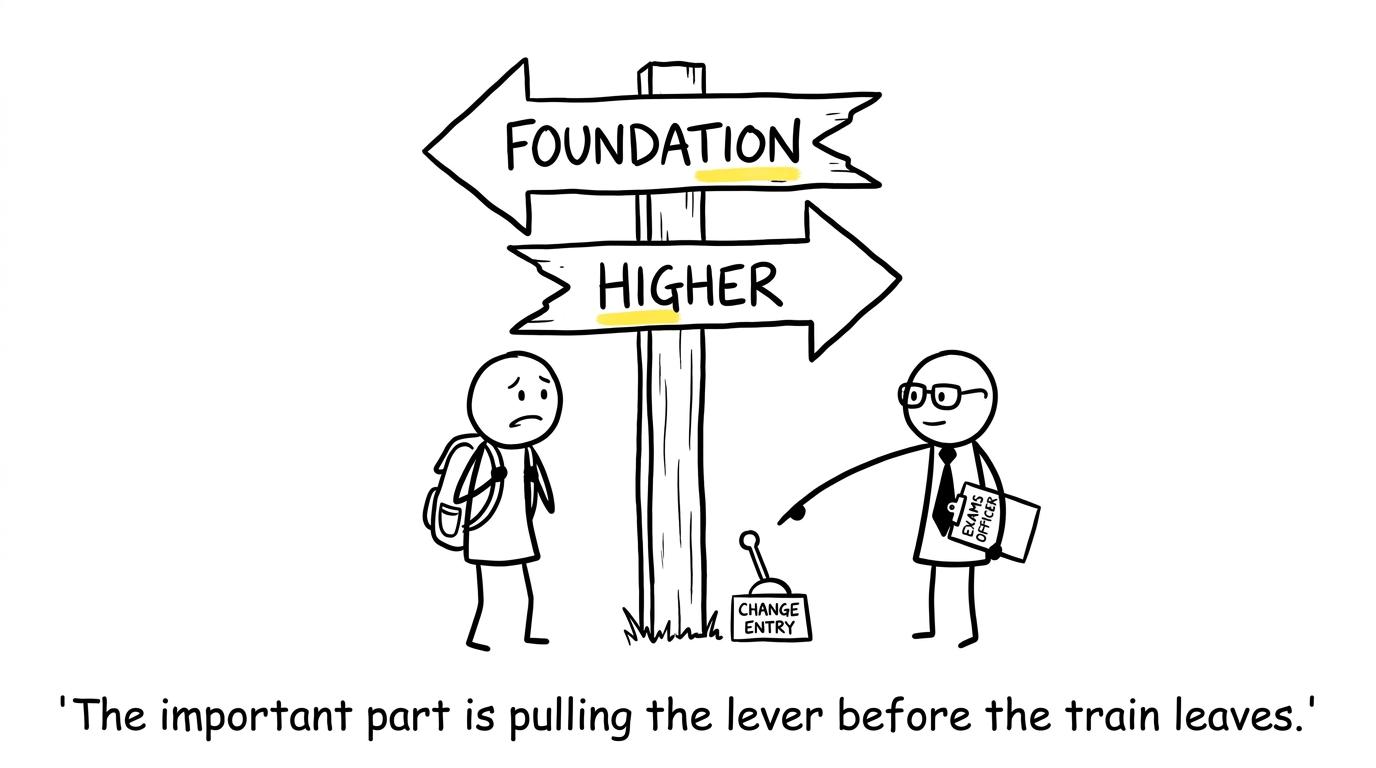 A student choosing between Foundation and Higher while an exams officer points towards the entry-change lever
What does the wrong tier mean in GCSE German?
GCSE German is tiered because the papers are designed for different grade ranges and levels of linguistic demand.
Foundation tier makes grades 111 to 555 available. Higher tier normally makes grades 444 to 999 available, with a narrow grade 333 safety net for a student who falls just below the required standard for grade 444. Below that safety-net threshold, the result is unclassified.
The consequences therefore depend on which way the error has gone.
Entered for Foundation instead of Higher
If you sit Foundation tier, the highest available grade is 555. Even an excellent performance cannot produce a grade 666, 777, 888 or 999 because those grades are outside that tier's range.
This matters if your target, predicted performance or next-step plans require a grade above 555. However, Foundation is not an inferior qualification. A grade 444 or 555 has the same value whether it was achieved on Foundation or Higher, and the certificate does not show the tier entered.
Entered for Higher instead of Foundation
Higher tier contains more demanding language and targets grades 444 to 999. A student who narrowly misses grade 444 may receive the permitted grade 3‘,butthisisonlyasmallsafetynet.AlowermarkcanresultinaUratherthanagrade3`, but this is only a small safety net. A lower mark can result in a U rather than a grade 3‘,butthisisonlyasmallsafetynet.AlowermarkcanresultinaUratherthanagrade1ororor2$.
That does not mean every student predicted a grade 444 should automatically take Higher. Official guidance indicates that Foundation can be an appropriate entry for students expected to achieve grade 444 or 555. The right choice is the paper on which the student can demonstrate their knowledge most reliably.
This principle will feel familiar to maths students. The GCSE Maths topics by exam board and tier guide explains the equivalent Foundation and Higher grade ranges in maths, although the subject content and assessment structure differ from German.
Can a wrong GCSE German tier be changed before the exam?
Usually, yes, provided the school acts early enough and complies with the board's entry procedures.
Exam entries are submitted by the school or registered exam centre. Students cannot log into an exam-board account and change their own tier. Your exams officer must amend the entry using the centre's official system.
Exam boards publish an initial entry deadline and later dates after which amendment or late-entry charges may apply. A board accepting a late amendment does not necessarily mean that every change remains operationally possible. Schools also set internal deadlines, often earlier than the board's published date, so that entries, access arrangements and examination materials can be checked.
For example, official AQA guidance for the summer 202620262026 series allowed tier amendments before its amendment deadline and treated changing an existing student's tier as an entry amendment. Pearson's German administration guidance stated that a change should be completed before the speaking assessment. Deadlines change between exam series, so your exams officer must check the current board guidance rather than relying on a date found in an old email or online post.
The practical lesson is simple: an early message creates options. Silence removes them.
Why the speaking assessment matters
The speaking assessment is part of the tiered qualification, not a separate untiered event. Its tasks and timing depend on the tier. Once you have completed a Foundation speaking assessment, the centre cannot simply give you Higher listening, reading and writing papers later. Mixed-tier entry is not permitted.
AQA and Pearson Edexcel assess speaking, listening, reading and writing, and all four must be taken at one tier. Eduqas also requires every component to be completed at the same tier. OCR is a major GCSE maths board, but it does not currently offer the reformed GCSE German qualification discussed here, so check the board printed on your entry information rather than assuming it matches your maths board.
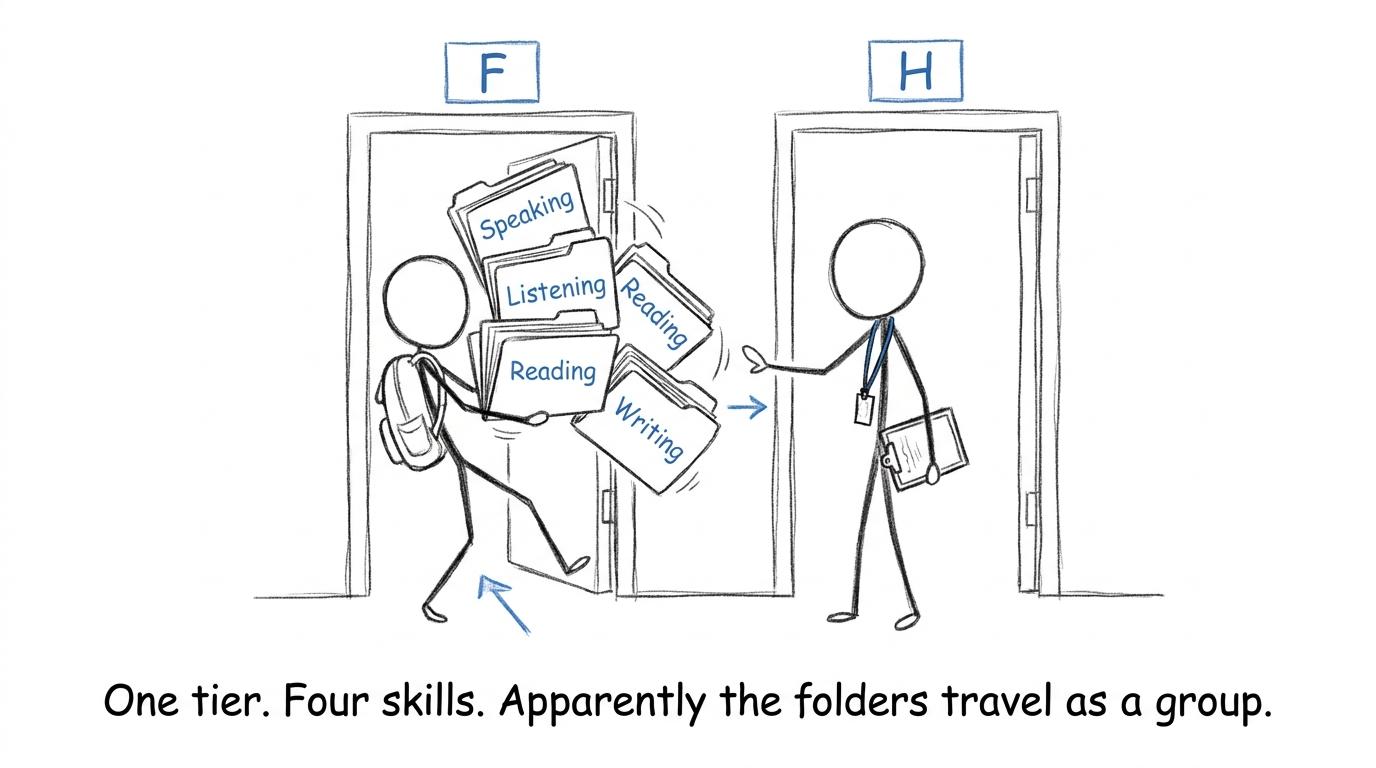 Four German assessment folders attempting to travel through different tier doors
What should you do if you think your entry is wrong?
Check the evidence calmly
Look at your statement of entry, candidate timetable or information supplied by your school. Common indicators include the word “Foundation” or “Higher”, or an entry code ending in “F” or “H”. Codes differ by board, so ask the exams officer to interpret anything unclear.
Do not rely solely on the tier used in a mock. A school may use a Foundation mock while considering a Higher entry, or change its recommendation after reviewing later evidence. The official entry is the record that matters.
Contact the right people immediately
Tell both your German teacher and exams officer. A useful message should include:
- your full name and candidate number, if known;
- the tier currently shown;
- the tier you expected;
- whether you have already completed speaking;
- a request for the entry to be checked;
- a request for written confirmation of the outcome.
Be direct without being confrontational. The first goal is to establish whether this is an administrative error, an outdated document or a deliberate tier decision.
Ask why the tier was chosen
Sometimes “wrong” means the entry differs from what the student hoped for, rather than from what the school intended. Ask what evidence informed the decision: mock results, performance across all four skills, classroom assessments and the risk attached to each tier.
One strong writing task does not necessarily prove that Higher is best if listening and speaking results remain insecure. Equally, an old mock result should not be the only evidence if your performance has changed substantially.
If you disagree, ask for the decision to be reviewed by the head of languages or another appropriate senior member of staff. Present recent evidence rather than arguing that Higher simply sounds better.
What if you discover the error on exam day?
Tell an invigilator immediately, ideally before the paper is opened. State which tier you expected and ask them to check your entry with the exams officer.
Do not swap papers with another student, leave the room to find a teacher or begin a different paper without authorisation. Exam staff need to follow secure procedures and confirm what the centre has officially entered.
If you have already completed the speaking assessment at one tier, the remaining papers should normally match it. This makes an exam-day discovery particularly urgent, but it also limits what can be changed. The centre may need to contact the awarding organisation for case-specific instructions.
An invigilator cannot personally redesign your entry or promise a particular result. Their job is to stop the situation becoming worse and alert the people authorised to resolve it.
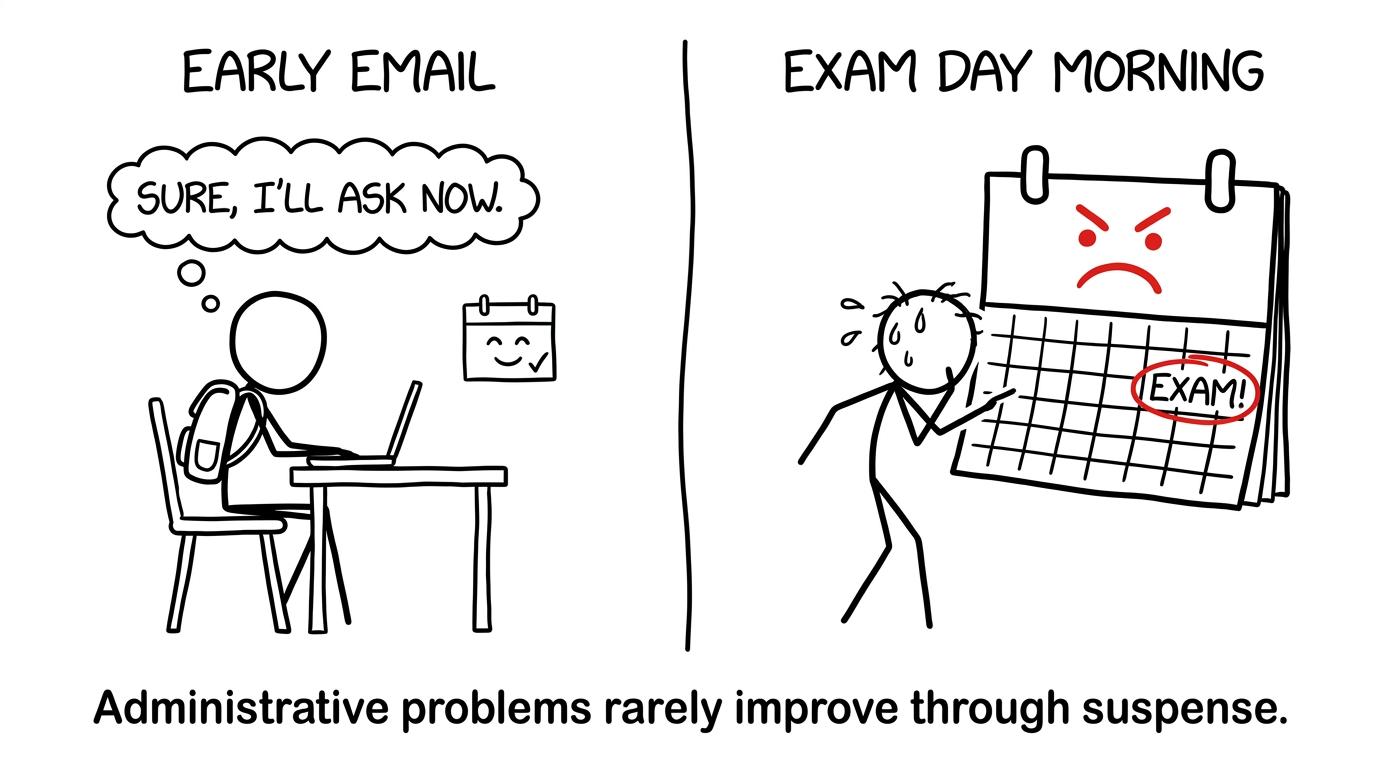 A student emailing early beside a calm calendar and waiting too long beside an alarmed calendar
How to revise while the tier is being checked
Administrative uncertainty can consume revision time because the mind keeps returning to a problem it cannot solve alone. Once you have reported it, separate the two jobs: let the exams officer investigate the entry while you continue preparing.
Until you receive confirmation:
- revise vocabulary and grammar shared across both tiers;
- practise speaking responses and accurate pronunciation;
- keep working on reading and listening comprehension;
- ask your teacher which sample papers to use temporarily;
- avoid switching your entire plan based on a rumour.
For maths revision, use the same discipline: always practise the tier you are officially due to sit. The free Edexcel GCSE Maths revision hub organises lessons and questions by level, while Edexcel GCSE Maths mini tests provide shorter checks when a full paper feels too large.
A clear plan also prevents one subject's problem from disrupting every other GCSE. MathsGenie's GCSE maths revision timetable can help you protect regular maths sessions while leaving space for German speaking, vocabulary and listening practice.
Common mistakes when dealing with a tier problem
Waiting for somebody else to notice
Exam offices process many entries. If your document looks wrong, report it. A concern raised early is easier to investigate than one raised after speaking or on the morning of a written paper.
Assuming a teacher's verbal comment changed the entry
A classroom conversation is not an official amendment. Ask for confirmation from the exams officer after the centre has updated its entry system.
Believing Higher is always better
Higher creates access to grades above 555, but it also carries greater demand and the risk of an unclassified result below the narrow grade 333 safety net. The best tier is the one that gives you a fair opportunity to show your attainment.
Thinking different skills can use different tiers
You cannot take Foundation speaking and Higher writing, or any other mixed combination. The four components travel together as one tiered entry.
Using old deadlines as current guidance
Entry and amendment dates vary by board and series. Your school may also have an earlier internal deadline. Ask the exams officer to check the current information for your qualification.
Letting the issue derail maths revision
German entry concerns deserve prompt action, not unlimited attention. Once reported, return to evidence-led revision. Use MathsGenie's weakest-topics routine to identify where maths marks are being lost, then practise those skills rather than revising randomly.
Keep the problem in proportion
A tier error feels enormous because it concerns the boundary around the grades you can receive. Yet before the relevant assessment and amendment cut-offs, it is often an administrative problem with an administrative solution.
Check the entry. Report the concern. Ask for the reasoning. Get the final decision in writing. Then revise for the confirmed tier.
The same habit improves maths results: replace uncertainty with evidence and a next action. Start at MathsGenie's free GCSE maths revision resources, use revision lessons and practice questions to repair weak topics, then build confidence with GCSE Maths predicted papers, mini tests, past papers, mark schemes and video solutions. A calm plan cannot remove every surprise, but it can stop one surprise controlling the rest of your exam season.