

When Should You Start Revising for A-Levels?
When should you start revising for A-Levels? Use this Year 12 and Year 13 timeline to plan calmly, practise effectively and prepare without last-minute panic.

A Year 13 student looks at the calendar and sees lessons, mocks and three subjects competing for the same evening. The question feels urgent: when should you start revising for A-Levels?
Begin light, regular review in Year 12, establish weekly revision from September of Year 13, and move towards focused exam preparation by January. These are planning milestones, not compulsory deadlines. Your subjects, understanding and exam dates should shape the timetable.
If you are starting later, begin now. A useful plan today matters more than an ideal one you never followed.
Your A-Level revision timeline
| Stage | Main priority | Useful approach |
|---|---|---|
| Year 12 | Retain new content | Weekly review and topic questions |
| Summer after Year 12 | Repair foundations | Target weak topics and organise resources |
| September-December of Year 13 | Establish consistency | Retrieval, practice and mock preparation |
| January-March | Develop exam readiness | Mixed questions, timed work and corrections |
| Easter to exams | Apply knowledge under pressure | Past papers and targeted topic repair |
| Final week | Protect recall and confidence | Brief review, selected questions and sleep |
Start in Year 12 with manageable review
Revision does not have to mean hours of exam papers. It can mean returning to last month's topic and checking whether you can still use it without notes.
Set aside a short weekly session to recall key ideas, attempt questions and check answers. In A-Level maths, earlier algebra supports later calculus, trigonometry and mechanics. Keeping those foundations accessible makes new lessons easier to follow.
Spacing these encounters gives you repeated opportunities to retrieve knowledge. A topic that feels familiar while reading may still be difficult to use independently; questions reveal that difference.
Use MathsGenie's free maths revision resources to connect explanations with practice questions, mark schemes and video solutions. Watch an explanation when needed, then close it and attempt the work yourself.
Use the summer as a reset
The summer after Year 12 need not become an extended mock season. Aim to resolve a few important weaknesses while preserving time to rest.
List your topics and label them secure, uncertain or weak. Test uncertain areas before rereading everything. Choose gaps that affect other topics, complete questions and record what needs another attempt.
If planning feels difficult, the principles in this guide to a sustainable revision timetable transfer to sixth form: make tasks specific, leave spare capacity and return to difficult material.
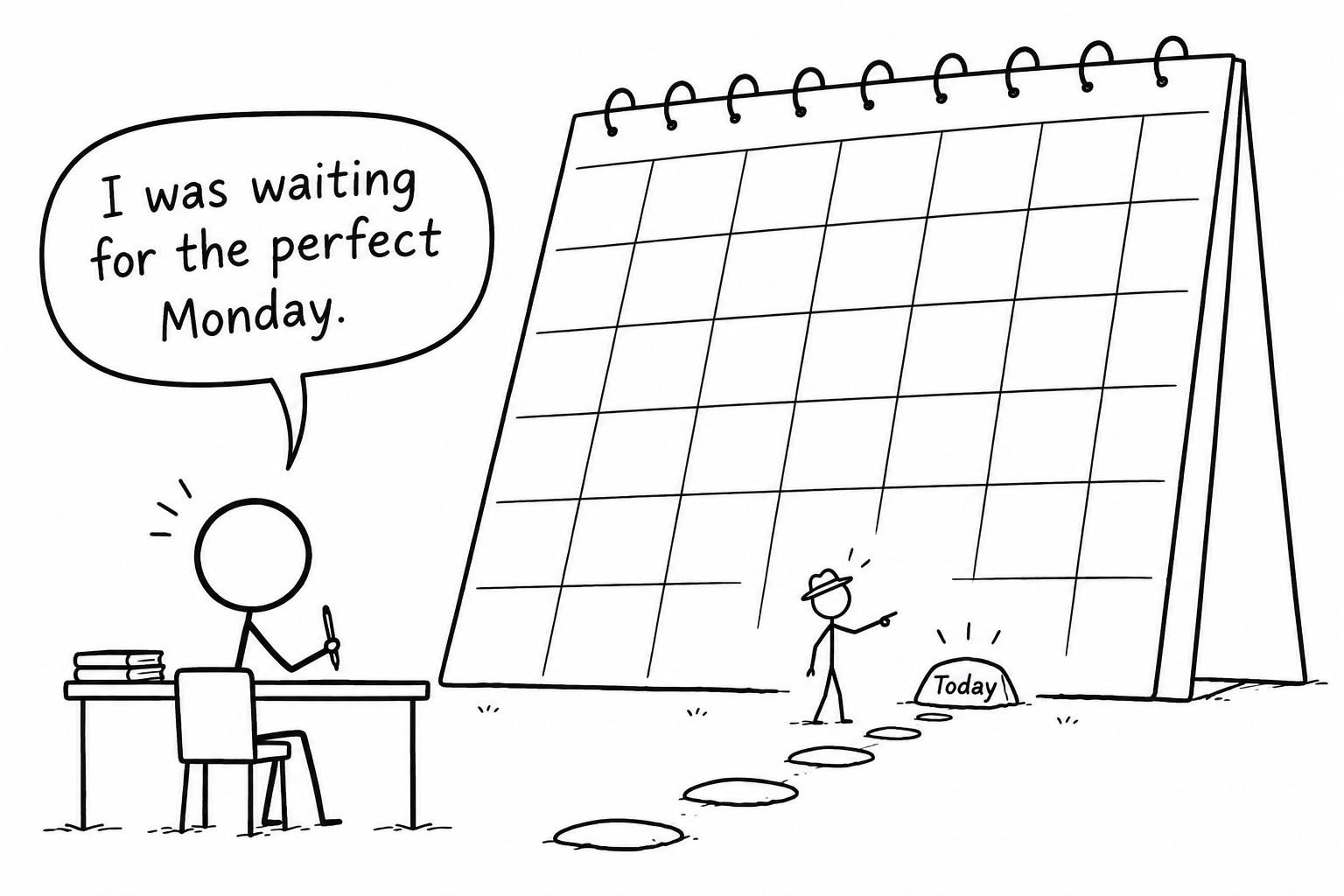 A student faces a giant revision calendar but is shown the first small step
Build a weekly routine from September
From the beginning of Year 13, give revision a regular place alongside homework. Waiting for a completely free evening makes consistency difficult.
Use a simple cycle:
- Retrieve: recall a method or explanation without notes.
- Practise: answer questions using that knowledge.
- Mark: compare your work with the mark scheme.
- Revisit: attempt the weak area again after a gap.
This cycle produces evidence for your next session. An incomplete explanation needs different attention from an arithmetic slip or an unfamiliar question format.
Keep sessions realistic. The revision timetable guide offers adaptable planning principles, while the advice on choosing realistic revision hours helps you think beyond impressive totals. Both focus on GCSE revision, so adjust the workload for A-Level demands.
Use the MathsGenie Revision Planner to give each session a clear purpose and leave room for unexpected commitments.
Move towards exam preparation by January
January is a useful checkpoint, although teaching schedules vary. Review mocks and marked homework before deciding what deserves more time.
Sort lost marks by cause: missing knowledge, misunderstood methods, unfamiliar applications, timing or avoidable errors. Each needs a different response. Forgotten content calls for retrieval; a misunderstood method needs explanation followed by independent practice.
Begin timed sections where appropriate. Choose papers for your exam board and specification, whether Edexcel, AQA, OCR or Eduqas, and check which content you have already covered. Mark carefully and redo significant errors without copying the solution.
Save some complete papers for later practice. Working through every available paper quickly leaves fewer fresh opportunities to assess readiness.
Make Easter revision specific
By Easter, replace broad intentions with tasks you can finish and assess. A session might involve a timed paper section, careful marking and follow-up questions on one weakness.
Alternate targeted topic work with mixed questions. Topic practice strengthens a method; mixed practice checks whether you can recognise when to use it. Full papers also help you practise pacing and sustained concentration.
The diagnose, prioritise, practise and correct approach in MathsGenie's one-week GCSE revision plan remains useful, although A-Level questions require greater depth. Predicted papers can provide extra practice, but they cannot guarantee what will appear.
If you are starting late
With six weeks remaining, prioritise using your specification, recent assessments and teacher feedback. Focus first on important weaknesses rather than repeatedly polishing favourite topics.
Combine brief content review with questions, mark promptly and revisit errors within the week. Avoid spending days rewriting entire folders. Protect sleep so the timetable remains workable.
Common revision-planning mistakes
Waiting until teaching finishes: revise earlier topics while learning new content.
Counting only hours: also record questions attempted, methods recalled and errors corrected.
Choosing comfortable work: use assessment evidence to identify what needs attention.
Skipping corrections: a paper score identifies problems; follow-up practice addresses them.
Abandoning the plan after one missed session: move the essential task and continue. Leave spare capacity so small disruptions stay manageable.
Give your next session a purpose
The timeline provides direction: light review in Year 12, a weekly routine from September and increasingly focused preparation from January. The useful next step is choosing one task you can complete and check.
Open MathsGenie's revision lessons, select questions on a weak topic and schedule a return visit. Build that routine into a day-by-day plan with the MathsGenie Revision Planner.















