

What to Revise in February of Year 11 Maths
What to revise in February of Year 11 maths: a focused weekly plan to repair mock gaps, practise key topics and prepare calmly for the spring exams.
February can feel awkward in Year 11. Mocks may have exposed gaps, lessons are still moving forward and GCSE exams feel both distant and uncomfortably close.
If you are wondering what to revise in February of Year 11 maths, prioritise weaknesses revealed by mocks, secure essential skills and begin regular mixed exam practice. You do not need to revise the entire specification at once. February is for building a reliable routine, not starting a last-minute sprint several months early.
Imagine a student called Sam, staring at a mock paper covered in corrections. Starting again from page one of a revision guide feels reassuring. A better approach begins with the evidence on that paper.
Your February revision checklist
Build your plan around five tasks:
- analyse your latest mock or practice paper;
- choose three or four weak topics;
- revisit essential number, ratio and algebra skills;
- complete mixed questions weekly;
- record mistakes and retest them.
Confirm your foundation or higher tier entry and check your exam board specification. Edexcel, AQA, OCR and Eduqas have substantial content overlap, but your checklist should match your qualification. Use the GCSE maths topics by exam board and tier guide to organise it.
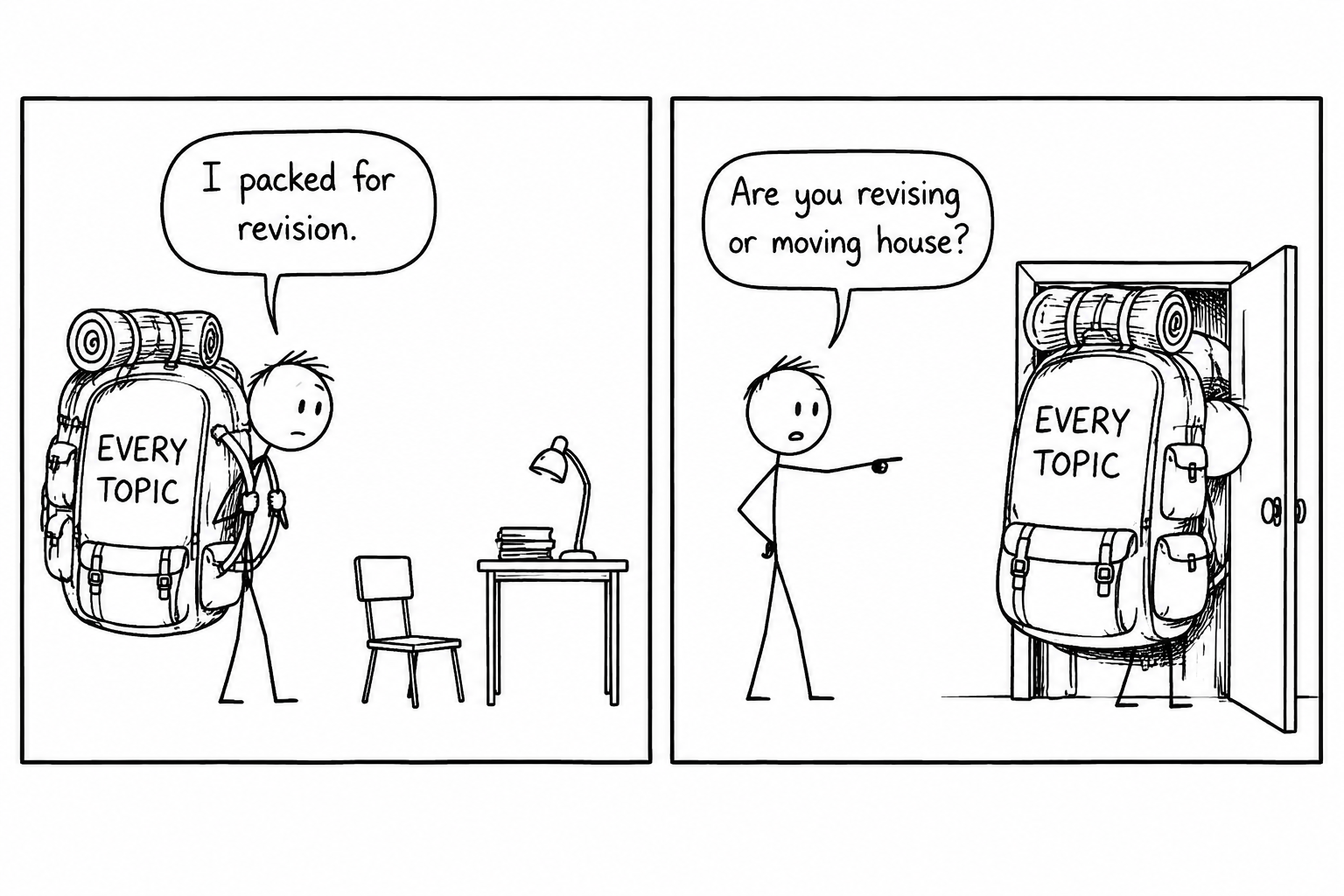 A Year 11 student discovers that carrying every maths topic at once is not a revision strategy
Where February fits into your revision
Think of February as the bridge between identifying weaknesses and practising whole papers confidently. Your school’s mock timetable may differ, but marked work gives you a starting point.
Later revision depends on earlier fluency. Ratio problems become harder when fractions remain uncertain. Quadratic graphs are less approachable when substitution is unreliable. What looks like a difficult-topic problem can actually be a missing foundation skill.
As gaps shrink, increase longer mixed sets and complete papers. Past papers, predicted papers and timed practice become more useful when you can attempt a wider range of questions independently.
For the wider structure, use the GCSE maths revision timetable guide to connect your February priorities with the months ahead.
What to revise in February of Year 11 maths
Begin with your mock evidence
Sam could sort lost marks into three categories:
- Knowledge gap: the method was unknown or forgotten.
- Application gap: the method was known but not recognised in context.
- Accuracy gap: the approach was correct, but calculation or notation failed.
Each needs a different response. Knowledge gaps need explanation and practice. Application gaps need varied questions. Accuracy gaps need clearer working and deliberate checking.
Read mark schemes for method marks, not just final answers. MathsGenie’s free revision lessons, practice questions and video solutions can then help you address the specific difficulty.
Secure skills that support other topics
Your weak areas come first, but check these foundations:
- fractions, decimals, percentages and standard form;
- ratio, proportion and rates;
- simplifying, expanding, factorising and solving equations;
- substitution and rearranging formulae;
- angles, area, volume and transformations;
- averages, probability and interpreting graphs.
Higher-tier students should also review whether surds, quadratics, trigonometry, vectors or algebraic fractions need attention. Foundation students should secure methods across their own specification rather than rushing into higher-only content.
Choose topics because your work shows they cost marks, not because they look impressive.
A weekly February revision template
Give each session a purpose before sitting down. This removes the daily decision about where to begin.
| Session | Focus | What to do |
|---|---|---|
| Monday | Learn | Review one weak topic using a revision lesson. |
| Wednesday | Practise | Attempt topic questions independently, then mark them. |
| Friday | Mix | Combine the new topic with two older topics. |
| Weekend | Review | Complete a mini test or timed section and correct mistakes. |
Sessions need not occupy whole evenings. The 20-minute GCSE maths revision routine offers a compact learn, practise and check cycle. Advice on realistic GCSE revision hours can help you balance maths with other subjects.
Leave a spare slot for unfinished work. If Wednesday becomes busy, move the session rather than treating the week as ruined.
Use the MathsGenie Revision Planner to turn your priorities into scheduled sessions.
How to use February half-term
Half-term offers flexibility, but it need not become seven consecutive days of papers. Try three focused maths sessions:
- repair your weakest topic;
- complete mixed practice;
- attempt a timed paper section and review it.
Corrections deserve time of their own. Attempting questions reveals a problem; explaining the mistake and answering fresh questions later helps prevent its return. Record the topic, what went wrong and what you will do differently.
Protect rest and time for other subjects. You can adapt the one-month GCSE maths revision plan, but keep February targeted rather than copying an intensive final-weeks schedule.
Common February revision mistakes
Choosing only comfortable topics
Familiar questions feel productive, but may leave important gaps untouched. Keep some confidence-building practice while directing most attention towards weaknesses in marked work.
Completing papers without repairing gaps
A pile of marked papers is not automatically progress. Select two weak areas after each paper, revise them and attempt fresh questions several days later.
Watching without answering
Videos explain methods; independent practice reveals whether you can use them. Pause before the solution, attempt the question and compare your working afterwards.
Planning every evening perfectly
An overloaded timetable leaves no room for schoolwork or tiredness. The guide to a GCSE revision timetable you will actually stick to supports a smaller, repeatable routine.
Make February useful, not overwhelming
The goal is not to finish every topic. It is to name your weaknesses, practise deliberately and check whether corrections last.
Start with one marked paper and one topic you can improve this week. Use MathsGenie’s free lessons, questions and mini tests, then schedule your next session. Small, completed revision tasks create a stronger foundation than an ambitious plan left untouched.















