AI Quiz GCSE Arabic: How to Revise Safely
AI quiz GCSE Arabic revision can sharpen recall and speaking. Learn how to create useful tests, check answers and avoid inaccurate AI feedback safely.
Revision often fails at the moment when a student has to decide what to do next. You know you should test your Arabic vocabulary, listening or grammar, but creating questions takes time and asking someone else is not always possible. An AI quiz GCSE Arabic session can remove that friction: give the tool reliable course material, ask for one question at a time, answer without help and check every disputed correction against an authoritative source.
That last step matters. AI can create an endlessly patient quiz, but it is not an examiner, teacher or mark scheme. It can mix dialects, invent vocabulary, mishandle Arabic grammar and sound confident while being wrong. Used carefully, it is a practice partner. Used uncritically, it can teach mistakes.
The quick checklist
A productive AI quiz should follow six rules:
- Use your exact qualification, tier and topic.
- Ground the quiz in the official specification or vocabulary list.
- Ask for one question at a time without revealing the answer.
- Practise listening, speaking, reading and writing separately.
- Record mistakes and verify uncertain feedback.
- Retest weak material later without notes.
The principle will feel familiar to students using the MathsGenie GCSE maths revision hub: attempt, mark, identify the gap, practise it and retest. The subject changes. The learning loop does not.
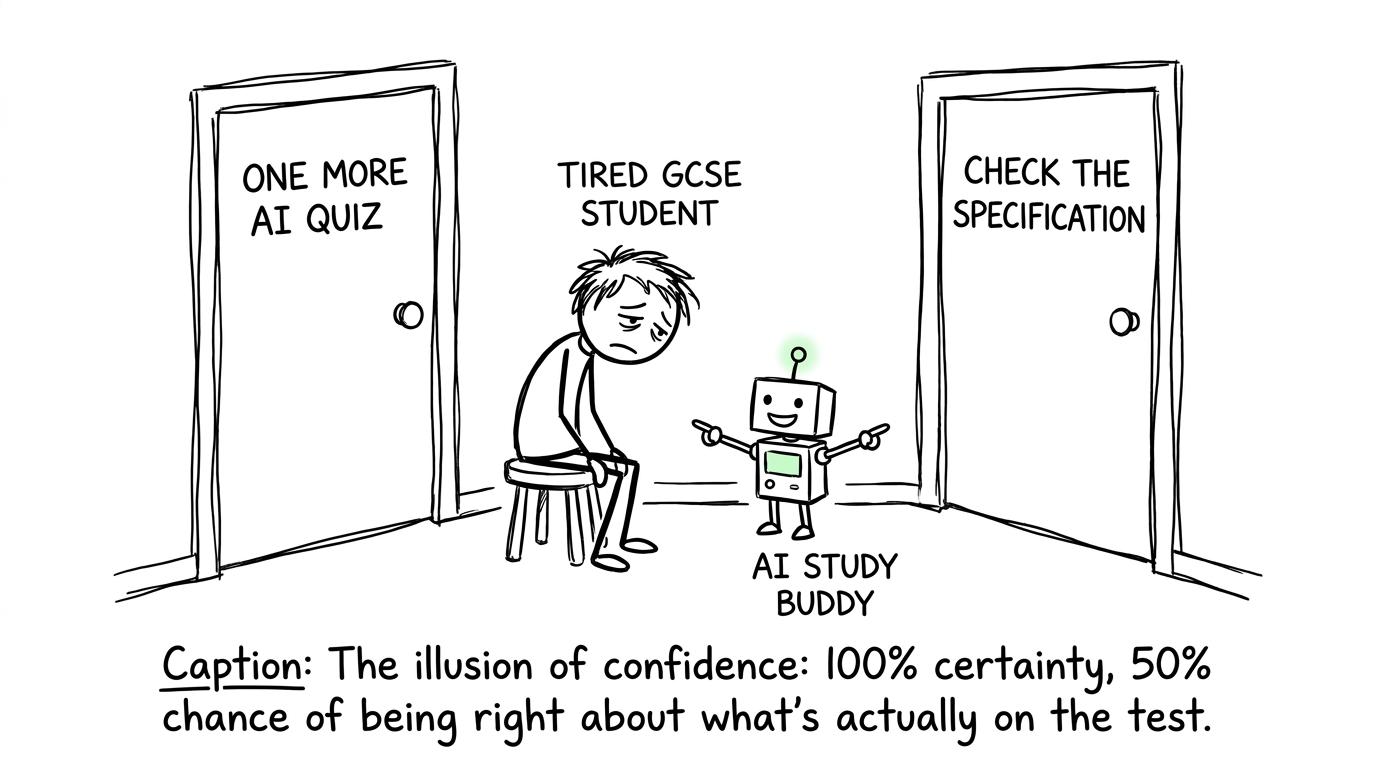 A student choosing between another AI quiz and checking the specification
Can an AI tool really quiz you on GCSE Arabic?
Yes. A general-purpose generative AI tool can produce vocabulary tests, multiple-choice questions, short translations, role-play prompts, reading questions and grammar checks. Some tools can also hold spoken conversations or generate audio, although pronunciation and transcription quality should never be assumed to be perfect.
For students taking Pearson Edexcel GCSE Arabic, the current qualification has four assessed skills: listening, speaking, reading and writing. It is available at foundation and higher tier, and candidates are entered at one tier across the papers. A useful AI routine therefore needs more than digital flashcards. It should rotate between all four skills and reflect the demands of your tier.
The official vocabulary list is an especially useful source because it separates high-frequency language from topic-specific vocabulary. Pearson describes it as core vocabulary that students should acquire and build upon. AI is much safer when it quizzes you from that supplied material rather than inventing its own version of the course.
Set up an AI quiz that matches your specification
A vague request such as “quiz me on Arabic” gives the tool too much freedom. It might choose vocabulary above or below GCSE level, switch between Modern Standard Arabic and a regional dialect, or reward an answer that would not address the actual task.
Start by telling it:
- your qualification and specification code;
- whether you take foundation or higher tier;
- the theme or vocabulary area;
- the skill you want to practise;
- how many questions you want;
- whether English instructions are allowed;
- what source material it must use;
- how and when it should reveal feedback.
A strong reusable instruction is:
Act as a GCSE Arabic retrieval-practice partner. Use only the vocabulary and notes I provide. Ask one question at a time and do not show the answer until I respond. After each answer, state whether it is correct, explain any correction briefly and identify anything you are uncertain about. Keep a list of my errors for a final retest.
Paste only material you are permitted to use. Do not upload copyrighted textbooks, private school documents or another student’s work without permission. Never include personal information such as your full name, school, candidate number, email address or details about other people.
The Department for Education advises that generative AI output may be inaccurate, biased, unsafe, out of date or taken out of context. It also recommends avoiding personal data in generative AI tools. Follow your school’s AI policy and the tool’s age requirements as well as these general precautions.
Build quizzes around the four Arabic skills
Vocabulary and reading
For vocabulary, ask the tool to alternate between Arabic-to-English and English-to-Arabic recall. Require short-answer questions before multiple choice. Recognition feels easier, but producing an answer from memory reveals whether the word is genuinely available to you.
For reading, supply a teacher-approved passage or permitted extract and ask for questions at your tier. Tell the AI not to introduce facts that are absent from the text. Answer first, then ask it to quote the exact part of the supplied passage that supports its feedback.
Be cautious if it rewrites the passage. A small change to a verb form, pronoun, negative or time marker can change the meaning. Keep the original beside you.
Listening and speaking
An AI voice tool can provide extra exposure between lessons, but synthetic Arabic may not reproduce the pronunciation, pace and recording conditions of an exam accurately. Treat it as supplementary practice rather than a substitute for teacher-approved recordings and official assessment material.
For speaking, ask for a sequence of unpredictable questions within one specification theme. Answer aloud before looking at any transcript. You can then use the transcript to notice missing detail, repeated vocabulary and hesitation.
Do not let speech recognition become the judge of your pronunciation. A transcription failure could come from your speech, the microphone or the model itself. Ask your teacher when pronunciation or intelligibility is in doubt.
Writing and grammar
AI can identify possible agreement, spelling, tense and word-order problems, but its corrections need scrutiny. Ask it to separate feedback into categories rather than rewriting your whole response. If it replaces everything with polished language, you lose sight of the precise skill that needs work.
Keep your original version, the suggested correction and the reason given. Verify unfamiliar grammar against class notes, an approved grammar source or your teacher. If the explanation cannot be checked, do not memorise it.
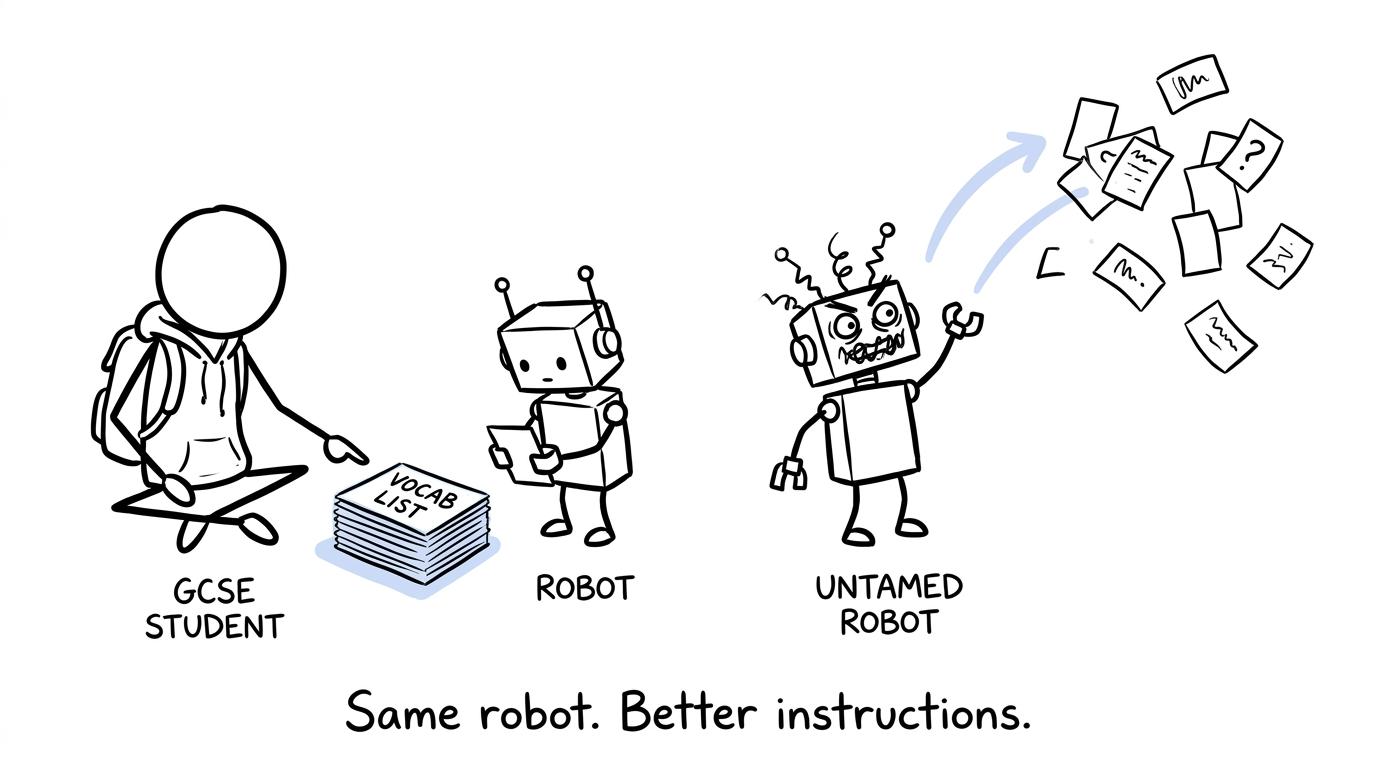 One robot receives a reliable vocabulary list while another scatters random flashcards
Where AI tends to give bad GCSE Arabic information
Arabic presents several challenges for a general language model.
Dialect mixing: the tool may introduce Egyptian, Levantine, Gulf or other regional language when your course material expects a different form. A phrase being natural somewhere does not automatically make it the safest specification-aligned answer.
Overconfident grammar correction: more than one expression may be acceptable. AI sometimes labels a valid alternative as wrong or “corrects” it into a sentence with a different meaning.
Unreliable vocalisation and spelling: short vowels, diacritics, hamza forms and letter shapes can be mishandled. Formatting can also make right-to-left text difficult to compare.
Invented exam rules: an AI tool may misstate timings, marks, permitted materials or tier requirements. For example, Pearson’s GCSE Arabic specification states that dictionaries are not permitted, including during preparation time for the speaking assessment. Check rules directly in the current specification and information from your school.
False marking precision: the tool does not have an examiner’s judgement simply because it awards a mark. Unless it is applying a supplied, current mark scheme accurately, treat any score as informal feedback.
A helpful rule is simple: AI may generate the question, but trustworthy materials decide what counts as correct.
Use an error log instead of chasing a quiz score
A score can feel satisfying while hiding the important detail: why was an answer wrong? Record each error under one of these headings:
- vocabulary not recalled;
- spelling or letter-form error;
- misunderstood question word;
- incorrect verb or tense;
- agreement problem;
- dialect or register uncertainty;
- answer lacked enough detail;
- AI feedback needs verification.
Retest the same items after a gap, with the order changed. Ask the AI to include previous mistakes among new questions without identifying them. That turns a conversation into retrieval practice.
This is also a sensible way to manage Arabic alongside maths. Use the MathsGenie revision planner to protect time for both subjects rather than allowing an open-ended chatbot session to consume the evening. Short sessions with a clear stopping point are easier to repeat.
Transfer the method to GCSE maths revision
AI-generated quizzes are less suitable for judging whether a full mathematical solution earns method marks. For maths, use resources built around the relevant specification and real assessment material.
Start with a focused lesson or question set, then move to board-specific papers. MathsGenie provides Edexcel GCSE maths past papers, AQA GCSE maths past papers and an OCR GCSE maths revision hub. These let you compare your work with mark schemes and worked solutions rather than accepting an improvised AI verdict.
Near the exam, Edexcel GCSE maths predicted papers can provide additional timed practice. Predicted papers are rehearsal tools, not promises about what will appear. The useful sequence remains lesson, practice questions, marking, correction and retest.
If you need a compact routine, the 20-minute GCSE maths revision plan shows how to combine retrieval, exam-style questions and immediate feedback. The same boundaries improve an Arabic AI quiz: decide the topic before opening the tool and finish by recording the next action.
Common mistakes when using AI for Arabic revision
Letting the AI reveal answers too early. Seeing an answer is not the same as retrieving it. Always respond before requesting feedback.
Using AI-generated material as the only source. Ground questions in the current vocabulary list, specification, class materials and teacher guidance.
Accepting every correction. Challenge unfamiliar feedback and verify disputed language. Confidence is a feature of the writing style, not proof of accuracy.
Practising only favourite topics. Ask the tool to prioritise your error log, not the themes you already find comfortable.
Confusing fluent output with exam success. A sophisticated model response may be unrealistic for your current level and may conceal the smaller changes that would improve your own answer.
Submitting AI writing as your own. JCQ guidance says assessed work must be the student’s own. Misuse can constitute malpractice. AI also cannot be accessed in an external examination. If a task could contribute to assessment, follow your teacher’s instructions and your school’s policy.
Ignoring privacy and safeguarding. Use an approved tool, observe age restrictions and keep personal information out of prompts.
Make AI the quizmaster, not the authority
The best AI quiz GCSE Arabic routine is deliberately limited. Give the tool verified material, make it ask rather than tell, answer without help, investigate mistakes and return later for a retest. Its value lies in creating more opportunities to recall and speak. Its weakness lies in pretending that plausible language is necessarily correct.
Bring the same discipline back to maths. Open the MathsGenie GCSE revision area, choose your exam board and work through free revision lessons, practice questions and mini tests. Then test your methods with past papers and predicted papers, using mark schemes and video solutions to understand every lost mark.
AI can keep asking questions. Improvement comes from what you do with the answers.