

What Is IGCSE Islamic Studies? Course Guide
What is IGCSE Islamic Studies? Explore course content, exam-board differences, assessment, revision methods and preparation for your final exams.
The hardest part of beginning a new subject is often not the content. It is not knowing what the course expects from you.
So, what is IGCSE Islamic Studies? It is an international secondary qualification exploring Islamic beliefs, practices, scripture and history. Depending on the exam board, students may study the Qur’an and Hadith, the life and teachings of the Prophet Muhammad, the early Muslim community, sources of authority and the influence of Islam on life today.
It is not simply a test of how many facts you can remember. Strong answers also explain significance, interpret sources and, where required, assess different arguments. Your exact course and examination structure depend on your specification, so identifying your exam board is the essential first step.
IGCSE Islamic Studies at a glance
Use this checklist before beginning revision:
- Confirm your exam board and specification code.
- Download the specification for your examination year.
- Identify the topics assigned to each paper or section.
- Check which Qur’anic and Hadith passages are prescribed.
- Learn the command words used in your papers.
- Practise both factual recall and extended writing.
- Complete past-paper questions under timed conditions.
- Compare your responses with official mark schemes.
Names vary slightly between boards. Cambridge uses IGCSE Islamiyat, Pearson Edexcel uses International GCSE Islamic Studies, and OxfordAQA uses International GCSE Islamiat. These courses overlap, but they are not interchangeable.
What do you study in IGCSE Islamic Studies?
Most specifications bring together three broad areas: sources, history, and lived belief. That combination matters. A source is not studied in isolation; students consider what it teaches, why it is significant and how it may influence Muslim thought or practice.
The Qur’an and Hadith
Students commonly examine selected passages from the Qur’an and Hadith. Depending on the board, you may need to understand:
- the central themes of prescribed passages;
- revelation and compilation of the Qur’an;
- the transmission and collection of Hadith;
- the difference between the text of a Hadith and its chain of transmission;
- the role of scripture as a source of belief, practice and authority;
- how teachings apply to individual and community life.
The precise passages are specified by the exam board. Do not assume that a passage studied by a friend following another specification is required for your examination.
The life of the Prophet Muhammad
The course may cover events in the life of the Prophet Muhammad, including his early life, the beginning of revelation, opposition in Makka, migration to Madina, leadership of the Muslim community and important relationships or events.
Examiners generally expect more than a timeline. You need to select accurate details and explain why an event, action or teaching was important. That distinction between knowing and explaining is one of the central demands of the subject.
The early Muslim community
Many courses examine the formation and development of the first Muslim community. This can include the Companions, members of the Prophet’s family, the Emigrants and Helpers, and the leadership of the Rightly Guided Caliphs.
The purpose is not merely to remember names. Students consider leadership, community, authority, challenges and the lasting importance of the early period within Islam.
Beliefs and practices
Common areas include beliefs about God, angels, revelation, prophets, divine decree, resurrection and the Last Day. Students may also study the Five Pillars, worship, charity, fasting, pilgrimage and other dimensions of Muslim life.
Questions may connect belief with action. For example, knowing what a practice involves is different from explaining its spiritual significance or its influence on a Muslim community.
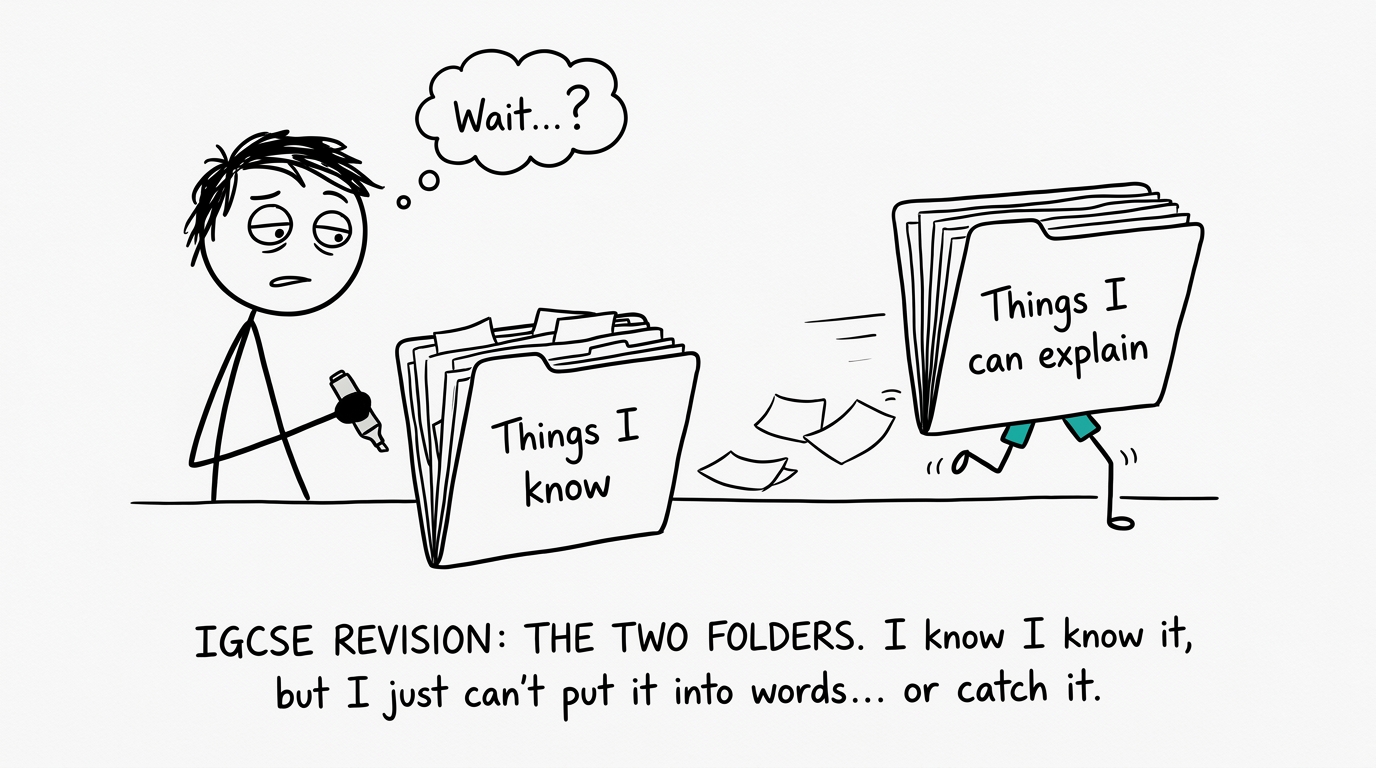 A revision folder labelled explanation escapes from a student who has mastered recall
How the examination depends on your board
There is no single examination format called “IGCSE Islamic Studies”. Current official specifications show important differences.
| Exam board | Qualification | Current assessment outline |
|---|---|---|
| Cambridge International | IGCSE Islamiyat (0493) | Two written papers, each lasting 1 hour 30 minutes and worth 50 marks |
| Pearson Edexcel | International GCSE Islamic Studies (4IS1) | One written paper lasting 2 hours 30 minutes, worth 90 marks and 100% of the qualification |
| OxfordAQA | International GCSE Islamiat (9237) | Two written papers, each lasting 1 hour 30 minutes and worth 50% of the qualification |
Cambridge candidates take both papers and answer in English. The 2026-2027 syllabus awards grades from A* to G. Its assessment objectives emphasise the accurate recall and presentation of knowledge alongside understanding of its significance.
Pearson Edexcel uses the 9-1 grading scale. Its paper covers the life and achievements of the Prophet Muhammad, the early Muslim community and living the Muslim life today. Students answer four questions across three sections, with longer responses requiring explanation, analysis and supported judgement.
OxfordAQA’s current Islamiat qualification is assessed for the first time in May/June 2026. Paper 1 covers beliefs, teachings and practices, while Paper 2 covers the life and teachings of Hazrat Muhammad and sources of authority. Both papers include prescribed Qur’an and Hadith passages.
These details are current at publication, but specifications can change. Always check the document for your examination year rather than relying on a general online summary.
What skills does the subject test?
Success rests on several connected skills.
Accurate knowledge: You need secure recall of relevant events, people, beliefs, practices and teachings.
Selection: An effective answer includes the facts that address the question. Writing everything you remember can hide your best material.
Explanation: You must show why something matters, how ideas connect or what influence a teaching has.
Source use: Where the question requires it, references to prescribed passages should support the argument rather than appear as disconnected quotations.
Analysis and judgement: Some specifications ask students to consider an assertion, weigh evidence and reach a reasoned conclusion.
Written communication: Clear paragraphs help examiners follow the answer. Each paragraph should make a point, support it with relevant knowledge and explain its significance.
This resembles the discipline required in maths more than it first appears. A correct conclusion without a visible method may lose marks in maths; an unsupported assertion can do the same in an extended Islamic Studies response. In both subjects, the examiner needs to see the reasoning.
How to revise IGCSE Islamic Studies effectively
Build revision from the specification
Turn each specification statement into a question. If the document says you must understand the compilation of the Qur’an, create prompts covering what happened, who was involved, why it occurred and why it remains significant.
This prevents revision from becoming endless rereading. The same principle underpins MathsGenie’s guide to finding your weakest GCSE topics: use evidence to decide what needs attention rather than revising only what feels comfortable.
Separate recall from explanation
Make two columns for each topic:
- facts, names, teachings and events you must recall;
- meanings, consequences and significance you must explain.
A student can know that an event occurred yet struggle to explain why it mattered. Testing the two skills separately makes that gap visible.
Use active retrieval
Close your notes and retrieve a topic from memory. You might create a timeline, list the themes of a prescribed passage or plan an extended answer. Then check your work and correct omissions.
Short, repeated retrieval is usually more useful than decorating notes. MathsGenie’s 20-minute GCSE revision routine offers a manageable structure that can be adapted across subjects.
Practise command words
“Describe”, “explain” and “assess” do not ask for the same response. Learn the wording used by your own board and inspect its mark schemes. Before writing, pause and translate the command into a task:
- Describe: give an accurate account.
- Explain: develop reasons or show significance.
- Assess: weigh the claim and reach a supported judgement.
Use past papers as feedback
Complete individual questions first, then sections and finally whole papers. Mark them carefully. Record whether each lost mark came from missing knowledge, weak explanation, irrelevant material, poor source use or timing.
That attempt, mark, repair cycle is also central to efficient GCSE maths revision. When you need to maintain maths alongside Islamic Studies, use the GCSE Maths revision hub to select your exam board and practise the exact topics requiring attention.
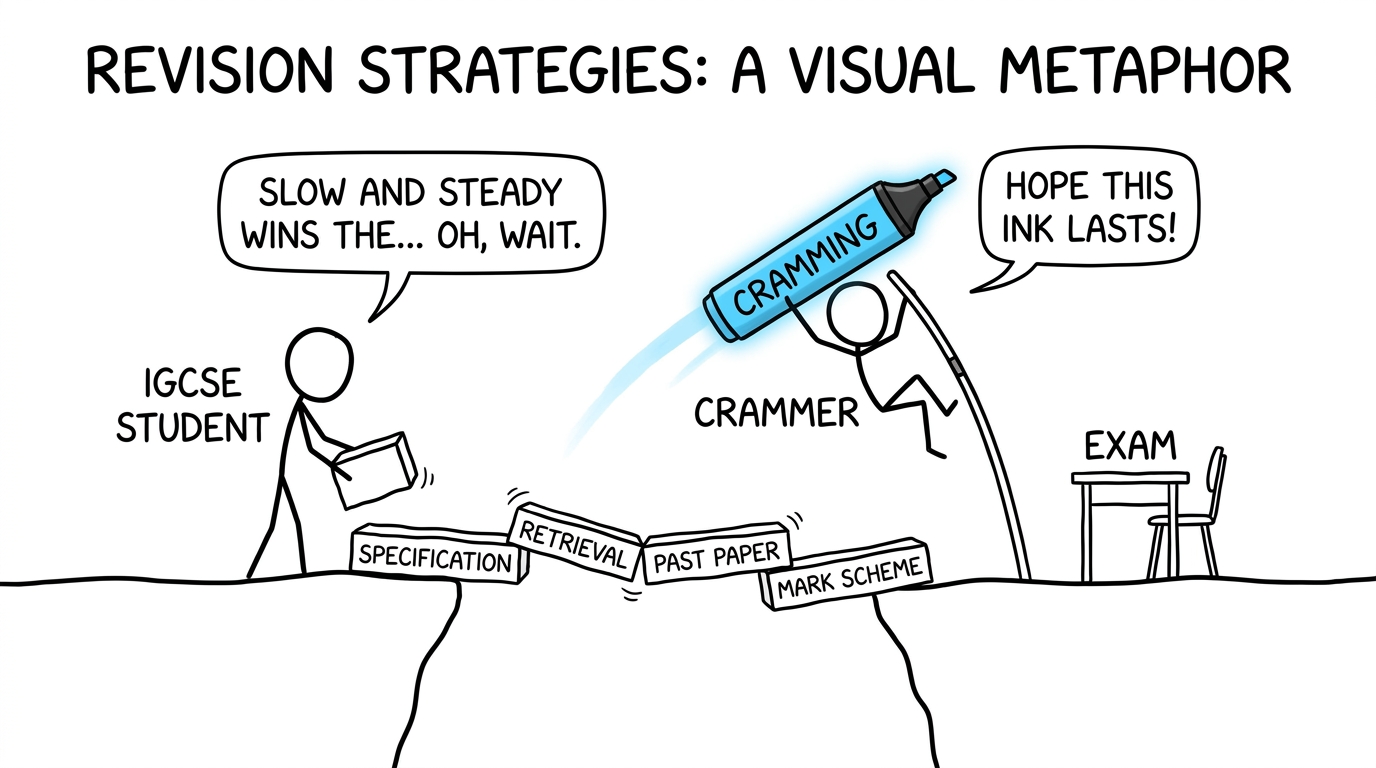 A careful revision bridge beats an ambitious attempt to pole-vault into the exam
Planning revision across IGCSE subjects
Islamic Studies can involve substantial reading and extended writing. Maths requires frequent practice so that methods remain fluent. A sensible timetable protects both.
Try alternating tasks rather than assigning an entire evening to one subject. A content-heavy Islamic Studies session could be followed by targeted maths questions. On MathsGenie, GCSE maths videos can refresh a method before you attempt questions, while the Edexcel GCSE Maths revision area brings together lessons, revision guides, question banks and papers.
As examinations approach, replace vague goals such as “revise Islamiyat” with specific actions:
- retrieve the themes of two prescribed passages;
- plan one extended response;
- complete one timed section;
- mark the response and rewrite its weakest paragraph;
- finish one short maths topic session.
Small tasks remove the negotiation that often delays revision.
Common mistakes in IGCSE Islamic Studies
Revising the wrong specification
Similar course titles create false confidence. Confirm the board, code and examination year before downloading resources.
Treating the subject as pure memorisation
Facts are essential, but many questions also reward explanation, interpretation or judgement. Attach significance to every major fact during revision.
Ignoring prescribed passages
Do not revise only broad themes. Identify every passage named in your specification and understand how it relates to the course content.
Answering the topic instead of the question
A rehearsed essay may contain excellent knowledge but still be irrelevant. Underline the command word and the precise focus before writing.
Quoting without explaining
A reference does not make the argument by itself. Explain how it supports the point and why it is relevant.
Completing papers without reviewing them
The score is only the beginning. Use the mark scheme to identify what a stronger response needed, then revisit the same weakness. This is why MathsGenie pairs Edexcel predicted papers with mark schemes and solutions rather than treating a completed paper as the end of revision.
From uncertainty to a workable plan
IGCSE Islamic Studies is a structured examination course in Islamic scripture, beliefs, practices and history. Its exact content, grading and paper format depend on the exam board. Once you identify the correct specification, the subject becomes far less mysterious: learn the required knowledge, practise explaining significance, understand the command words and use papers to expose the next weakness.
Revision works best when every session produces evidence. A recalled topic, a marked paragraph or a corrected paper is evidence. Highlighted pages alone are not.
For the maths part of your IGCSE or GCSE timetable, make MathsGenie your free revision base. Use revision lessons and videos to rebuild understanding, practice questions and mini tests to check it, then past papers and predicted papers with mark schemes and video solutions to prepare for examination conditions. Choose one small task now, complete it properly, and let the next session build from what you discover.











