What Is A Level Classical Greek? Texts & Exams
What is A Level Classical Greek? Discover the OCR course, set texts, four written exams, entry expectations, revision demands and university pathways.
Choosing A Levels can feel like being asked to plan a journey before you know what the roads look like. Some subjects are familiar. Classical Greek may be little more than a name on a sixth-form options sheet.
So, what is A Level Classical Greek? Texts, exams & pathways can be summarised simply: it is an OCR qualification combining advanced Ancient Greek language with the close study of prose and verse literature. You translate unseen passages, study prescribed authors, analyse literary techniques and complete four written examinations. There is no coursework.
It is demanding, but its difficulty has a shape. Once you understand that shape, you can decide whether it suits you.
A quick A Level Classical Greek checklist
Before choosing the subject, find out:
- whether your school or college offers OCR Classical Greek;
- what GCSE grade or previous language experience it expects;
- which prescribed texts your class will study;
- whether you enjoy both precise translation and literary analysis;
- how the subject will fit beside your other A Levels;
- whether remote or shared teaching is available if it is not offered locally.
OCR currently provides the A Level Classical Greek specification in England under qualification code H444. Schools set their own entry requirements, so there is no single GCSE grade that guarantees admission everywhere.
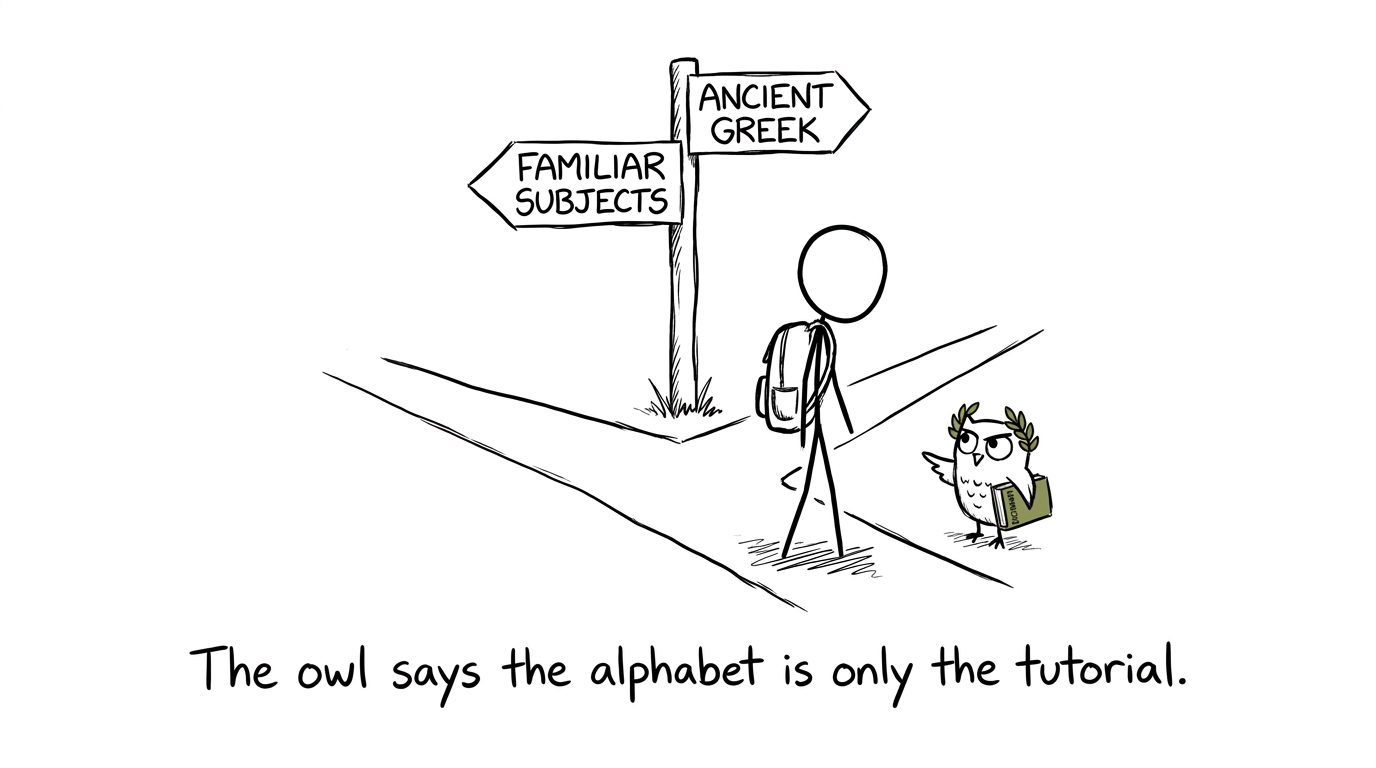 A student meets an unusually demanding owl at the A Level subject-choice crossroads
What do you study in A Level Classical Greek?
The course has two connected halves: language and literature. Neither is an optional extra. Language allows you to understand what an author wrote; literature asks why the author wrote it that way.
Classical Greek language
At GCSE, you may already have met noun cases, verb endings, participles and sentence constructions. A Level develops this foundation through a wider range of vocabulary, accidence and syntax.
You learn to:
- recognise more complex word forms;
- identify how clauses fit together;
- translate prose and verse accurately into natural English;
- scan verse where required;
- answer grammatical and comprehension questions;
- translate English into Greek or complete the alternative comprehension route.
This can appeal to students who enjoy algebra. The subjects are not identical, but both reward careful structure. A Greek ending changes the function of a word just as a mathematical sign can change an entire argument. Guessing tends to be expensive; disciplined checking tends to pay.
If maintaining GCSE maths alongside your new subject choices is a concern, the GCSE Maths revision hub keeps lessons, questions and papers organised by exam board.
Prose and verse literature
You also study passages from ancient authors in the original Greek, supported by wider reading in English translation. Prose may include history, philosophy, biography or satire. Verse can include epic, tragedy and comedy.
Literature study is not simply memorising a translation. You must understand:
- context and argument;
- characterisation;
- tone and narrative method;
- imagery, word choice and sound;
- the effect of literary techniques;
- how to support an interpretation with precise textual evidence.
A strong response therefore combines knowledge with judgement. You need to know the text, but you also need to explain what its details achieve.
Which Classical Greek texts are studied?
OCR places the prescribed literature into four groups. A Level students study one prose option from Group 1 and one from Group 2, followed by one verse option from Group 3 and one from Group 4. Your teacher or centre selects the combination; you do not study every listed work.
For the set-text cycle beginning with the 2027 examination series, OCR has published options involving authors and works such as:
- Herodotus, including passages from Histories Books 7 and 8;
- Plato’s Crito;
- Lucian’s Charon;
- Homer’s Odyssey Books 16 and 22;
- Sophocles’ Electra;
- Aristophanes’ Birds.
OCR announced in 2026 that this fifth set-text cycle would run across the 2027, 2028 and 2029 examination series. Prescriptions can change, however, so students should check the current OCR specification and confirm their exact texts with their school before buying an anthology.
This matters because a title alone is not enough. OCR prescribes particular sections in Greek and additional passages to be read in English. Revision should follow those boundaries precisely.
How is A Level Classical Greek assessed?
The qualification is linear. All four compulsory components are externally assessed through written papers, normally at the end of the two-year A Level course.
| Component | Length | Marks | Weighting |
|---|---|---|---|
| Unseen Translation | 111 hour 454545 minutes | 100100100 | 33%33\%33% |
| Prose Composition or Comprehension | 111 hour 151515 minutes | 505050 | 17%17\%17% |
| Prose Literature | 222 hours | 757575 | 25%25\%25% |
| Verse Literature | 222 hours | 757575 | 25%25\%25% |
Together, the papers contain 300300300 marks and last 777 hours. The published percentage weightings are rounded to whole percentages.
Unseen Translation
This paper tests translation from Classical Greek into English. You work with prose and verse passages that you have not studied as set texts.
The named unseen authors depend on the examination cycle. OCR’s specification identifies the relevant prose and verse authors, so preparation should be based on the correct series rather than an old textbook list. The paper can also assess verse scansion.
Prose Composition or Comprehension
This component gives students a choice between two routes.
In prose composition, you translate English into Classical Greek. This demands accurate vocabulary, endings and syntax. In comprehension, you work with an unseen Greek prose passage, answering questions and completing specified language tasks.
Schools may prepare students mainly for one route, although the examination paper provides the formal choice. Ask how your prospective department teaches this component.
Prose and verse literature
The two literature papers assess the prescribed passages and their wider contexts. Tasks can include translation, comprehension, analysis of literary techniques and extended responses.
Knowing an English translation is not sufficient. Examiners can ask how particular Greek words, structures or sounds create meaning. Effective revision moves repeatedly between the original text, its translation and its literary effect.
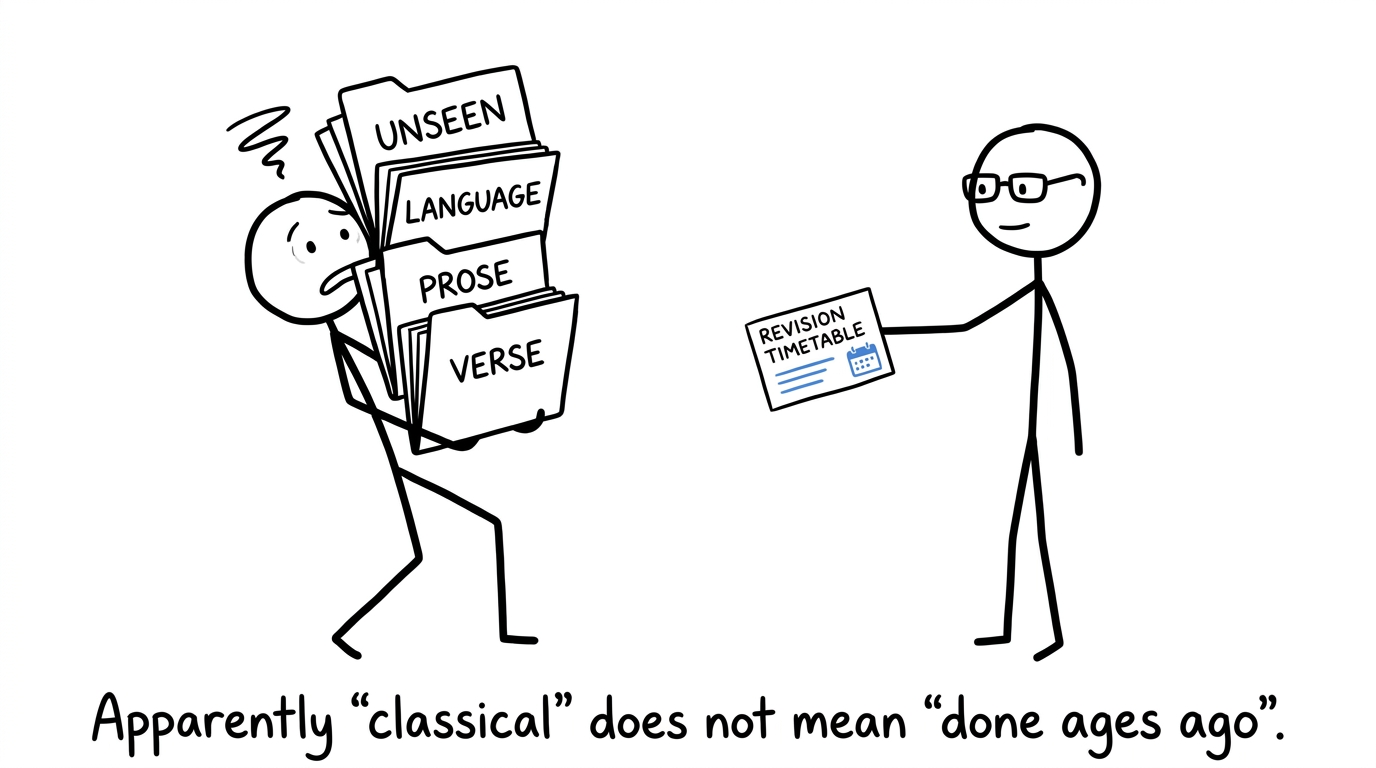 A student discovers that four Classical Greek papers require a timetable rather than a heroic last stand
Is A Level Classical Greek difficult?
It is academically demanding because several skills must operate together. You need reliable grammar, a growing vocabulary, accurate translation and the ability to write analytical essays.
The workload becomes more manageable when it is divided into small routines:
- retrieve vocabulary frequently rather than rereading lists;
- parse difficult sentences before translating them;
- revisit set-text passages at spaced intervals;
- practise unseen translation under gradually tighter timings;
- compare marked work with the mark scheme;
- keep separate logs for language errors and literature gaps.
This is the same principle that makes maths revision effective: feedback must change what you do next. MathsGenie’s guide to finding your weakest GCSE topics demonstrates a useful diagnose, practise and re-test cycle that can be adapted for vocabulary, grammar and translation.
Do you need GCSE Classical Greek first?
OCR describes the A Level as building on GCSE Classical Greek, so previous study is the normal foundation. However, entry decisions belong to individual schools and colleges. Some may require GCSE Classical Greek at a particular grade; others may consider students with Latin or substantial preparatory teaching.
Before applying, ask four direct questions:
- Is GCSE Classical Greek required?
- What minimum grade is expected?
- Is any summer preparation set?
- How many taught lessons are provided each week?
Availability can be a bigger obstacle than ability. Classical Greek is offered in fewer centres than subjects such as history or maths. If it is unavailable, ask about local partnerships, shared sixth-form provision or recognised distance-learning arrangements before assuming the subject is impossible.
Which subjects work well with Classical Greek?
There is no compulsory combination. Natural partners include Latin, English literature, history, ancient history, classical civilisation, philosophy and modern languages.
Maths can also make a balanced combination. Classical Greek develops interpretation and extended writing, while maths develops modelling and formal problem-solving. The practical issue is workload: both improve through regular practice rather than occasional long sessions.
A simple weekly plan can protect both subjects. The GCSE one-month revision plan explains how to build short retrieval sessions and timed practice into a realistic timetable. Students considering A Level Maths can also explore the Edexcel A Level Maths revision hub before making final choices.
What pathways can Classical Greek lead to?
The clearest university pathway is Classics, but it is not the only one. Depending on each university’s entry requirements, related possibilities include ancient history, archaeology, philosophy, theology, linguistics, literature and joint honours courses.
Prior Greek is not required for every Classics degree. Oxford’s current Classics course accommodates applicants with different levels of Latin and Greek experience. Cambridge offers different course routes, with requirements varying between the three-year and four-year options and, in some cases, between colleges. Always check the current university course page rather than relying on a general subject guide.
The A Level can provide evidence of close reading, sustained language learning, analytical writing and attention to detail. Those abilities are relevant to many later directions, including education, law, publishing, heritage, research and the civil service. The qualification does not guarantee a particular career, but neither does it confine you to one.
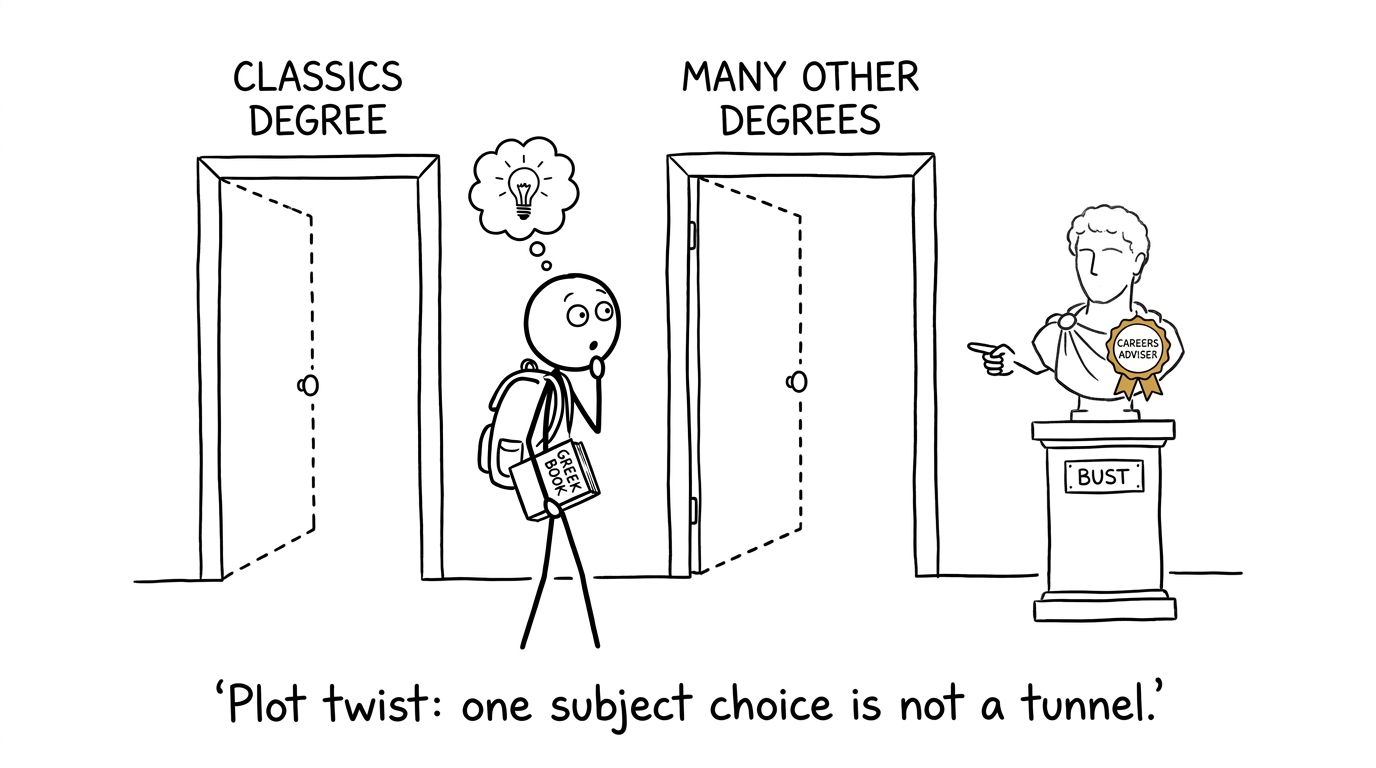 A museum bust explains that choosing Classical Greek opens more than one future door
Common mistakes when choosing or revising Classical Greek
Choosing it only because it looks unusual
Distinctiveness is not enough. Read a sample passage, look at the specification and ask whether you actually enjoy language detail and literature.
Assuming it is mainly mythology
Myths may appear within ancient texts, but this is fundamentally a language-and-literature A Level. Grammar, translation and textual analysis sit at its centre.
Learning translations without the Greek
A memorised English version can collapse when a question focuses on a specific word or construction. Connect each translated phrase to the original language and its effect.
Treating vocabulary as a one-time task
Vocabulary fades without retrieval. Short, repeated tests are more useful than highlighting the same list. In maths, Edexcel GCSE mini tests serve a similar purpose: quick evidence of what is genuinely secure.
Using outdated set-text information
Prescribed texts and unseen authors operate in examination cycles. Check the year attached to every anthology, resource and past paper.
Neglecting other core subjects
An exciting new A Level should not consume every revision hour. Keep GCSE maths secure through board-specific GCSE resources, then use GCSE predicted papers and mark schemes to test your readiness.
Is A Level Classical Greek right for you?
The best indicator is not whether the subject sounds impressive. It is whether you can imagine enjoying its ordinary Tuesday afternoon: learning endings, untangling a sentence, revisiting a passage and explaining why one word matters.
Speak to the teacher, inspect the current OCR specification and ask to see the texts your centre intends to teach. Then consider the full timetable, not the subject in isolation.
Whatever combination you choose, protect the habits that make difficult courses manageable. Use MathsGenie’s free revision lessons and practice questions to secure individual maths topics, mini tests to check recall, and A Level Maths past papers or GCSE predicted papers to build exam stamina. Choose your subjects thoughtfully, then let consistent practice do the quieter work of turning them into results.