

What Does GCSE English Language Actually Test?
What does GCSE English Language actually test? Learn how examiners reward reading, analysis, evaluation, comparison, writing and technical accuracy.
The unsettling thing about GCSE English Language is that it can look as though there is nothing solid to revise. In maths, you can learn a method and practise it. In English Literature, you can revisit characters, themes and quotations. But English Language often gives you a text you have never seen before.
So, what does GCSE English Language actually test? Primarily, it tests transferable reading and writing skills: understanding unfamiliar texts, making inferences, analysing writers' choices, comparing perspectives, evaluating ideas and communicating effectively. Examiners are not mainly rewarding how many facts, quotations or impressive words you can remember.
There is some knowledge to learn. You need to understand your paper, recognise useful language and structural features, and know the conventions of different forms of writing. But knowledge is the toolkit. Marks come from using it accurately in response to the task.
GCSE English Language assessment at a glance
Across AQA, Edexcel, OCR and Eduqas, the precise papers and question sequences differ. However, the core assessment objectives are set nationally and cover the same broad areas.
Your preparation should develop the ability to:
- retrieve explicit information and infer implicit ideas;
- select concise, relevant textual evidence;
- analyse how language and structure create effects;
- compare ideas, perspectives and methods where required;
- evaluate a text and support your judgement;
- write clearly for a specified audience, purpose and form;
- organise ideas coherently;
- use vocabulary, sentences, spelling and punctuation accurately;
- deliver and respond to a spoken presentation for the separate endorsement.
The written qualification is evenly divided between reading and writing. Writing is split into AO5, worth 30%30\%30% of the qualification, and AO6, worth 20%20\%20%. The remaining 50%50\%50% assesses reading, although the exact balance among individual reading objectives varies by specification.
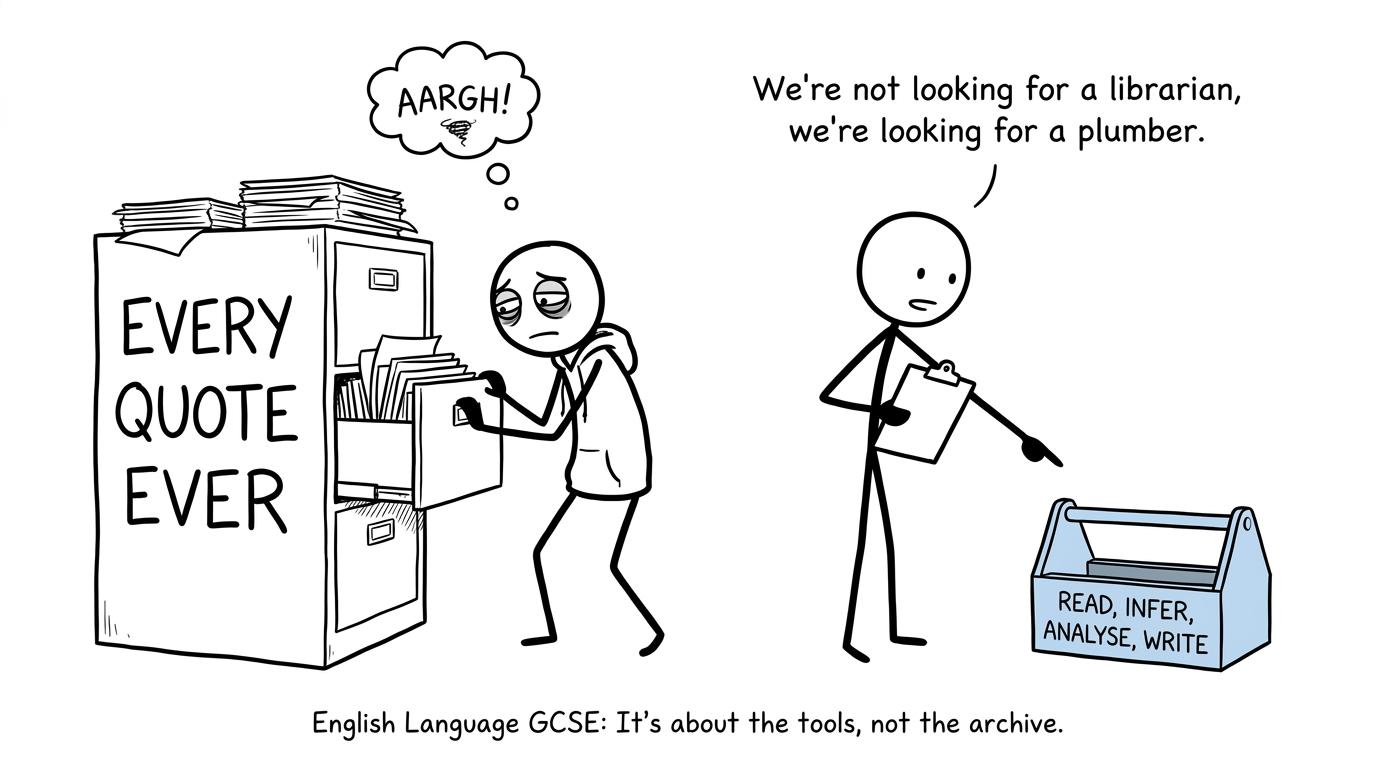 A student discovers that English Language uses a skills toolbox rather than a giant cabinet of memorised quotations
Content knowledge or skills: what is the real balance?
The simplest answer is skills supported by knowledge.
A student could memorise definitions of metaphor, juxtaposition and cyclical structure yet gain few marks if those terms are inserted without explaining the text. Another student might use less elaborate terminology but make a precise observation, choose strong evidence and explain its effect convincingly. The second response is usually doing more of what the assessment objective requires.
This is similar to GCSE Maths. Knowing a formula is useful, but knowing when and how to apply it is what converts recall into marks. Maths students can develop that habit through free GCSE Maths revision, where lessons lead into questions rather than stopping at notes. English Language needs the same movement from recognition to performance.
Knowledge that still matters
English Language is not a knowledge-free subject. Useful knowledge includes:
- the format and timing of your own exam board's papers;
- the meaning of command words such as analyse, compare, evaluate and summarise;
- grammatical and literary terminology;
- structural choices, including shifts in focus, contrast and changes in pace;
- conventions associated with articles, speeches, letters, narratives and descriptions;
- spelling, punctuation, sentence construction and Standard English;
- broad awareness of how context can affect vocabulary, attitudes and perspectives.
Wide reading also matters. It gives you a richer sense of how arguments, descriptions and narratives work. However, it does not replace close attention to the source and question in front of you.
What examiners reward in reading responses
Reading is not a single skill. The assessment objectives separate it into several kinds of thinking.
Accurate understanding and inference
AO1 rewards identifying and interpreting explicit and implicit information. Explicit information is stated directly. Implicit meaning must be inferred from details, tone or patterns in the text.
Examiners reward answers that select the information requested rather than copying a large section and hoping the answer is somewhere inside it. Where two texts are involved, AO1 can also assess synthesis: drawing relevant information together into a clear account.
The key question is not simply, “What can I find?” It is, “Which detail answers this particular question?”
Analysis of language and structure
AO2 asks how writers use language and structure to achieve effects and influence readers. Examiners are looking for a connected explanation:
- identify a purposeful choice;
- support the point with precise evidence;
- explore what the choice suggests or emphasises;
- connect it to the writer's purpose, tone or effect.
Technique spotting alone is not analysis. Naming a simile earns little if the response never explores why that comparison matters. Equally, unsupported claims about “making the reader want to read on” are too general to demonstrate close analysis.
Subject terminology should make an explanation more precise. It should not become the explanation.
Comparison of perspectives
AO3 rewards comparison across texts. This involves more than finding one similarity and one difference. Strong comparison considers what each writer thinks, feels or values and, where the question requires it, how those perspectives are conveyed.
A useful response keeps both texts active. If most of the answer discusses one source and the other appears in a final sentence, the comparison is unlikely to be sustained.
Critical evaluation
AO4 asks students to evaluate a text critically and support their judgement with appropriate references. Evaluation means reaching a reasoned view about how successfully the text creates an impression, develops an idea or supports a statement in the question.
Examiners reward a judgement that is specific, developed and evidenced. Merely agreeing with the statement is a starting position, not a complete evaluation.
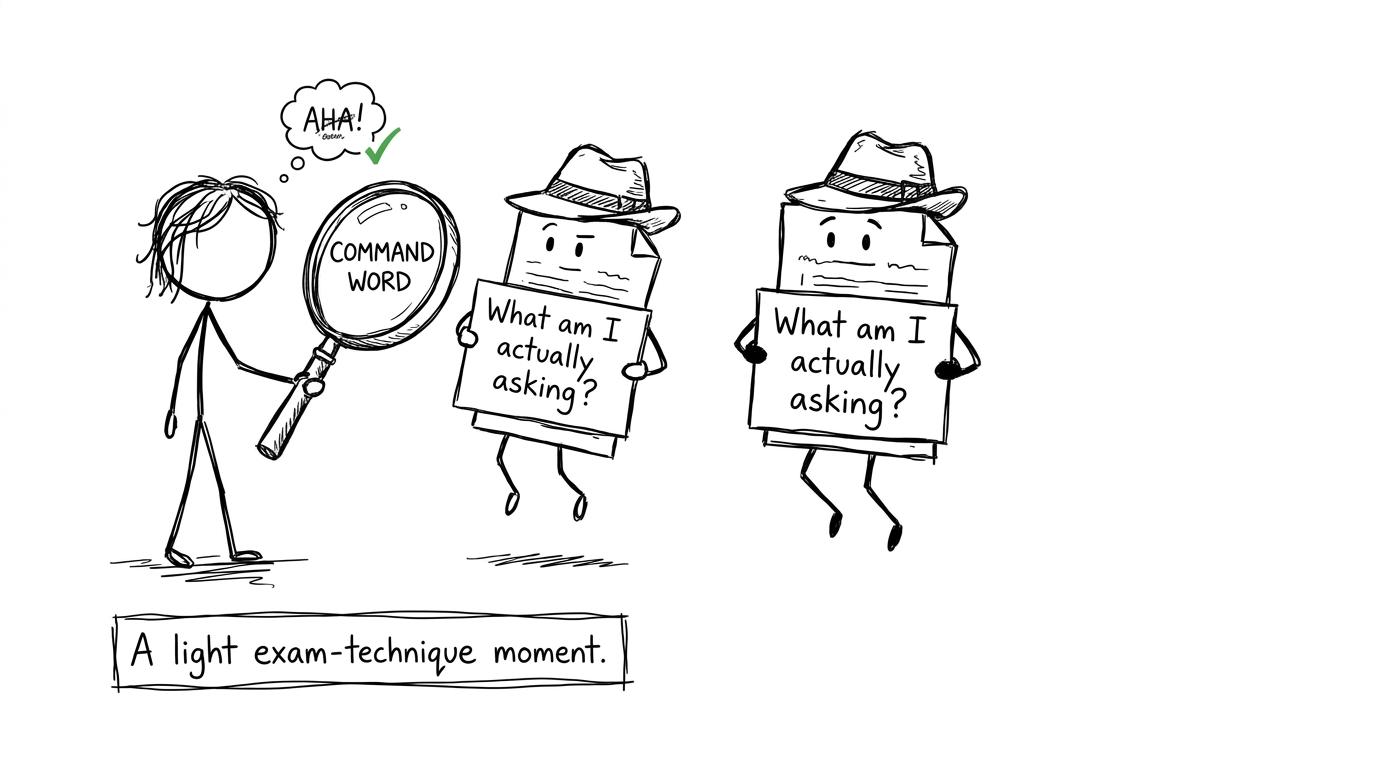 An exam question asks what it is actually asking while a student inspects its command word
What examiners reward in writing
Half of the written GCSE assesses your own writing. That makes writing practice too important to leave until the final weeks.
Communication, organisation and adaptation
AO5 rewards clear, effective and imaginative communication. It also assesses whether you adapt tone, style and register to the required form, purpose and audience.
This means a persuasive speech should sound designed to be heard. An article needs a coherent line of thought appropriate to its readership. A narrative needs controlled development rather than an overcrowded sequence of dramatic events.
Examiners reward deliberate choices: a purposeful opening, logically developed ideas, controlled paragraphing, effective transitions and an ending that feels earned. A complicated idea is not automatically better than a clear one.
Technical accuracy
AO6 rewards vocabulary and sentence structures used for clarity, purpose and effect, alongside accurate spelling and punctuation. It accounts for 20%20\%20% of the whole qualification, so accuracy is not a minor finishing touch.
The phrase “range of vocabulary” is sometimes misunderstood. Examiners do not reward unusual words simply for being unusual. A precise ordinary word is stronger than an ambitious word used incorrectly. Sentence variety works in the same way: it should control emphasis, pace and clarity rather than display a memorised collection of constructions.
How the exam boards differ
The assessment objectives are shared, but paper structures are not interchangeable.
AQA uses two equally weighted papers covering creative reading and writing, then writers' viewpoints and perspectives. OCR also has two equally weighted papers, one focused on communicating information and ideas and the other on effects and impact. Eduqas gives different weightings to its two written components. Edexcel offers specifications whose source arrangements and task structures require careful checking.
Depending on the board and specification, you may encounter unseen fiction, literary non-fiction, journalism, speeches or material connected with an anthology. Writing tasks may involve creative, persuasive or transactional forms.
Do not revise from a generic checklist alone. Confirm your specification, paper names, timings, mark allocations and question order with your teacher and the current official materials. The principle resembles choosing the correct maths paper: AQA GCSE Maths resources are not a substitute for an Edexcel paper, even when much of the underlying mathematics overlaps.
The qualification is untiered, unlike foundation and higher tier GCSE Maths. Every student taking a particular English Language specification faces the same paper, with the mark scheme distinguishing different levels of performance.
A better way to revise English Language skills
Because the subject assesses performance, passive rereading has limited value. Revision should produce evidence of what you can do independently.
Use a short practice loop
Choose one narrow skill, such as inference, structural analysis or adapting tone. Complete a timed question, mark it against the relevant assessment objective, identify one weakness and attempt a different question using the correction.
This is the same feedback loop described in MathsGenie's guide to finding your weakest GCSE topics. A broad label such as “bad at English” is not actionable. “My evidence is too long” or “I identify techniques without explaining effects” gives you something specific to repair.
Study mark schemes without copying phrases
A mark scheme shows the qualities examiners reward, but its language should not become a script. Translate each level descriptor into a practical question:
- Is my point relevant to the task?
- Is my evidence precise?
- Have I explained the writer's choice?
- Is my judgement supported?
- Does my writing suit its audience and purpose?
- Have I checked sentence boundaries and spelling?
Maths past-paper practice with mark schemes teaches the same lesson: marking is most useful when it changes the next attempt.
Keep English practice manageable during maths revision
If maths is your main concern, English need not disappear from the timetable. A short reading response, writing plan or editing exercise can maintain fluency without consuming an entire evening. MathsGenie's one-month GCSE Maths revision plan can help you protect regular maths sessions while leaving planned space for English and other subjects.
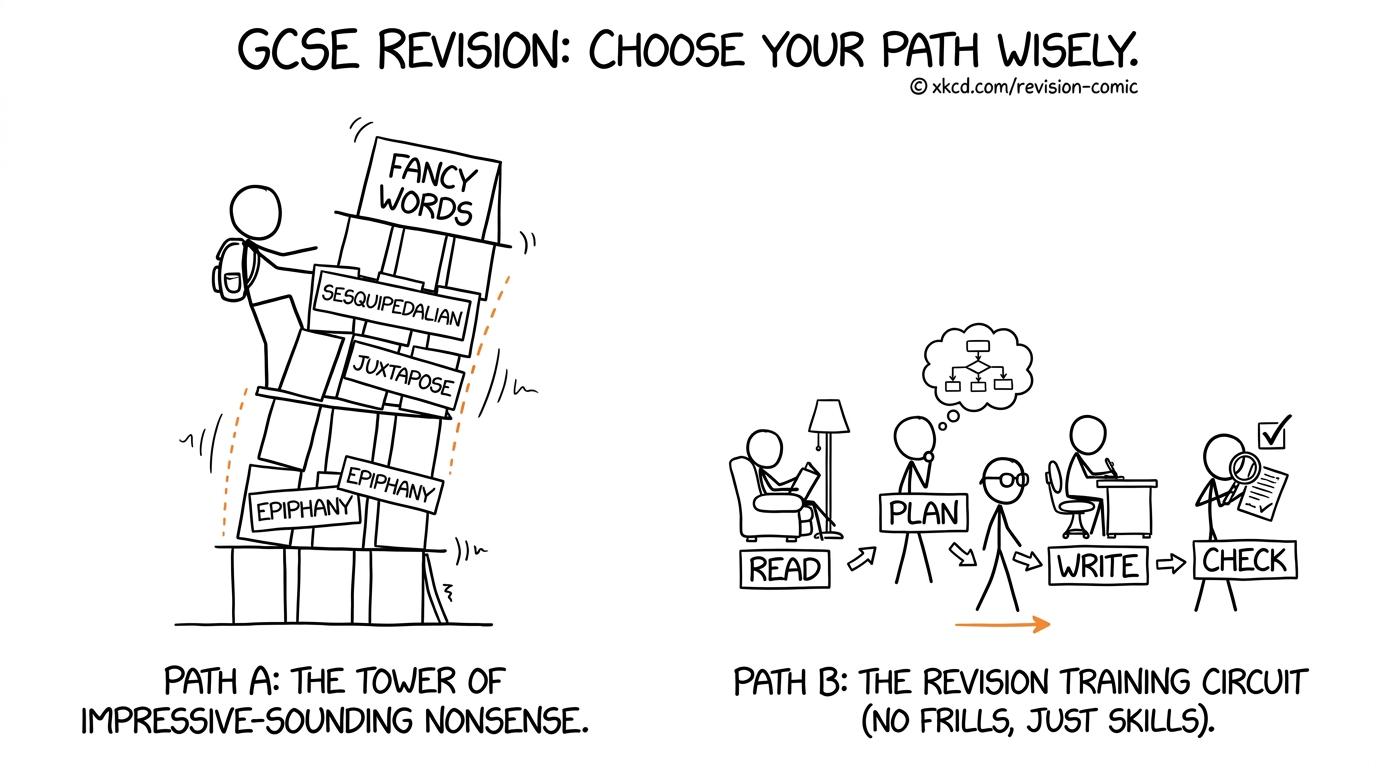 One student builds a shaky castle of fancy words while another practises reading, planning, writing and checking
Common mistakes that lose English Language marks
Memorising an answer instead of answering the task
Prepared openings and paragraph structures can provide confidence, but forcing them onto an unsuitable question weakens relevance. Adaptation is part of the skill being tested.
Feature spotting without explanation
A list of metaphors, adjectives and short sentences does not show how the writing works. Select fewer details and explain them more fully.
Writing about an imagined reader reaction
Claims such as “this makes the reader sad” are often too broad. Explain what the language suggests and why that might shape the reader's understanding.
Treating ambitious vocabulary as a shortcut
Misused words damage clarity and accuracy. Choose vocabulary for precision, tone and effect, not simply to sound sophisticated.
Ignoring the form or audience
A speech, letter and article may share persuasive techniques, but they are not identical. Examiners reward writing that feels genuinely shaped for the specified situation.
Practising without reviewing
Completing many answers without diagnosing mistakes can make weak habits faster. The MathsGenie resources hub offers mini tests, papers and structured practice for maths; apply the same test / review / retest principle to English.
Skills become reliable through practice
GCSE English Language does not ask you to arrive with a warehouse of memorised content. It asks you to meet an unfamiliar text or task and make good decisions: notice accurately, select carefully, explain clearly and write with control.
That can feel less predictable than revising a list of topics. It is also encouraging. Skills can be trained. Use your assessment objectives as a map, practise one precise task at a time and let each mark scheme tell you what to improve next.
Then keep your maths preparation equally purposeful. Start with MathsGenie's GCSE Maths revision hub, use revision lessons and video solutions to rebuild understanding, practise with exam questions and mini tests, and finish with past papers and predicted papers. In both subjects, progress comes from the same quiet cycle: attempt, check, correct and try again.










