Typing vs Handwriting Notes GCSE Further Maths
Typing vs handwriting notes GCSE Further Maths: discover what memory research suggests and build a practical revision system for stronger recall and marks.
A page of neat notes can create a comforting feeling: I have revised this. Yet the real test arrives when the notes are closed and you must recall a method for matrices, functions or differentiation. That is why the debate about typing vs handwriting notes GCSE Further Maths needs a more useful answer than “pen is always better”.
Current research suggests that handwriting has a small average advantage for learning and recall, while typing is faster and better for organising information. But the evidence mainly comes from university students taking lecture notes, not GCSE Further Maths candidates. For your exams, the strongest approach is usually hybrid: handwrite the mathematical thinking you need to remember, type material that benefits from editing and organisation, then practise retrieving and applying it without either set of notes.
The short answer: which type of notes sticks better?
Use this checklist as your starting point:
- Handwrite formulas, diagrams, method summaries and corrections you need to recall.
- Type specification checklists, revision plans and searchable error records.
- Avoid copying complete explanations word for word in either format.
- Close your notes and reconstruct key ideas from memory.
- Move quickly from notes to practice questions.
- Use mark schemes to correct errors, then re-test the topic after a gap.
Handwriting may support stronger encoding because it is slower and forces selection. Typing may tempt you to capture more words without deciding what matters. However, a handwritten page copied passively is still passive revision. A short typed explanation produced from memory can be far more valuable.
The medium influences learning. It does not determine it.
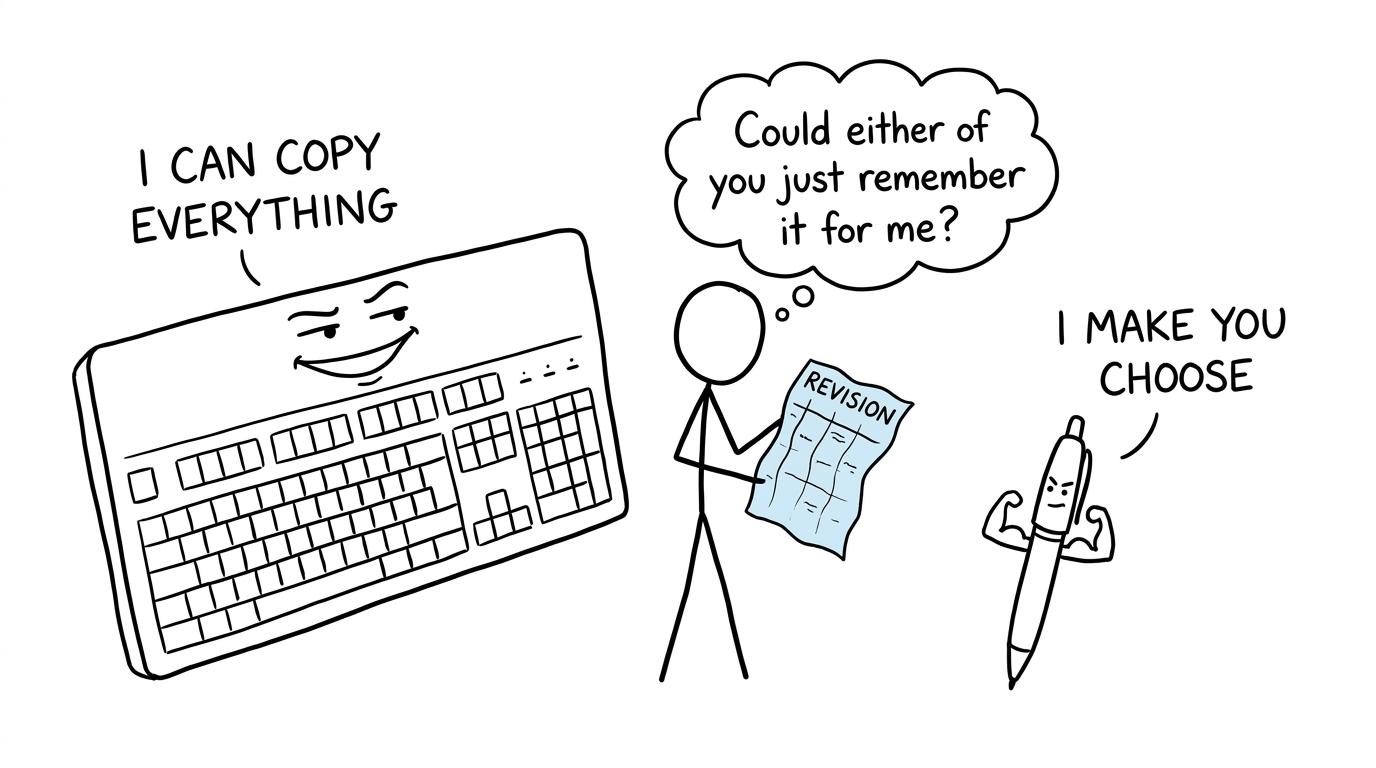 A student negotiates with a keyboard that copies everything and a pen that forces choices
What memory research actually tells us
Memory is not a recording that becomes clearer when you copy more information. Learning depends on at least two important processes: encoding, when information is understood and connected to existing knowledge, and retrieval, when that information is brought back without being presented to you.
A 2024 meta-analysis combined 242424 studies comparing typed and handwritten lecture notes among university students. On average, students taking and reviewing handwritten notes achieved slightly better outcomes, although typists produced substantially more notes. That distinction matters: volume is not the same as learning.
There are limits to what GCSE students should conclude. The research concerned college-level lecture note-taking, not revision for a GCSE-stage Further Maths qualification. Individual studies also use different tests, review conditions and digital devices. The evidence supports a modest preference, not a universal law.
A 2024 EEG study found more widespread patterns of brain connectivity when young adults wrote familiar words by hand than when they typed them. This is interesting, but it does not prove that handwriting automatically produces better exam results. A later academic commentary noted that the experiment did not directly test learning or memory. Brain activity can suggest a mechanism; it cannot replace evidence of successful recall.
The safest conclusion is simple: handwriting often encourages useful mental work, but what you do with the notes afterwards is at least as important.
Why Further Maths changes the note-taking question
Further Maths is not mainly a collection of sentences to memorise. It involves relationships, notation, spatial organisation and chains of reasoning.
For example, AQA's Level 2 Further Mathematics content extends GCSE knowledge through areas including algebra, coordinate geometry, calculus, matrix transformations and geometry. Students can explore these areas through the free AQA GCSE Further Maths revision hub, which brings lessons, questions and paper practice together.
When you are learning a relationship such as
ddx(xn)=nxn−1,\frac{\mathrm{d}}{\mathrm{d}x}\left(x^n\right)=nx^{n-1},dxd(xn)=nxn−1,the goal is not merely to recognise it. You need to recall it, understand the role of nnn, apply it accurately and present enough working for the mark scheme. Similarly, a matrix transformation is easier to understand when the matrix, coordinates and resulting movement are arranged spatially rather than buried inside a paragraph.
Handwriting suits this kind of flexible layout. You can position a sketch beside a formula, circle a sign change and connect two stages with an arrow. It also resembles the physical act of writing in an examination.
Typing remains useful when you need to reorganise a long topic list, search an error log or keep resources together. It is less naturally suited to entering notation such as f−1(x)f^{-1}(x)f−1(x), 3\sqrt{3}3 or a matrix quickly unless you already use mathematical typesetting confidently.
When handwriting is the better choice
Condensing a method
The slowness of handwriting can be productive. If you allow yourself only three or four lines for a method, you must decide which conditions, operations and checks matter. That selection creates more mental engagement than copying a full model answer.
A useful handwritten summary might contain:
- the cue that identifies the topic;
- the essential formula or sequence of steps;
- one warning based on a previous mistake;
- a final check you can perform.
This is especially valuable for algebra, where a small sign or index error can change an entire solution.
Sketching and connecting ideas
Graphs, transformations, coordinate geometry and trigonometry often depend on where information sits on the page. Pen and paper let you develop a diagram naturally. You can also add annotations while watching a MathsGenie lesson rather than trying to recreate every sentence.
If your core GCSE algebra or graph knowledge needs strengthening first, use the GCSE Maths revision hub and the GCSE topic list by board and tier to identify the prerequisite skill precisely.
Correcting errors
A correction written immediately beside your original attempt preserves the contrast between the wrong decision and the better one. That contrast is often more memorable than replacing the entire page with a clean version.
Keep corrections brief. Write what caused the lost mark, not merely the correct answer: “expanded the negative bracket incorrectly” is more useful than “careless mistake”.
When typing earns its place
Typing is excellent for information that changes frequently. A digital specification checklist can be reordered by confidence, date or topic. A searchable error log lets you find every occasion when an incorrect sign, incomplete proof or calculator input caused trouble.
Typing can also improve accessibility. If handwriting is painful, unusually slow or difficult to read, forcing every revision task onto paper may reduce the amount of meaningful practice you complete. Your normal access arrangements and way of working should guide your choice.
Use typed notes for:
- a topic checklist linked to the relevant specification;
- an error log with the question, cause and re-test date;
- a revision timetable;
- links to lessons, papers and video solutions;
- short summaries recalled without looking at the source.
The danger is transcription. Fast typing can create pages that look comprehensive while allowing ideas to pass through your attention almost untouched. If you type, pause regularly and ask: Could I explain this with the screen hidden?
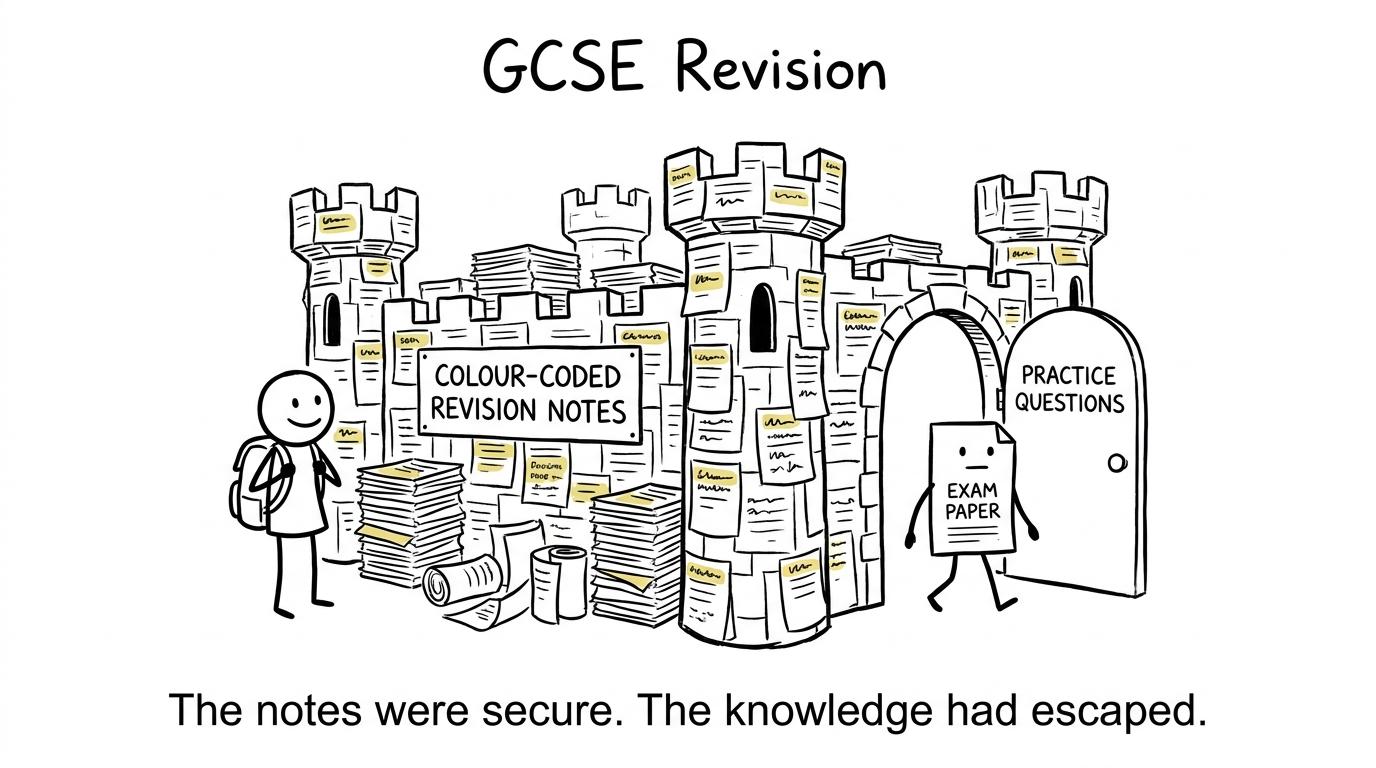 Beautiful revision notes form a fortress while the knowledge escapes towards practice questions
A hybrid note-taking system that supports recall
The best system separates storage from learning. Digital tools are good at storage. Exams reward learning.
Capture only what deserves to survive
After a lesson, create a short digital topic entry containing the lesson link, specification statement and questions to revisit. Do not rewrite the whole lesson. MathsGenie's guide to efficient GCSE maths revision follows the same principle: learn briefly, practise, mark and fix.
Build one handwritten recall sheet
Close the lesson and write the important ideas from memory. Include formulas, diagrams, decision cues and common traps. Leave gaps where recall fails, then check the lesson and add corrections in another colour.
This turns note-making into a test. The blank space is useful evidence, not failure.
Apply the idea without notes
Further Maths requires execution, so move into practice questions while the method is still fresh. Mark your work carefully. MathsGenie's past-paper library places papers and official mark schemes together, making it easier to compare your working with what earns marks.
For shorter diagnostic practice, a focused test can be less intimidating than a full paper. The GCSE Maths mini tests show how short, timed sets can expose specific gaps before you build full-paper stamina.
Revisit after a delay
Return to the topic later and reconstruct the sheet again without looking. Then answer fresh questions. Retrieval should include feedback because repeatedly recalling an incorrect method can strengthen the misconception.
A practical rhythm is:
- first contact: lesson and short notes;
- same session: questions and marking;
- next review: recall before checking;
- later review: mixed or timed questions;
- final phase: full past papers and appropriate predicted papers.
The guide to finding weak GCSE topics can help turn your marked work into a focused revision order.
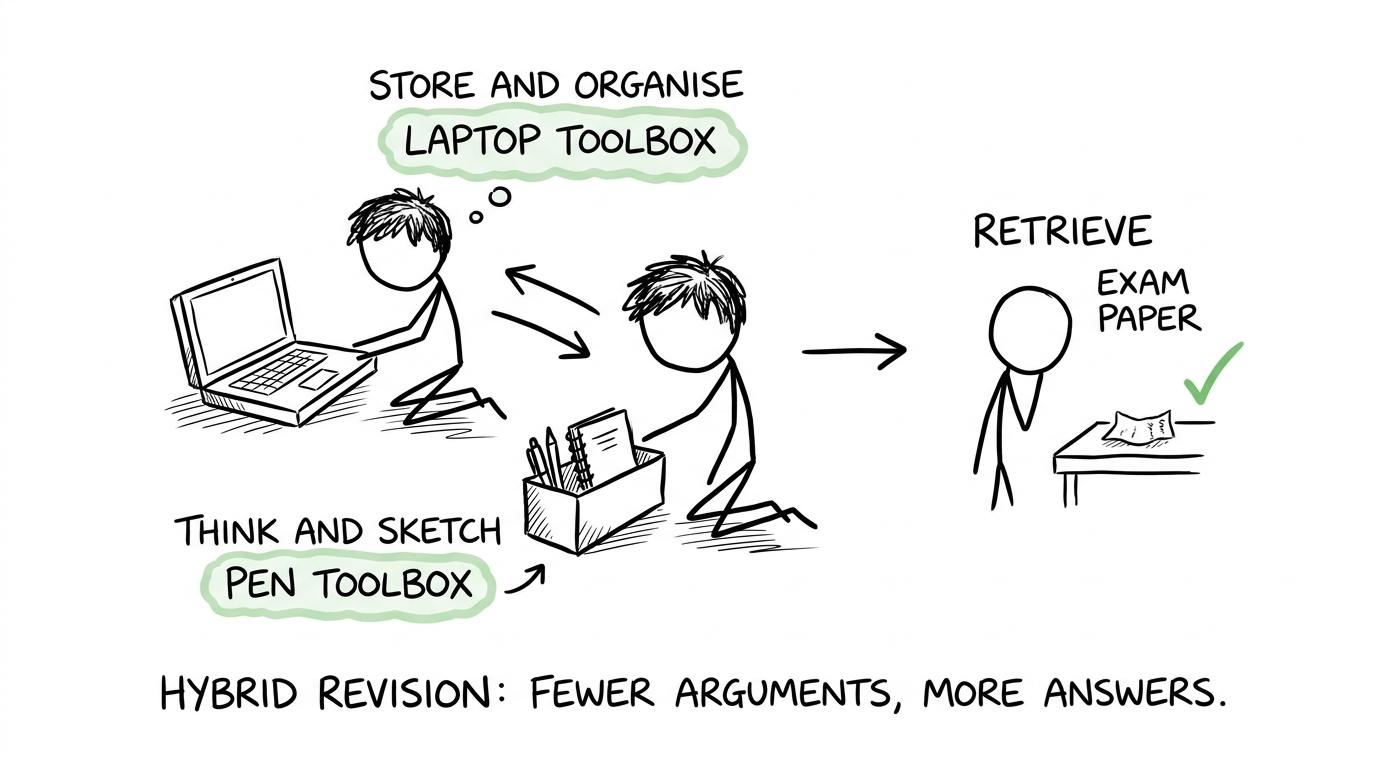 A student uses a laptop for organisation, a pen for thinking and an exam paper for retrieval
Common mistakes with typed and handwritten notes
Making notes instead of doing maths
Notes can explain a method, but only questions reveal whether you can use it. Set a limit on note-making and protect most of the session for independent practice.
Copying model solutions line by line
Copying can feel smooth because the next step is always visible. Cover the solution, attempt the question, then compare. The moment of uncertainty is where useful learning begins.
Judging revision by neatness
Colour and layout can improve navigation, but decoration is not retrieval. If presentation consumes more time than thinking, simplify the page.
Keeping every mistake in one vague category
“Algebra” is too broad. Record the exact problem: incorrect index law, weak factorisation, missing domain restriction or sign error after rearranging. Specific diagnoses lead to specific practice.
Never testing notes under exam conditions
A summary may feel familiar and still disappear under time pressure. Use timed questions, mark schemes and eventually complete papers. Predicted papers can provide fresh practice, but they should complement rather than replace real past papers.
Choose the method by the job
Handwriting appears to have a small average advantage for learning, but the most effective GCSE Further Maths revision is not a stationery contest. Handwrite when selection, notation, diagrams and physical recall matter. Type when organisation, editing, searching or accessibility matters. Then close both formats and make your memory do the work.
Start with the free AQA GCSE Further Maths resources. Use revision lessons to clarify a method, practice questions to apply it, mark schemes and video solutions to diagnose errors, and past papers to build exam readiness. Mini tests can reveal smaller gaps, while predicted papers provide additional unseen practice nearer the examination.
Good notes are not the destination. They are the bridge between meeting an idea and being able to produce it when marks depend on it.