Typing vs Handwriting Notes for GCSE French
Typing vs handwriting notes GCSE French: see what memory research suggests and build a practical, recall-first revision routine that helps learning stick.
A page of French notes can look reassuringly complete. The headings are neat, every verb is highlighted, and nothing appears to be missing. Then you close the page and discover how little you can recall.
So, in the debate over typing vs handwriting notes GCSE French, which method sticks better? Research suggests handwriting may offer a small average advantage because it encourages selection and deeper processing. But neither method guarantees learning. What matters most is what happens after you make the notes: retrieving vocabulary, producing sentences, checking errors and returning to the material after a delay.
The practical answer is to type for organisation and speed, handwrite for focused processing and exam rehearsal, then use active recall with both.
The short answer: which note-taking method is better?
Use this checklist as your starting point:
- Handwrite when learning unfamiliar vocabulary, practising spelling and accents, summarising grammar or preparing for a handwritten assessment.
- Type when organising large topic lists, editing model structures, searching your notes or creating digital flashcards.
- Avoid copying word for word, regardless of the medium.
- Close the notes and retrieve what you know before checking.
- Practise all four language skills rather than treating written notes as complete French revision.
- Review after a delay so that learning is strengthened rather than merely recognised.
If you want one default choice, begin with handwriting for a small, difficult set of material. Switch to typing when digital organisation gives you a genuine practical advantage.
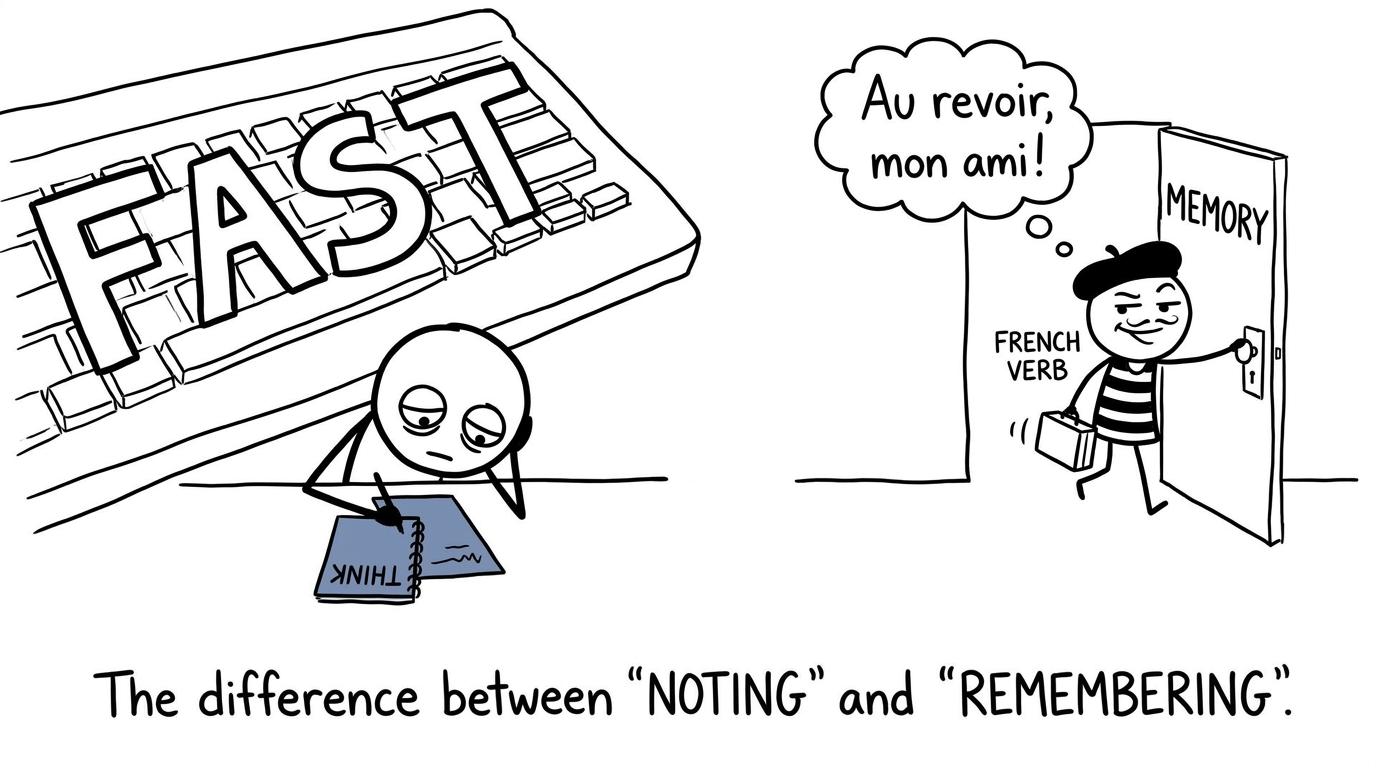 A GCSE student choosing between a fast keyboard and a notebook while a French verb escapes towards memory
What memory research actually tells us
The evidence is more interesting than the familiar claim that “writing by hand is always better”.
A 2024 meta-analysis of research involving university students found that taking and reviewing handwritten lecture notes was associated with higher achievement on average, while typed notes generally contained more words. Other studies have reported little or no meaningful difference between the two methods, particularly when students were allowed to review their notes.
That uncertainty matters. Most note-taking studies involve adults learning from lectures, not GCSE students memorising French vocabulary, grammatical forms and sound-spelling relationships. It would therefore be too strong to claim that handwriting automatically produces better GCSE French marks.
A calmer conclusion is more defensible: handwriting can encourage deeper encoding because it is slower and forces greater selection, but the learning activity matters more than the tool alone.
Encoding is only the beginning
Encoding is the process of getting information into memory. Handwriting may help when the slower pace makes you choose the central idea, translate it into your own words or notice the spelling of a French phrase.
Typing can also involve deep encoding. A student who types a concise explanation from memory is thinking harder than one who hand-copies an entire textbook page. Conversely, a handwritten page created through mindless copying may produce little durable learning.
The real distinction is not simply pen against keyboard. It is active thought against passive transcription.
Retrieval is what reveals whether learning has stuck
Reading a familiar page creates recognition: the information feels known because it is in front of you. An exam requires retrieval: producing the information when the support has disappeared.
Research on retrieval practice is much broader than the note-taking debate. The useful principle is straightforward: attempting to recall previously learnt material, receiving feedback and repeating the attempt after a delay can strengthen later access to that knowledge.
For French, that means closing the notes and trying to:
- recall the meaning of a word in both directions;
- spell it accurately, including accents;
- say it aloud without reading;
- place it in an original sentence;
- recognise it in speech and connected text;
- retrieve the correct tense or agreement under time pressure.
Your notes are a starting point. The attempt to remember is the revision.
Why handwriting can help with GCSE French
Handwriting naturally slows the session down. That can be useful when accuracy matters.
French contains details that are easy to skim on a screen: accents, silent endings, gender, adjective agreement and changes within verb forms. Writing a short phrase carefully can focus attention on these features. Handwriting also lets you add arrows, group related forms and annotate recurring errors without turning note-making into a formatting project.
There is another practical reason to use it. If your writing assessment is completed by hand, subject to any approved access arrangements, some handwritten practice makes the physical process familiar. You can learn whether your writing remains legible when timed and whether you can produce accurate language without digital spelling prompts.
Handwriting is especially useful for:
- compact vocabulary cards;
- grammar summaries written in your own words;
- short closed-book sentence production;
- dictation corrections;
- an error log containing only mistakes you need to revisit.
The word compact matters. A smaller page you repeatedly test is more valuable than a beautiful notebook you never reopen.
When typing GCSE French notes works better
Typing is faster, searchable and easy to edit. Those are real advantages, particularly when you need to organise material from several themes or combine feedback from different lessons.
A digital document can help you:
- sort vocabulary by theme, gender or grammatical pattern;
- maintain a searchable bank of useful structures;
- hide translations for self-testing;
- reorganise teacher feedback into an error list;
- prepare flashcards efficiently;
- add audio links provided by your school or exam board;
- revise on more than one device.
Typing is less effective when speed becomes transcription. If every word from a slide reaches your document without being evaluated, the file may be complete while your memory remains unchanged.
Digital distractions are another practical risk. Notifications and open tabs fragment attention. If you type, use full-screen mode, silence notifications and decide in advance what the finished resource will be used to test.
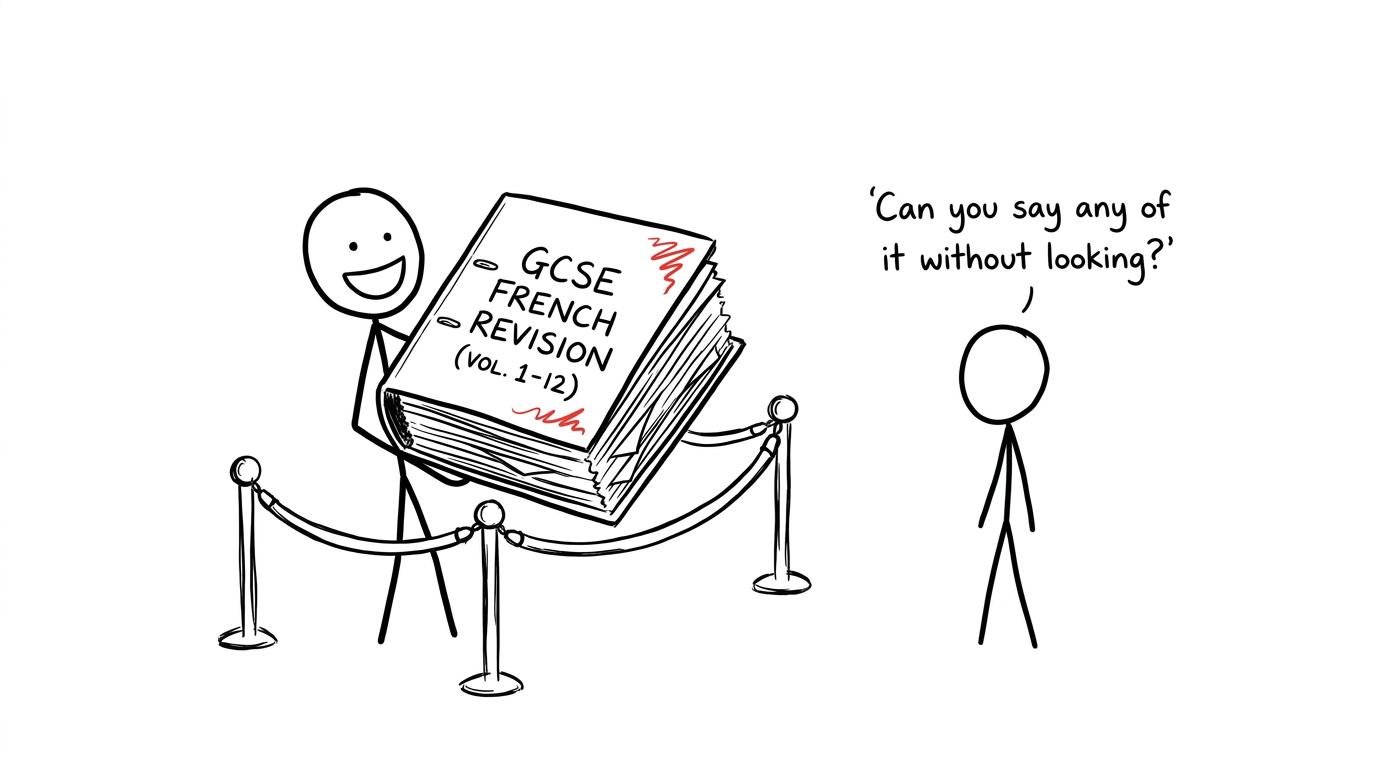 A beautifully organised French binder treated like a museum exhibit while recall waits outside
The best method is a hybrid recall system
You do not need to declare lifelong loyalty to a pen or keyboard. Give each tool a specific job.
Capture and organise
Type large collections of vocabulary, teacher feedback and topic resources when searchability will save time. Keep one dependable master document rather than several overlapping versions.
Compress by hand
Choose a small section and reduce it to its essential vocabulary, grammar and sentence patterns. Do not copy the digital document. Reconstruct the ideas in your own words, checking only when necessary.
Retrieve without notes
Put both versions away. Write, say or type everything you can recall. The medium used for this test can vary, but no source material should be visible during the first attempt.
Check and correct
Compare your response with an accurate source. Correct accents, agreement, word order and verb forms. Feedback matters because repeatedly retrieving an incorrect form can make the error more familiar.
Revisit later
Return to the same material after a delay. Material that feels difficult to retrieve deserves more attention than material that merely looks impressive on the page.
This is also a useful cross-subject principle. In maths, copying a method can feel fluent without proving that you can apply it. The MathsGenie GCSE Maths revision hub moves students from revision lessons into practice questions, mini tests and papers because independent performance is the honest test.
Match your notes to the GCSE French assessment
Current GCSE French specifications assess listening, speaking, reading and writing, although exact formats depend on your exam board and qualification. AQA, Edexcel, OCR and Eduqas materials should not be treated as interchangeable, so check the specification your school follows.
Written notes directly rehearse only part of what you need. A sensible revision system converts the same knowledge into several forms:
- Listening: hear a phrase, identify it and write what you heard.
- Speaking: answer aloud without reading a prepared paragraph.
- Reading: identify meaning, tense and key grammatical details in context.
- Writing: produce accurate language from a prompt rather than copying a model.
This matters because memory is cue-dependent. Recognising a word in a colour-coded list does not guarantee that you will understand it in rapid speech or retrieve it during an unprepared speaking task.
Build a revision routine that survives busy weeks
The best system is not the most elaborate one. It is the one you can repeat while preparing for several GCSE subjects.
A practical French session might contain four stages:
- retrieve an older vocabulary set;
- learn or reorganise one small section;
- produce language without notes;
- check mistakes and schedule the next review.
Use the same rhythm in maths: learn, practise, mark and retest. The GCSE revision timetable guide helps you plan specific tasks rather than vague blocks labelled “revision”. If exams are approaching, the one-month GCSE maths plan shows how retrieval, topic practice and papers can fit into a manageable week.
Short sessions still count. On low-energy days, use the principle behind the short GCSE revision routine: choose one narrow target, test it and correct one weakness. Consistency usually matters more than producing another complete set of notes.
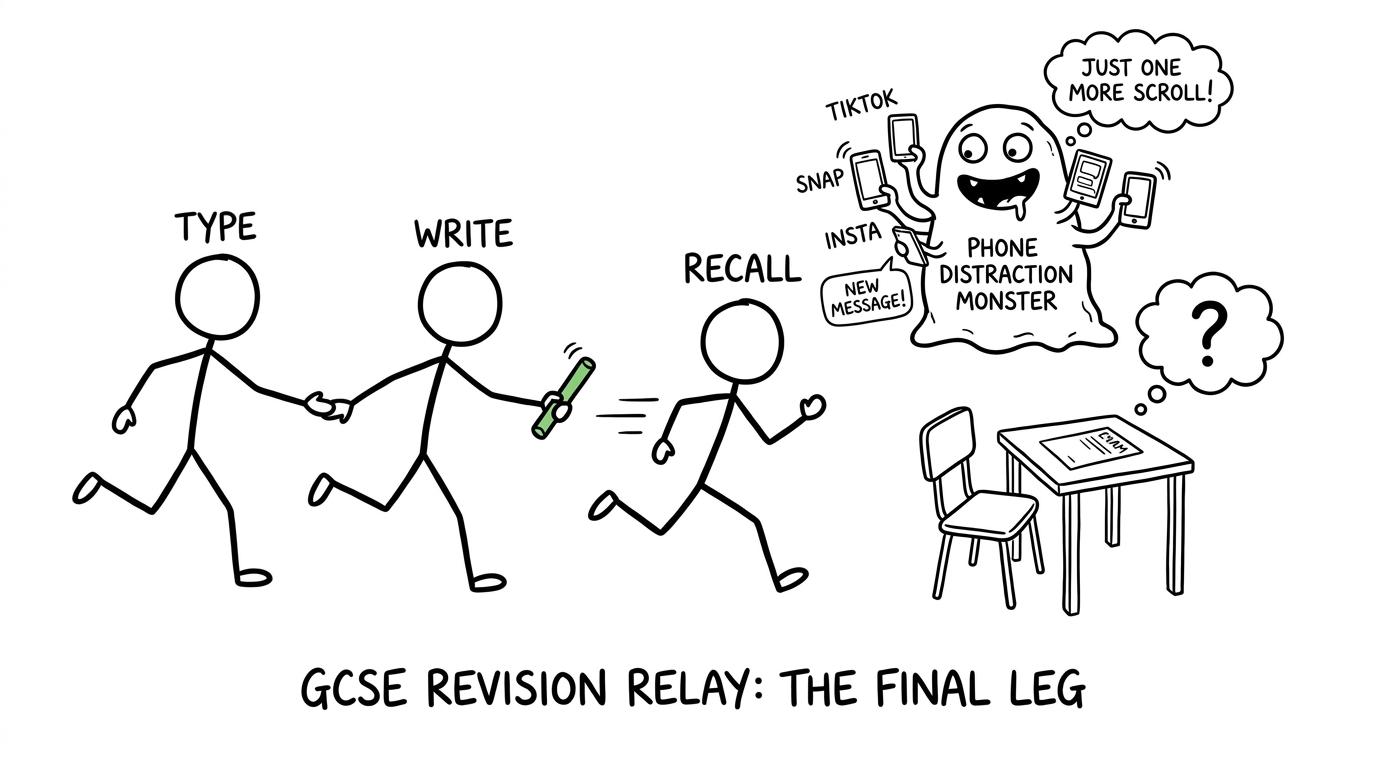 Typing and handwriting passing the revision baton to active recall while notifications wave from the sidelines
Common mistakes when making French notes
Copying without making decisions
Copying creates visible work but little evidence of understanding. Pause, select and paraphrase. If a sentence must be copied exactly, explain its structure afterwards.
Making notes too attractive to test
Colour can support organisation, but decoration is not retrieval. Set a time limit for creating the resource, then spend at least as much attention using it from memory.
Testing only French to English
That direction is often easier. Speaking and writing also require English-to-French retrieval, accurate spelling and control of grammar.
Trusting digital spelling tools
Autocorrect can conceal weak accents, agreement and conjugation. Turn assistance off during retrieval, then use accurate feedback when checking.
Rewriting everything after one mistake
Keep an error log instead. Record the incorrect form, the correction and a prompt that will test it later. This directs revision towards gaps rather than material already known.
Confusing familiarity with exam readiness
The same trap appears in maths. Looking through solutions is not equivalent to completing questions independently. Learn to use GCSE past papers properly, including marking, diagnosing and retesting mistakes. The guide on when to start GCSE past papers also explains why shorter diagnostic work should come before endless full papers.
Choose the method that leads to recall
Handwriting probably has a modest average advantage in some note-taking contexts, but it is not a memory guarantee. Typing is not automatically shallow either. The stronger question is: what will these notes make you retrieve tomorrow?
Use handwriting when slowing down improves attention, spelling and sentence production. Use typing when organisation, editing and searchability make revision easier. Then close both and practise recalling, speaking, writing and recognising the language without support.
Apply the same discipline to your maths preparation. Choose your board through the GCSE Maths revision area, then use resources such as Edexcel GCSE Maths past papers, AQA GCSE Maths past papers and Edexcel predicted papers. MathsGenie brings free revision lessons, practice questions, mini tests, mark schemes, video solutions and predicted papers into one clear loop: learn, retrieve, check and improve.