Typing Answers Under Timer: GCSE Spanish Speed
Typing answers under timer GCSE Spanish practice can build speed, but only in the right exam format. Learn a method that protects structure and accuracy.
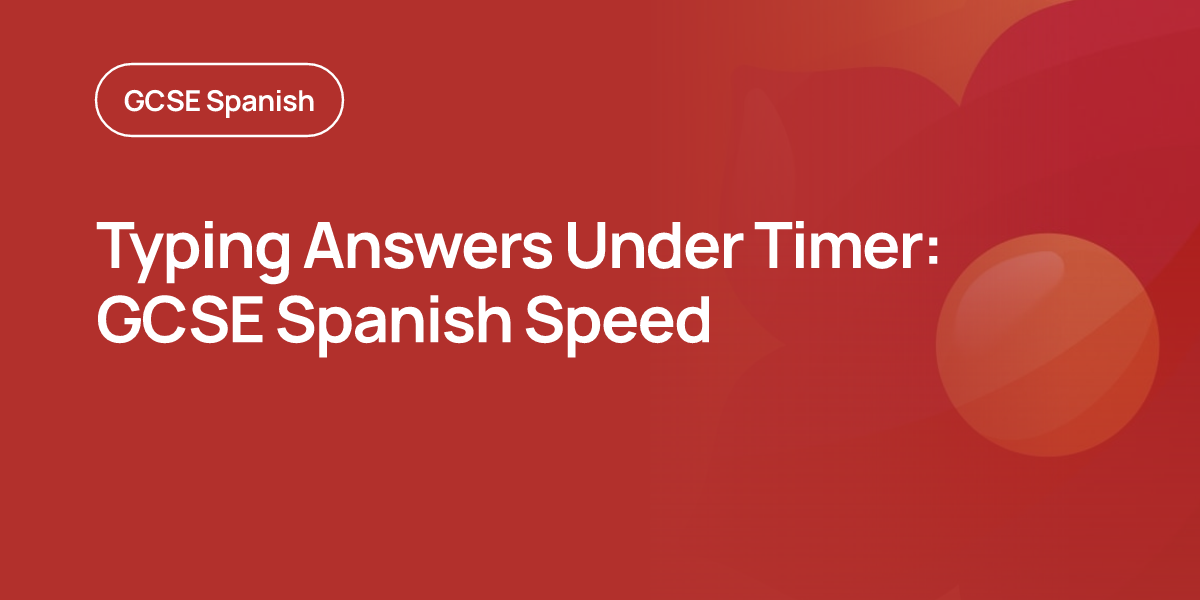
There is a familiar revision trap: an answer feels fluent at home, then the clock starts and every sentence becomes expensive. If you are considering typing answers under timer GCSE Spanish practice, the short answer is yes; it can improve typed writing speed, planning and decision-making. But it will not automatically improve your Spanish, and it is less useful if you must handwrite the real examination.
The best approach is to practise under time in the format you will actually use, review the quality of each answer and repeat the same process regularly. Speed matters only when the answer still covers the task, uses accurate language and leaves time for checking.
That principle will sound familiar to GCSE maths students. A fast incorrect calculation earns little. A beautifully completed first page is not enough if half the paper remains untouched. In both subjects, useful speed means producing mark-worthy work within a fixed time.
The quick verdict and checklist
Timed typing is likely to help when:
- you are authorised to use a word processor in the examination;
- typing is already your normal way of working at school;
- you practise without spelling, grammar or predictive-text assistance;
- each attempt includes planning, writing and checking;
- you review accuracy and task coverage, not merely word count;
- you use prompts and timings that match your exam board and tier.
It is less effective when you type practice answers but will handwrite the examination, copy memorised paragraphs without adapting them, or chase speed while ignoring accents, verb endings and compulsory bullet points.
Before building a routine, confirm your exam board, tier and permitted method with your Spanish teacher or examinations officer.
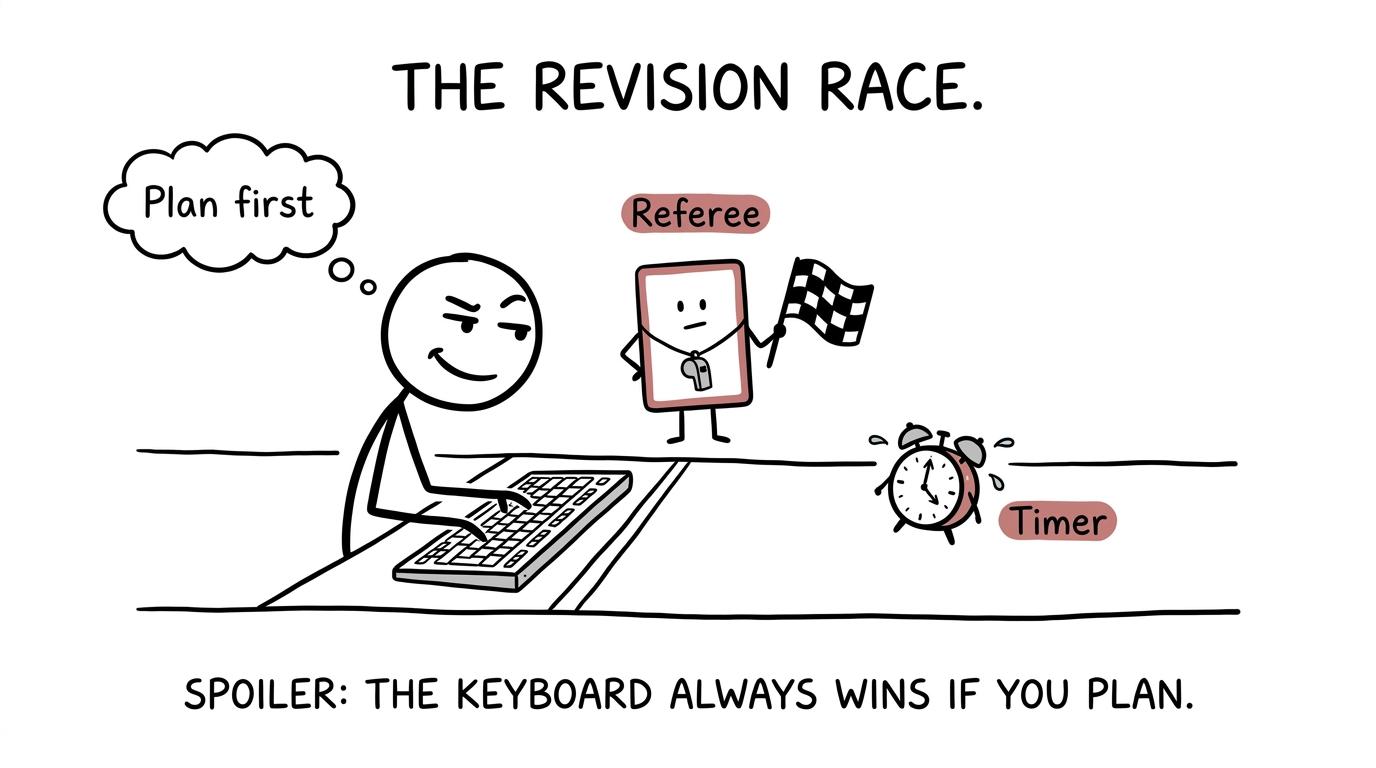 A keyboard races a tiny timer while a vocabulary card referees
Why timed typing can improve GCSE Spanish speed
A writing paper tests more than the physical act of recording words. You must interpret the prompt, retrieve vocabulary, select grammar, organise ideas and monitor accuracy. If typing is slow or unfamiliar, it competes for attention with all of those decisions.
Short, repeated keyboard practice can make transcription more fluent. Research into typing interventions has found that practice can improve typed fluency, although evidence about improvement in the overall quality of writing is more mixed. Research on retrieval practice is stronger: attempting to recall knowledge, rather than simply rereading it, generally supports learning across classroom settings.
Timed Spanish writing combines both processes. You retrieve language while practising how to produce it under pressure. However, the timer is not magic. The useful cycle is:
attempt; check; identify the bottleneck; correct; repeat.
This is also the logic behind effective maths revision. MathsGenie's GCSE Maths revision hub moves students from revision lessons into practice questions, papers and solutions. The subject changes, but the learning mechanism does not: active performance exposes weaknesses that passive reading can hide.
Typing speed is not the same as answer quality
A student can type quickly and still lose marks through weak content. Spanish writing assessments reward communication and the accurate application of vocabulary and grammar. Your exact mark scheme depends on the board and task, but raw word production is never the whole objective.
Think of performance as four connected elements:
- coverage: have you responded to every required part of the prompt?
- communication: are your ideas understandable and relevant?
- range: have you selected suitable vocabulary and structures?
- accuracy: are verb forms, agreements, spelling and accents secure?
The timer should train you to protect all four. If your word count rises while compulsory content disappears, you have become faster at the wrong thing.
This mirrors a timed maths paper. Completing more questions helps only if your methods remain accurate and sufficiently clear to earn marks. Maths students can develop that balance through Edexcel GCSE Maths mini tests, which provide a shorter environment for practising decisions under time pressure.
Match practice to the examination you will sit
This is the most important qualification. Typing practice transfers most directly to a typed examination. If you will handwrite your GCSE Spanish paper, at least most of your timed extended-answer practice should also be handwritten.
Under current JCQ rules, a school may provide a word processor where it reflects a candidate's normal way of working within the centre. In examination conditions, automatic spelling and grammar checks and predictive text are normally switched off. Access to the internet and unauthorised applications is also prohibited. A laptop at home therefore does not, by itself, mean that you will type the real paper.
If a word processor is your approved method, practise on a plain document with assistance disabled. Learn how to type Spanish accents using the setup your school provides. Do not build a routine around autocorrect quietly repairing errors that the examination system will leave untouched.
Current writing-paper durations also differ by board and tier. For the specifications assessed from 202620262026, AQA lists 111 hour 101010 minutes at foundation and 111 hour 151515 minutes at higher. Pearson Edexcel lists 111 hour 151515 minutes at foundation and 111 hour 202020 minutes at higher. Task structures vary too. Check the current specification and sample materials for AQA, Edexcel, OCR or Eduqas rather than borrowing another board's timing plan.
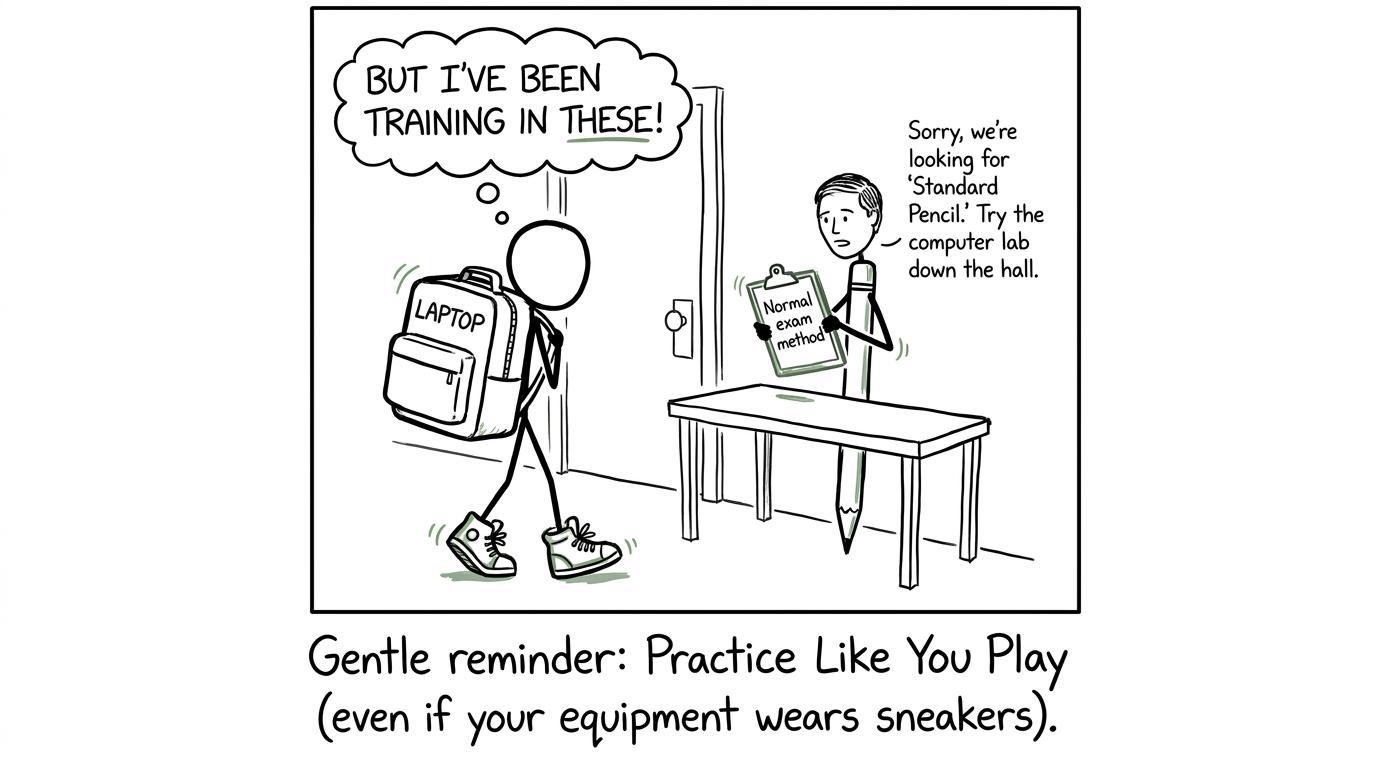 A laptop in trainers asks a pen for permission to enter the exam hall
A practical timed-typing routine
Establish an untimed baseline
Complete one appropriate Spanish writing prompt without a timer. Record where time goes: understanding the task, planning, recalling vocabulary, typing accents, composing sentences or checking.
This distinction matters. More keyboard drills will not solve a vocabulary-retrieval problem. More vocabulary revision will not fix an unfamiliar accent shortcut. Diagnose the limiting step before prescribing the practice.
Maths students can see the same idea in action through MathsGenie's guide to finding weak GCSE maths topics. A total mark is useful, but identifying why marks were lost is what creates the next revision task.
Use short, manageable intervals
Begin with one section or writing task rather than a complete paper. Set a realistic limit based on the paper's total duration, the marks available and the time you need elsewhere. Your timer must include planning and checking; those are part of writing, not optional extras after it.
A simple session has four phases:
- read the prompt and identify every requirement;
- make a brief content and language plan;
- type without notes or digital assistance;
- proofread systematically before time expires.
Short sessions are easier to repeat and analyse. GCSE maths students can use Edexcel 454545-minute tests for the same reason: full-paper skills can be developed in smaller, focused blocks before endurance becomes the priority.
Review more than the word count
After each attempt, record:
- whether the response was finished;
- which prompt elements were covered;
- recurring grammar and spelling errors;
- time spent planning, drafting and checking;
- places where you stopped because vocabulary was unavailable;
- whether the final answer remained coherent.
Ask your teacher to apply the relevant mark scheme where possible. Otherwise, use official assessment materials and your own focused error log. The aim is not to prove that today's answer was good. It is to make tomorrow's answer more controlled.
Repeat with one change at a time
If planning consumed too long, practise making shorter plans. If you repeatedly paused for basic vocabulary, retrieve that vocabulary separately before attempting a fresh prompt. If accents slowed you down, practise the correct keyboard method in brief bursts.
Retest with a different question. Repeating the identical answer may improve memory for that passage while giving an exaggerated impression of general writing speed.
MathsGenie's advice on using GCSE past papers properly follows the same loop: complete, mark, diagnose, repair and retest. A paper is not merely a score-producing event. It is evidence.
How to improve structure without becoming formulaic
Timed practice can strengthen structure because it forces decisions. You learn how much planning is enough, how long an opening idea should take and when to move to the next required point.
Before writing, reduce the task to a compact checklist. Include each compulsory point, the time references you need and a small selection of language you can use accurately. Then draft in an order that makes the answer easy to follow.
Avoid constructing a giant memorised response and forcing it into every prompt. Prepared phrases can support fluency, but irrelevant material costs time and may weaken communication. Flexible structure is more valuable than an impressive paragraph that does not answer the question.
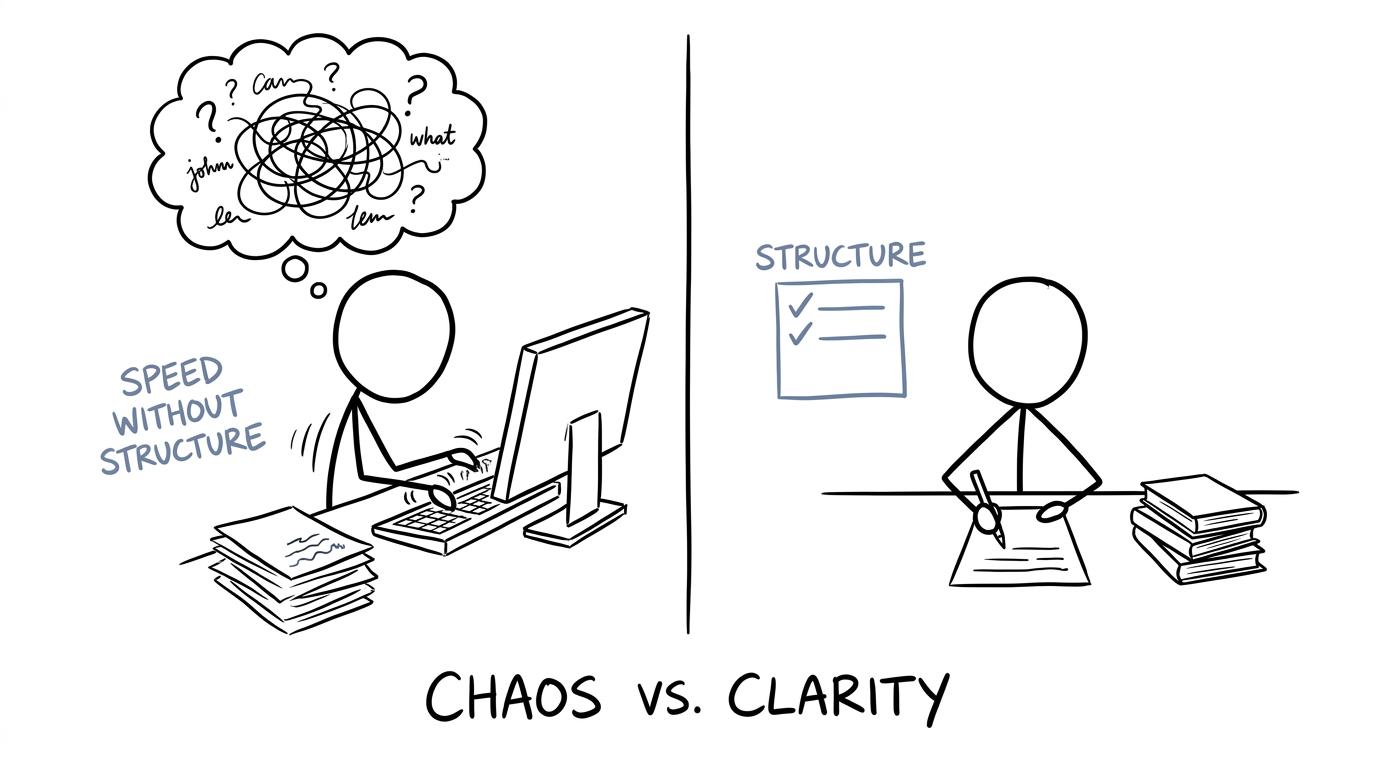 One student types a tangled sentence while another calmly consults a tiny checklist
Transfer the lesson to GCSE maths revision
Although Spanish and maths are assessed differently, timed practice develops several shared exam habits:
- starting promptly rather than waiting to feel certain;
- allocating time according to the task's value and demand;
- moving on when one section becomes disproportionately expensive;
- preserving a checking period;
- distinguishing a knowledge gap from a timing problem;
- performing without notes, hints or pause buttons.
For maths, use the same progression: revise a method, answer targeted questions, complete a mini test and then move to a full timed paper. MathsGenie's Edexcel GCSE Maths past papers include mark schemes and solutions, while the OCR GCSE Maths revision hub provides board-specific lessons and question practice.
Do not let Spanish typing sessions replace subject-specific maths practice. Instead, borrow the process. A timer reveals pressure; marking explains the loss; focused revision repairs it.
Common mistakes with timed Spanish typing practice
Using autocorrect or predictive text
This creates an unrealistic safety net. Practise with spelling and grammar assistance disabled if your approved examination setup will not provide it.
Measuring only words per minute
A longer response is not necessarily a better response. Track completion, task coverage, communication and accuracy alongside speed.
Typing when the examination will be handwritten
Some planning and language-retrieval benefits may transfer, but physical writing speed and handwriting stamina will not be trained properly. Match most practice to your confirmed exam method.
Starting with full papers every day
Constant full-paper practice can consume prompts without isolating weaknesses. Use short tasks first, then build towards complete papers. MathsGenie's one-month GCSE revision plan shows how targeted practice and timed papers can coexist rather than compete.
Never reviewing the finished answer
Unreviewed repetition can reinforce the same errors. Every timed attempt needs feedback, corrections and a later retest.
Copying memorised material
Copying measures transcription, not retrieval or adaptation. Use unseen prompts and write from memory under realistic conditions.
Speed should make good decisions easier
Typing answers under a timer can improve GCSE Spanish speed when typing is your real examination method and every session includes retrieval, planning, checking and feedback. It cannot replace vocabulary knowledge, grammatical accuracy or careful reading. Nor can it prepare your handwriting if that is what the examination requires.
The deeper lesson is useful across your GCSE preparation. Do not practise speed in isolation. Practise producing work that earns marks while the clock is running.
For maths, build that habit with the free MathsGenie revision planner. Combine revision lessons and practice questions with mini tests, past papers, predicted papers, mark schemes and video solutions. Set the timer, review the evidence and let each attempt decide what you revise next.