Tracking Revision Progress: GCSE Religious Studies
Tracking revision progress GCSE Religious Studies can expose weak topics, but only if your spreadsheet leads to recall, feedback and better exam answers.
Revision spreadsheets have a peculiar talent: they can make you feel organised before you have learnt anything. The colours look reassuring. The percentages rise. Yet the exam will not ask whether your cells were neatly formatted.
So, does tracking revision progress GCSE Religious Studies in a spreadsheet or app genuinely help? Potentially, yes, but tracking is not the activity that improves your knowledge. Its value lies in directing you towards effective revision: retrieving teachings from memory, planning arguments, answering exam questions, checking feedback and revisiting weaknesses.
That distinction matters for students balancing Religious Studies with GCSE maths. A tracker should reduce decisions across your subjects, not become another subject of its own.
The short answer: a tracker is a compass, not revision
A useful spreadsheet tells you three things:
- what the specification requires;
- what you can currently recall or apply without help;
- what you should practise next.
It becomes unhelpful when it measures only minutes, pages read or videos watched. These figures record activity, but they do not prove learning.
A sensible checklist is:
- organise topics according to your exam board;
- separate knowledge from evaluation and exam technique;
- base confidence on closed-book evidence;
- record marks and specific errors;
- schedule a retest;
- keep updates brief;
- use the results to choose your next task.
The same principle strengthens maths revision. MathsGenie's GCSE maths revision hub brings together board-specific lessons, worksheets, flashcards, practice papers and solutions, while a tracker records which resource you need next.
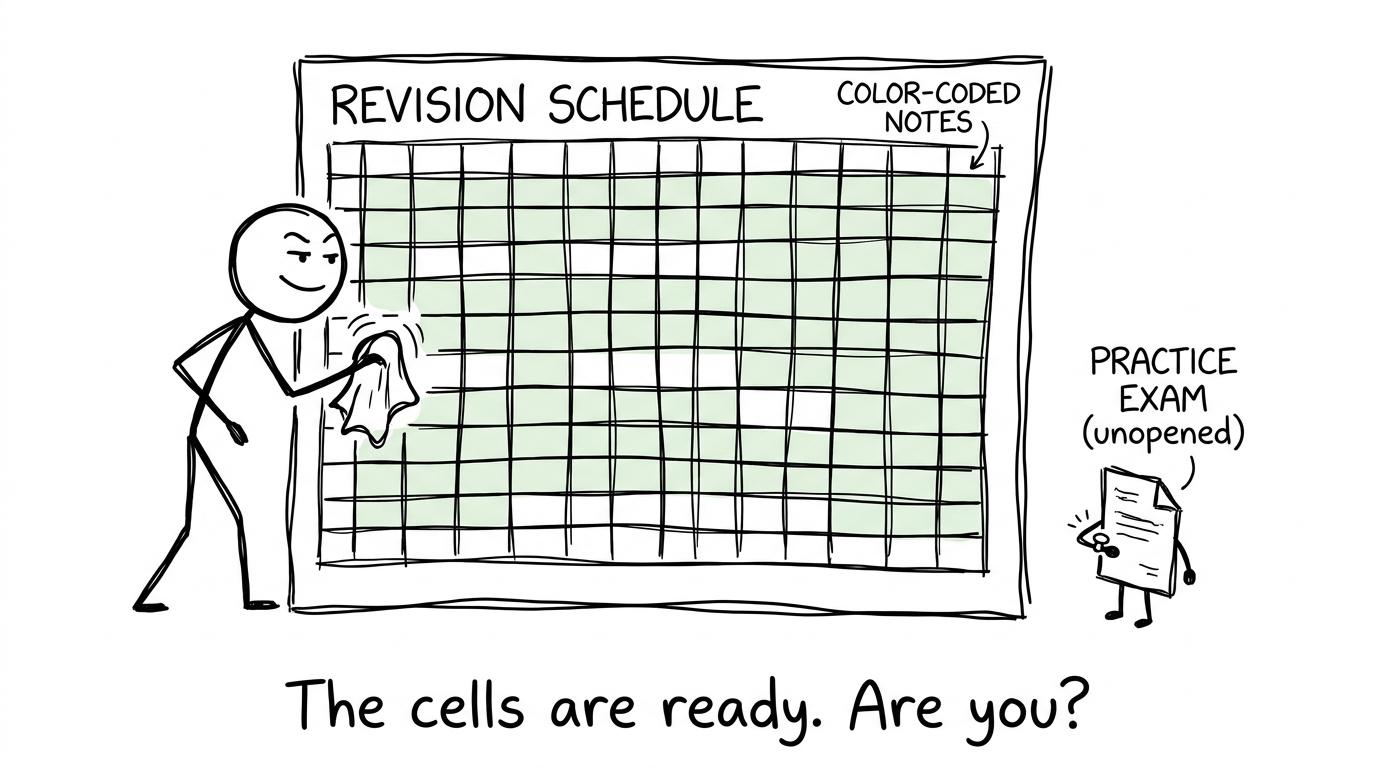 A student perfecting a spreadsheet while a practice paper waits
Why tracking can help GCSE Religious Studies
The strongest case for tracking is not that spreadsheets possess a special learning power. They do not. It is that a well-designed tracker supports planning, monitoring and evaluation.
Research on metacognition and self-regulated learning indicates that students can benefit from setting goals, monitoring performance and adapting their approach. However, guidance from the Education Endowment Foundation also stresses that these strategies work best when applied to specific subject content. In other words, a generic green tick is less useful than evidence that you can explain a particular belief or evaluate a particular claim.
Retrieval-practice research also consistently supports trying to recall material rather than relying only on rereading. Feedback makes this process more useful because it allows errors to be corrected. The spreadsheet can schedule and record that cycle, but the learning occurs when you retrieve, check and improve.
It reveals gaps hidden by familiarity
Religious Studies notes often feel familiar after several readings. Familiarity is comforting, but it is not the same as being able to produce a precise answer under time pressure.
A tracker can replace “I think I know this” with evidence such as:
- teaching recalled accurately without notes;
- source of wisdom or authority used in context;
- similarities or differences explained;
- alternative viewpoints developed;
- timed response completed and reviewed.
This reflects the broad demands of GCSE Religious Studies. Ofqual's current subject guidance divides assessment between knowledge and understanding, known as AO1, and analysis and evaluation, known as AO2. Each carries 50%50\%50% of the assessment overall, although individual question structures vary by specification.
Consequently, a tracker that records only quotations or key terms captures only part of exam readiness.
It makes the next session easier to choose
The quiet benefit of tracking is that it reduces negotiation. Instead of spending ten minutes deciding what to revise, you open the file and see that one topic needs a closed-book test, another needs an evaluative paragraph, and a third is awaiting a retest.
Maths students can use the same approach. The GCSE revision timetable guide explains how to prioritise personal weaknesses and combine topic work with timed questions. If time is limited, the twenty-minute maths revision routine offers a smaller learn, practise, mark and log cycle.
What should an RS revision tracker contain?
Keep the design narrow enough to update in under two minutes. Useful columns include:
- exam board and paper or component;
- religion, theme or topic;
- precise specification statement;
- skill being tested: recall, explanation, comparison or evaluation;
- date last tested;
- evidence used;
- score or confidence rating;
- exact weakness;
- next action;
- retest date.
Check that topic names match your own AQA, Edexcel, OCR or Eduqas specification. Paper structures and prescribed content differ, so copying somebody else's online template without checking it can create serious omissions.
Track evidence rather than mood
A red-amber-green system is quick, but confidence alone is unreliable. Define each colour through performance:
- Red: unable to recall the central content or begin an answer without support.
- Amber: core knowledge is present, but detail, explanation, balance or timing is insecure.
- Green: successful closed-book recall and an accurate exam-style response, followed by a later retest.
Where a task has a clear mark total, you may record:
accuracy=marks earnedmarks available×100\text{accuracy} = \frac{\text{marks earned}}{\text{marks available}} \times 100accuracy=marks availablemarks earned×100Do not compare percentages from unlike tasks as though they mean exactly the same thing. A short knowledge question and an extended evaluative response test different demands. Record the skill alongside the mark.
Record the reason a mark was lost
“Theme B: amber” gives little direction. “Accurate teaching, but no developed alternative viewpoint” tells you what to do next.
Useful error labels might include:
- inaccurate knowledge;
- missing source of authority;
- assertion without explanation;
- weak link to the question;
- viewpoints listed rather than analysed;
- unsupported conclusion;
- poor timing;
- misread command word.
This is similar to the method in MathsGenie's guide to finding your weakest GCSE topics: diagnose with evidence, identify why marks were lost, repair the smallest relevant skill and retest it.
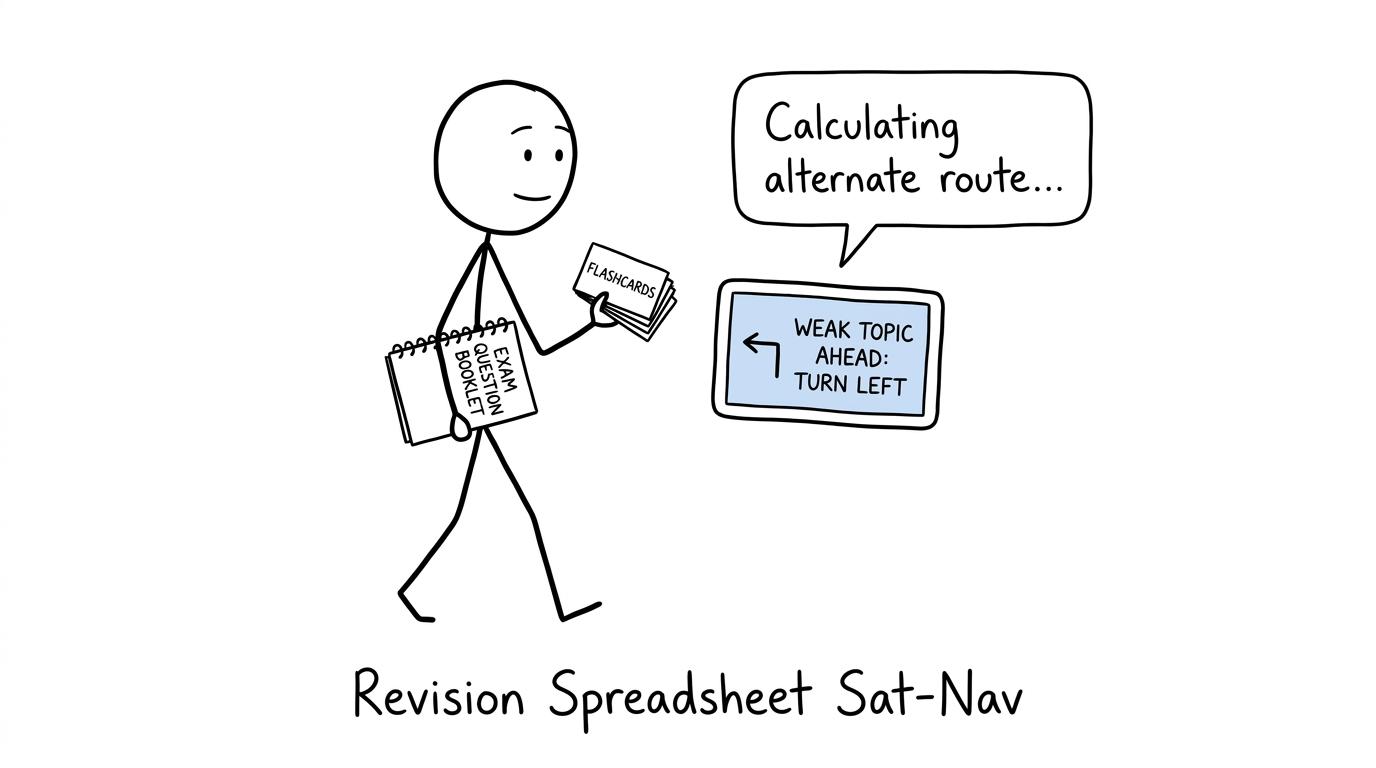 A spreadsheet acting as a sat-nav towards a weak topic
Spreadsheet, revision app or paper planner?
The format matters less than the behaviour it produces.
A spreadsheet is helpful if you want filters, dates, conditional formatting and simple score calculations. An app may be better if reminders encourage you to revisit material. A paper planner can be preferable if opening a device leads to distraction.
Choose the simplest system you will actually maintain. The tool should answer “What should I practise now?” within seconds.
A spreadsheet is probably too complicated if you:
- spend longer formatting it than testing yourself;
- add charts that never influence your decisions;
- record every minute but no performance evidence;
- keep changing categories;
- avoid revision because updating the system feels burdensome.
The best tracker is often slightly boring. It holds a small amount of trustworthy information and points towards the next useful action.
Turn the tracker into an active revision loop
Use the file after practice, not instead of practice.
Start with the specification
List only the content required for your particular course. Organise it by component, religion and theme rather than by the order of your exercise book.
Test before consulting notes
Attempt retrieval first. You might list relevant teachings, explain an influence, plan viewpoints or answer an exam-style question. Then check your class materials, specification guidance or mark scheme.
This produces better evidence than rating a topic immediately after reading it.
Log one precise action
Every weak entry should create a task. Examples include learning one missing teaching, improving a paragraph's reasoning, planning alternative viewpoints or completing another timed response.
Revisit the topic later
A correction made while the answer is visible may feel easy. A later closed-book retest shows whether it lasted. Keep amber status until the skill survives that delayed attempt.
The same loop applies to maths. Use Edexcel GCSE maths mini tests for quick evidence, or complete an appropriate paper from the AQA GCSE maths past-paper collection. Mark it, log the reason for each lost mark and return to the relevant revision lesson or practice questions.
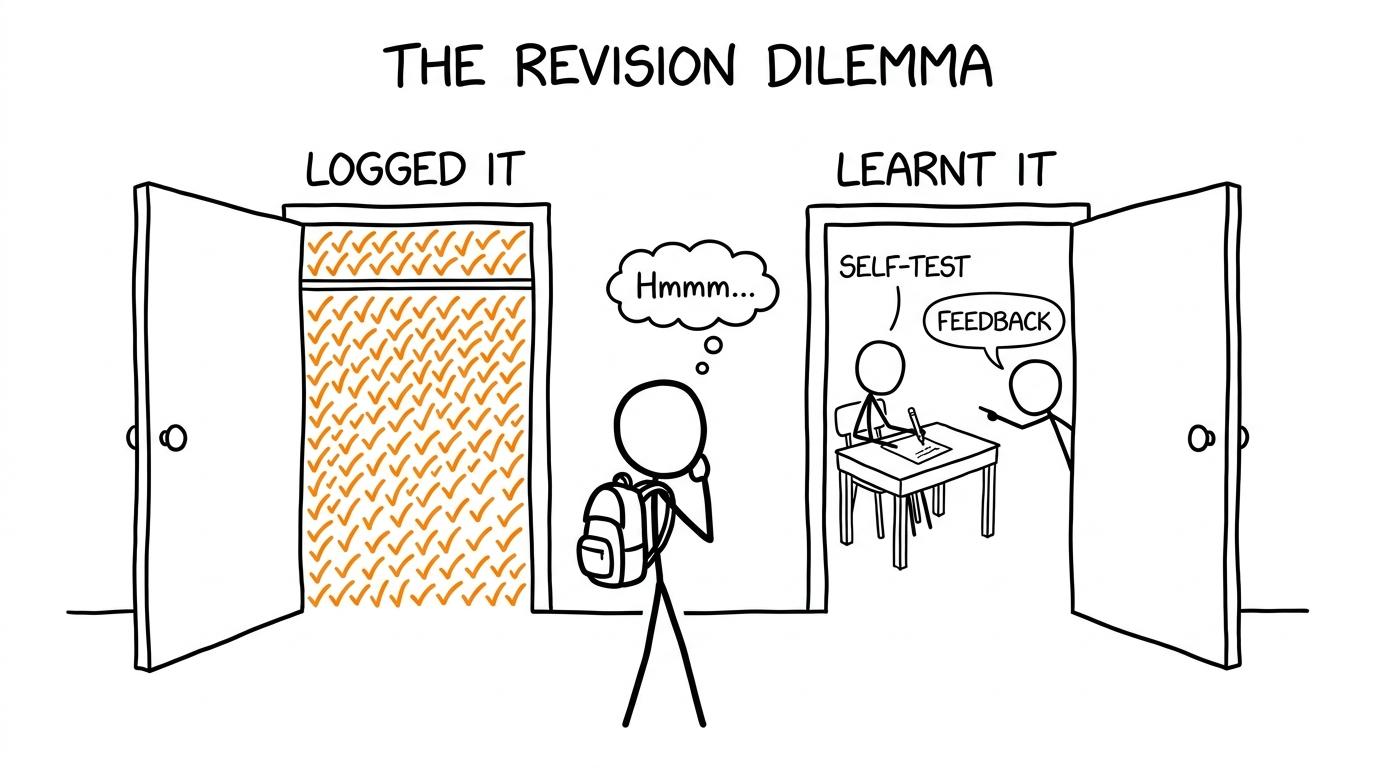 Two doors showing the difference between logging revision and learning
Does tracking genuinely change outcomes?
The careful answer is that tracking alone does not guarantee better GCSE results. The broader evidence supports metacognitive planning, monitoring and evaluation, as well as retrieval practice with feedback. It does not justify claiming that a particular spreadsheet will directly raise an individual student's Religious Studies grade.
A tracker can still contribute meaningfully when it changes behaviour. It may help you distribute revision, notice neglected AO2 practice, return to forgotten content and spend less time choosing comfortable topics. Those are plausible benefits grounded in established learning principles.
But if two students complete the same practice and receive the same feedback, while only one spends extra time colouring cells, the colouring itself offers no obvious academic advantage.
Judge your system by its consequences:
- Are weak topics being revisited?
- Are scores or answer quality improving?
- Are mistakes becoming more specific?
- Are you completing more closed-book and timed practice?
- Is planning taking less time?
If not, simplify the tracker or stop using it.
Common mistakes when tracking revision progress
Counting time as mastery
An hour spent rereading is not equivalent to an hour of successful learning. Record what you could retrieve or produce, not merely how long the book remained open.
Turning topics green too quickly
Do not award green status immediately after watching a lesson or reading notes. Require closed-book evidence and a later retest.
Tracking AO1 but ignoring AO2
Knowing beliefs and teachings is essential, but Religious Studies also assesses analysis and evaluation. Include both dimensions rather than allowing quotation recall to dominate the sheet.
Using one vague score for a whole theme
A broad topic may contain secure knowledge and weak evaluation. Separate content and skills so that one confident area does not conceal another.
Building the system instead of doing the work
Set a strict limit on administration. If an update takes longer than a couple of minutes, remove columns.
Treating predicted papers as predictions of certainty
In maths, predicted papers provide fresh exam-style practice; they cannot guarantee the content of the real examination. MathsGenie's Edexcel predicted papers are most valuable when completed under timed conditions, marked carefully and used to identify the next revision target.
Make the spreadsheet earn its place
Tracking revision progress can help with GCSE Religious Studies, but only when every entry leads back to learning. Let the spreadsheet expose a gap, direct a task and schedule a return. Then close it and do the difficult part: recall, write, check and improve.
Use that same discipline across your GCSE subjects. For maths, begin with MathsGenie's free revision lessons and practice questions, build confidence through mini tests, and then use past papers, predicted papers, mark schemes and video solutions to test whether your methods hold under pressure. A tracker can show the route. MathsGenie gives you the resources to travel it.