Tracking Revision Progress in GCSE Biology: Does It Help?
Tracking revision progress GCSE biology: learn when a spreadsheet improves recall, exposes weak topics and supports smarter exam-question practice.
Revision can look impressively organised without producing much learning. The spreadsheet has coloured cells, completion percentages and neat dropdown menus. Yet when an exam question asks you to explain osmosis or evaluate a practical method, the answer still feels distant.
So, does tracking revision progress GCSE biology in a spreadsheet genuinely help? Yes but only indirectly. A tracker can reveal weak topics, schedule spaced retrieval and turn mistakes into next actions. It cannot create understanding or recall by itself. If updating it takes time away from answering questions, checking feedback and retesting, it has become productive-looking procrastination.
The useful question is not whether you use a spreadsheet, an app or paper. It is whether your system changes what you practise next.
The short answer: when progress tracking works
A GCSE Biology revision tracker is likely to be useful when it helps you:
- organise topics according to your exam board's specification;
- record evidence from quizzes and exam questions;
- distinguish recall problems from application and practical-skills problems;
- schedule another attempt after a gap;
- prioritise topics that repeatedly cost marks;
- spend less time deciding what to revise.
It is less useful when you mainly record time spent, videos watched or chapters highlighted. Those activities may support learning, but they do not prove that you can retrieve and apply the material without help.
This distinction also matters in maths. MathsGenie's guide to finding your weakest GCSE topics begins with evidence from questions rather than confidence alone. Biology benefits from the same honesty.
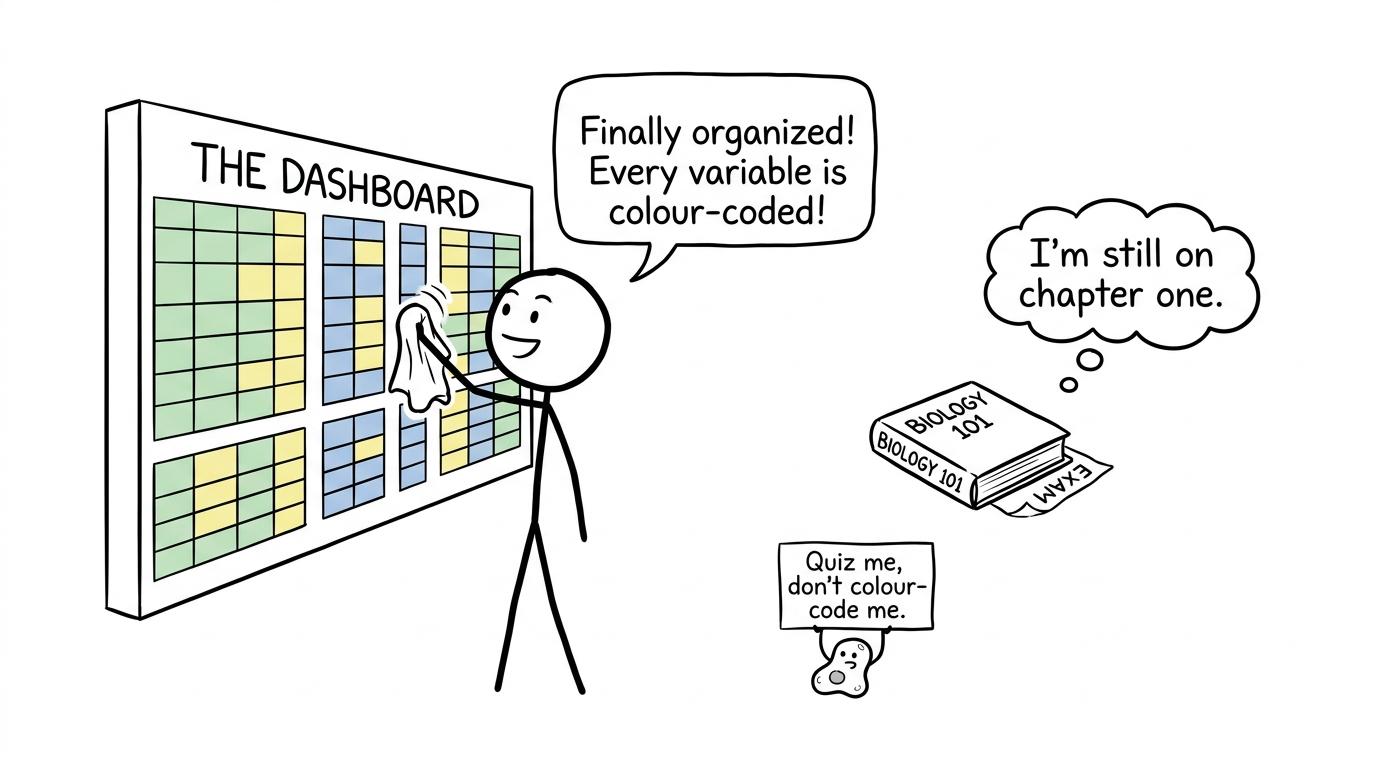 A student polishing a spreadsheet while a biology cell asks to be quizzed
Why a spreadsheet can help GCSE Biology revision
A spreadsheet is not a learning technique. It is a decision tool. Its value comes from supporting planning, monitoring and evaluation: the cycle associated with self-regulated learning.
Research reviewed by the Education Endowment Foundation indicates that metacognition and self-regulation can improve learning when pupils are explicitly taught to plan, monitor and evaluate work on specific tasks. That qualification matters. Simply possessing a colourful tracker is not the same as using a strong metacognitive strategy.
A useful tracker answers three questions:
- What can I do securely without notes?
- Where am I losing marks, and why?
- What is the smallest useful action I should take next?
This is particularly relevant to GCSE Biology because examinations assess more than factual recall. Across regulated GCSE Biology specifications, assessment objectives cover knowledge and understanding, application, and analysis or evaluation. Questions may also involve practical methods, data, graphs and calculations. A single label such as “cell biology complete” hides too much.
It makes the specification manageable
A specification can feel like one enormous list. A spreadsheet turns it into visible units: cell biology, organisation, bioenergetics, ecology and the precise subtopics used by your board.
Build your rows from the current specification for your qualification. AQA, Edexcel, OCR and Eduqas organise content differently, while Combined Science and separate Biology do not always contain identical material. Do not copy a generic checklist and assume it matches your entry.
It replaces vague confidence with evidence
Recognition is deceptive. A page about the nervous system may look familiar because you have read it several times. That does not mean you can produce a precise response from memory.
Instead of recording “understood”, record evidence such as:
- retrieval quiz result;
- marks earned and available;
- command words that caused difficulty;
- missing scientific vocabulary;
- practical or graph skill involved;
- planned retest date.
If you want one numerical measure, use:
Success rate=marks earnedmarks available×100%\text{Success rate}=\frac{\text{marks earned}}{\text{marks available}}\times 100\%Success rate=marks availablemarks earned×100%Treat this as one signal, not a permanent judgement. A high result immediately after reading notes may be less convincing than a slightly lower result achieved independently after a gap.
It supports spaced retrieval
Retrieval practice means bringing information to mind rather than merely looking at it again. A systematic review of classroom research found broadly consistent benefits across different ages and subject areas, although the size of the benefit varies with the task and context.
A spreadsheet helps by recording when a topic was last tested and when it should return. The intervals do not need to be perfect. What matters is revisiting material on different days and attempting recall before reopening notes.
The same principle is explained in MathsGenie's guide to stopping GCSE maths content from being forgotten. Whether the content is quadratic equations or homeostasis, the tracker should bring old learning back into practice.
What your GCSE Biology tracker should contain
Keep the system small enough to update in under a few minutes. A sensible structure is:
| Column | What to record |
|---|---|
| Topic | The precise specification statement or skill |
| Paper | The relevant paper or component |
| Evidence | Quiz, exam question or practical task |
| Result | Marks earned and marks available |
| Error type | Recall, application, data, practical or communication |
| Next action | The exact task needed to improve |
| Retest | The date for another independent attempt |
| Outcome | Improved, unchanged or needs teaching |
A status dropdown can be useful, but avoid relying on red, amber and green alone. Confidence ratings are subjective. Attach each colour to observable evidence: a marked question, a successful explanation without notes or a corrected practical response.
You can also use an app, notes database or paper grid. There is no reason to expect spreadsheet software itself to improve a grade. The best format is the one you will maintain consistently without allowing administration to consume revision time.
Track learning, not just activity
A tracker becomes misleading when its rows celebrate inputs rather than outcomes.
“Watched a video” records an activity. “Answered an unfamiliar question independently and corrected the missing idea” records learning evidence.
Useful evidence includes:
- recalling a process without prompts;
- applying knowledge to an unfamiliar context;
- interpreting biological data;
- identifying variables or improving a practical method;
- using a mark scheme to locate missing precision;
- answering a similar question successfully later.
This creates a productive loop:
Attempt; mark; diagnose; repair; retest.
Maths students can build exactly the same habit through the MathsGenie GCSE maths revision hub, where revision lessons lead into practice questions, papers, mark schemes and solutions. The subject changes; the feedback loop does not.
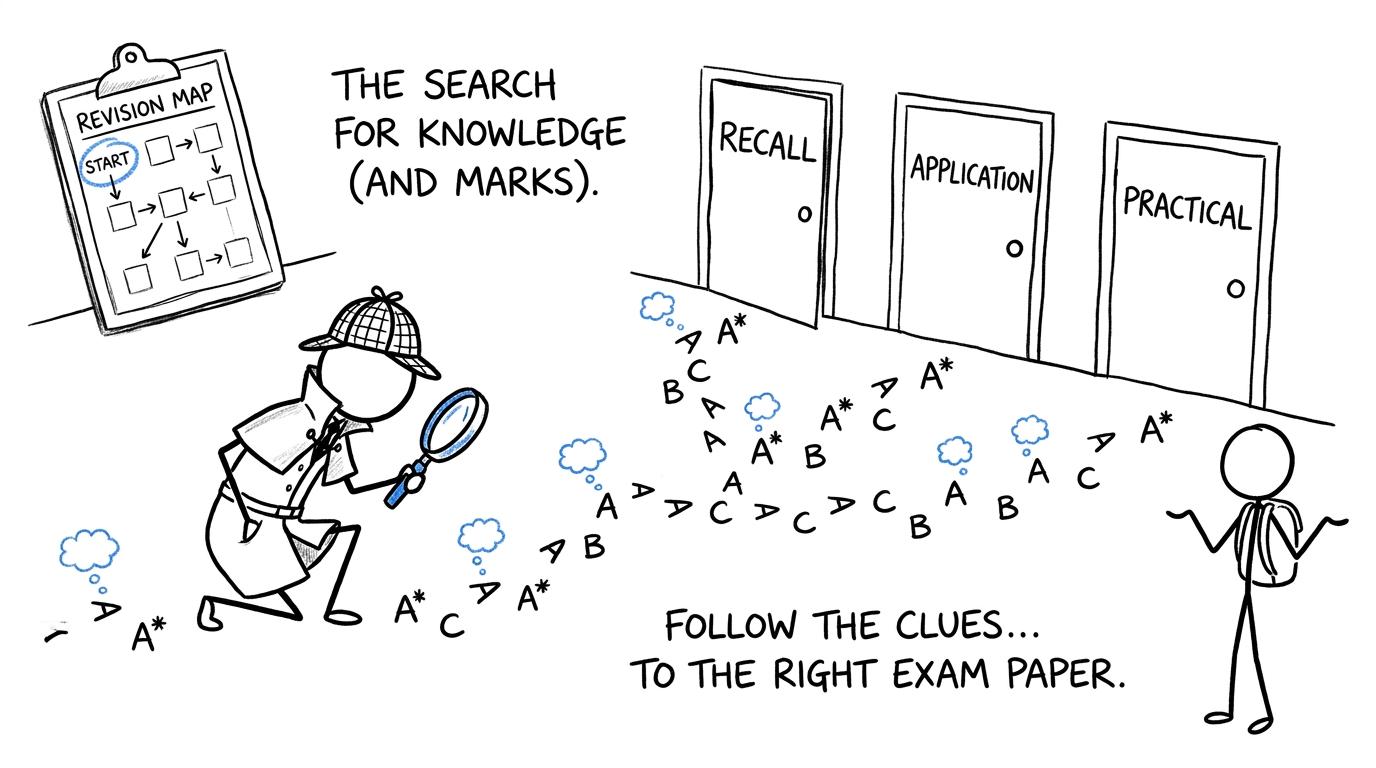 A revision detective follows lost marks towards recall, application and practical skills
How to make the tracker change your next session
At the end of each revision session, enter only the information needed to make tomorrow's decision.
Start with an unassisted attempt
Use a short retrieval task or exam-style question before consulting notes. This reveals what is available from memory. Keep the challenge achievable: a task that is impossibly difficult produces little useful diagnosis, while one that is effortless tells you little.
Mark for the reason, not only the total
A total score can hide different problems. Classify lost marks carefully:
- Recall: the biological fact or process was missing.
- Application: the knowledge was known but not adapted to the context.
- Analysis: data, evidence or a conclusion was interpreted poorly.
- Practical: variables, apparatus, accuracy or evaluation caused difficulty.
- Communication: the answer lacked required terminology, detail or structure.
This is the spreadsheet's most valuable column because each error requires a different response.
Assign one concrete action
“Revise ecology” is too broad. Better actions identify the task: retrieve definitions, answer graph questions, review a required practical, or rewrite an explanation before attempting a fresh question.
MathsGenie's advice on using GCSE past papers properly follows the same principle: a paper becomes useful after marking, when each lost mark feeds targeted revision.
Retest rather than declaring completion
Do not mark a topic permanently complete after one successful session. Schedule another attempt after a gap and use a different question where possible. The purpose is to discover whether learning survived, not whether you remember the answer you just checked.
For maths maintenance alongside Biology, Edexcel GCSE maths mini tests provide short evidence that can be logged without requiring a full paper.
Spreadsheet or revision app: which is better?
Neither format automatically wins.
A spreadsheet offers flexibility, simple filtering and control over your data. It is especially useful if you want to sort by paper, weak topic, error type or retest date. An app may reduce setup time and send reminders, but notifications and streaks can encourage activity tracking rather than meaningful practice.
Choose a spreadsheet if you enjoy simple organisation and can resist redesigning it. Choose an app if reduced friction makes you more likely to retrieve material and follow scheduled reviews. Choose paper if opening another screen creates distraction.
A good test is simple: after a week, can the system tell you which topic to practise next and why? If not, simplify it.
Common mistakes when tracking revision progress
Spending longer building the system than revising
Templates, formulas and colour palettes can become avoidance. Build a basic tracker once, then limit updates to a brief end-of-session routine.
Recording hours as proof of mastery
Time matters, but it is an input. Two hours of rereading may produce less durable learning than a shorter session involving retrieval, feedback and correction.
Marking an entire topic as complete
GCSE topics contain different demands. You may recall definitions securely while struggling with application or required-practical questions. Track the weak skill, not just the chapter heading.
Logging marks without analysing mistakes
A score tells you where you are. The error category and next action tell you how to move.
Never returning to corrected material
An answer can feel obvious when the mark scheme is open. Only a later independent attempt shows whether the correction became retrievable knowledge.
Mixing resources from the wrong course
Check your board, qualification and tier where applicable. Biology and Combined Science content can differ, just as maths students must select the correct board and foundation or higher paper. MathsGenie provides separate collections for AQA GCSE maths past papers, OCR GCSE maths past papers and Edexcel GCSE maths past papers.
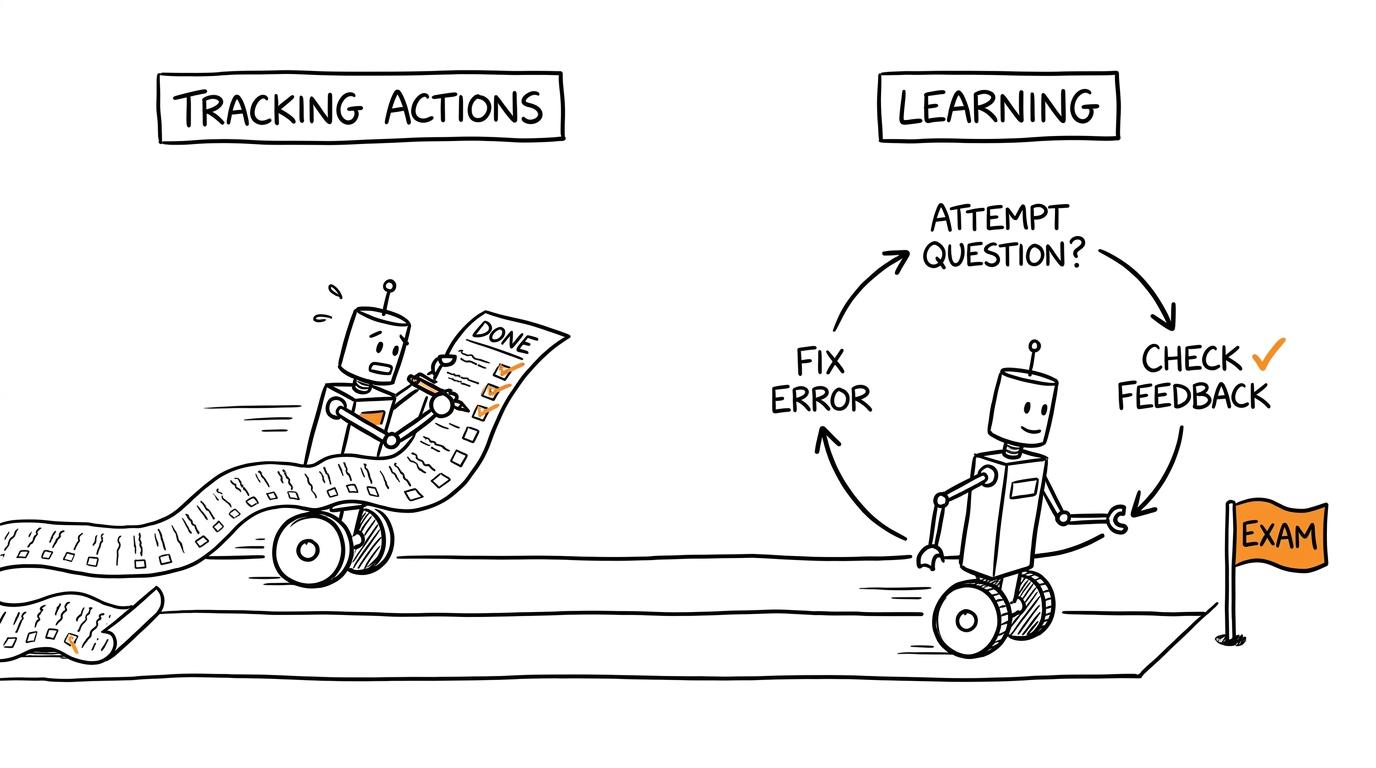 Two revision robots race: one ticks boxes while the other attempts, checks and fixes
The verdict: a dashboard should lead to action
Tracking GCSE Biology revision can help, but the spreadsheet is not the intervention. The useful ingredients are planning from the correct specification, retrieving knowledge, attempting exam questions, receiving feedback, diagnosing errors and returning to weak material later.
Your tracker should make those behaviours easier. If it merely counts hours and colours topics green, it may feel productive while leaving recall unchanged. Keep it lean, evidence-based and slightly uncomfortable: the rows should reveal what you cannot yet do.
Then apply the same system to maths. Open the MathsGenie GCSE revision area, choose your board and tier, and gather real evidence through free revision lessons, practice questions, mini tests, past papers and predicted papers. Use the mark schemes and video solutions to diagnose each error, record the next action, and retest it.
A spreadsheet cannot earn marks. But it can stop you guessing where the next mark will come from.